
InteleGates Guide
Automatic Gate Safety Sensors: A Property Owner's Guide
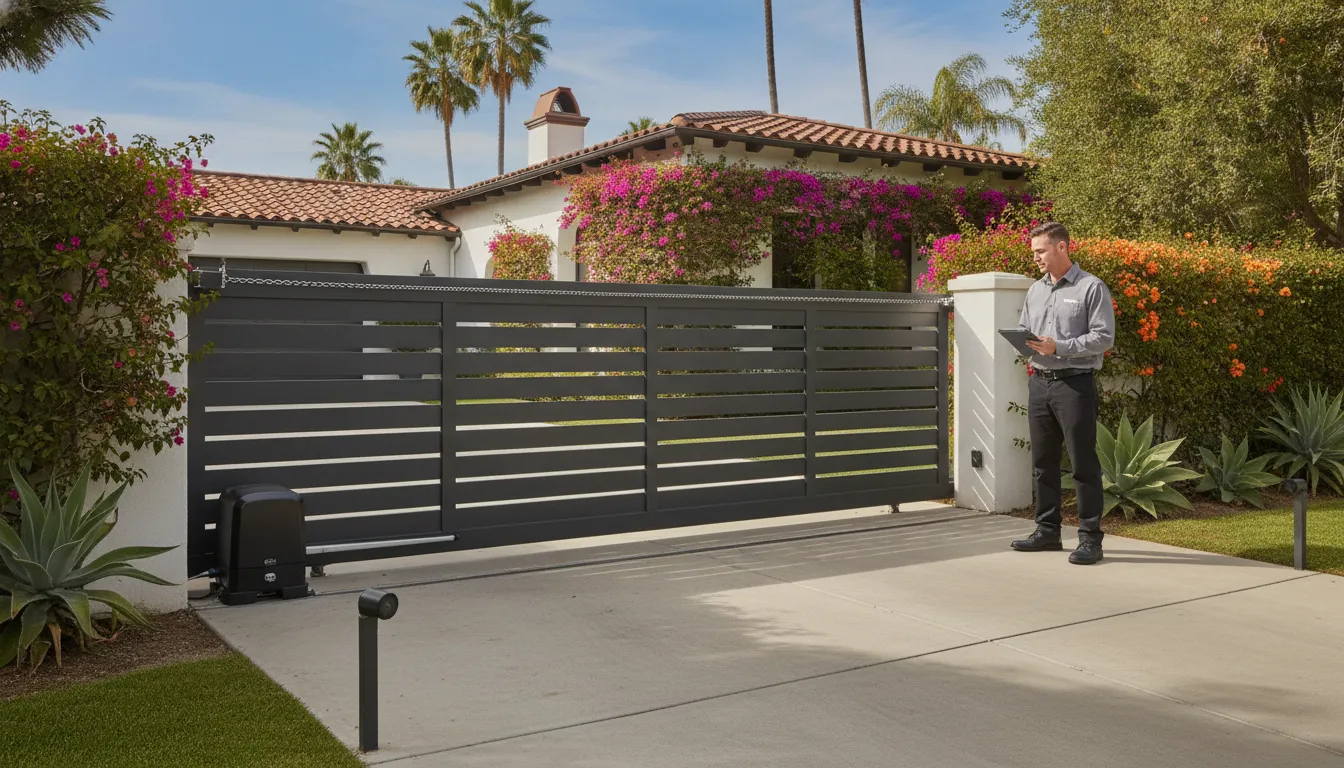
Automatic gates depend on more than a motor and a remote. A coordinated sensor system helps the operator recognize an obstruction, respond during a moving cycle, and support dependable access for people and vehicles. For Los Angeles and Orange County homeowners, property managers, and business owners, understanding these devices makes professional gate care easier to plan.
Contact InteleGates for professional automatic gate safety sensor service.
Photo-eyes, safety edges, and vehicle-detection loops each monitor a different condition. A complete evaluation considers the operator, control board, wiring, gate movement, access controls, and every protective device together. This system-wide view is more useful than focusing on one visible sensor or one unusual gate cycle.
What Do Automatic Gate Safety Sensors Do?
Automatic gate safety sensors help an electric gate operator recognize people, vehicles, pets, or objects in a protected area and respond during movement. InteleGates evaluates these devices as part of the complete motor and automation system, so photo-eyes, safety edges, controls, and gate travel work together for reliable operation.
An operating cycle begins when a remote, keypad, intercom, card reader, or another access control device sends a command. The access control device manages the request for entry. The operator then moves the gate while its protective devices monitor designated areas. When a sensor detects a condition that requires attention, the operator can stop or reverse according to its design and programmed response.
Safety sensors therefore have a different role from access control. A keypad helps identify an authorized code. An intercom supports communication with a visitor. A remote sends an operating command. Sensors monitor the movement zone and help the motor react to conditions around the gate. A well-designed installation coordinates both functions without confusing access permission with movement protection.
The exact arrangement depends on the gate configuration, operator model, travel direction, clearance, site layout, and traffic pattern. A sliding gate creates a different movement path from a swing gate. A driveway used by one household presents different operating conditions from a multifamily or commercial entrance. Professional service accounts for those differences when reviewing the sensor array.
UL 325 addresses hazards associated with automated operator systems, including entrapment. Its safety framework is one reference used when equipment and installations are evaluated. UL explains the safety issues addressed by CAN/UL 325. Equipment-specific requirements and the installation context matter, so a standard reference should support a qualified assessment rather than replace one.
InteleGates provides electric gate automation, motor repair, and maintenance service across Los Angeles and Orange County. The team can assess whether the sensors and operator are communicating as intended, then recommend the appropriate professional service for the property.
How Do Photo-Eye Gate Sensors Protect the Opening?
Photo-eye gate sensors create an invisible infrared detection path across or beside an automatic gate opening. InteleGates checks the paired sensors, their alignment, mounting, wiring, and operator response. This confirms that an interrupted beam receives the intended stop or reverse response during a protected cycle.
One photo-eye sends an infrared beam toward a receiving photo-eye. When the beam remains clear, the operator can continue its programmed movement. When a person, vehicle, pet, or object interrupts the beam, the signal tells the operator that a monitored area has changed. The programmed response may stop or reverse gate movement, depending on the equipment and configuration.
Photo-eyes can protect a passage through the opening, a section beside a moving gate, or another location identified during system design. Their value comes from the relationship between the beam, the gate's travel path, and the operator's control logic. A sensor mounted in the wrong position may not protect the area that a property owner expects it to cover.
Why alignment and visibility matter
A photo-eye pair needs a clear, stable line of sight. A shifted bracket, impact, settling, landscaping, dust, condensation, or moisture can affect the sensing path or the housing. Outdoor equipment also experiences changing light and weather conditions. A professional inspection reviews the mounting position and the electrical connection alongside the operator response.
Unexpected stopping, repeated reversing, or a cycle that pauses at a predictable location can provide useful information for a technician. The behavior may involve a photo-eye, another protective device, the control board, wiring, or the operator itself. A service evaluation identifies the complete pattern instead of assuming that one visible component is the only cause.
For related guidance, read about automatic gate safety measures. That resource complements a professional inspection by explaining how protective features fit into a broader automated gate system.
What Is a Gate Safety Edge Sensor?
A gate safety edge sensor is a pressure-sensitive strip placed along a designated contact area of a moving gate or operator assembly. InteleGates evaluates the edge alongside photo-eyes, controls, and gate travel. This confirms that contact protection covers the relevant zone and that the operator recognizes the edge signal as intended.
When the pressure-sensitive strip contacts an obstacle, it sends a signal to the gate operator. The operator can then stop or reverse movement according to its programmed response. This contact-based function complements the non-contact beam from a photo-eye. Each device monitors a different condition, and their placement should reflect the gate's movement and the areas people can reach.
A safety edge can be useful along a moving surface or at a point where clearance changes during the cycle. The best location depends on the operator, gate type, travel direction, fixed structures, and the protection zones identified during the installation. An edge is one part of a coordinated arrangement, not an isolated accessory that can be judged by appearance alone.
How a safety edge complements a photo-eye
Photo-eyes detect an interruption in an invisible sensing path. A safety edge responds to physical contact at its installed location. For example, a beam can monitor a passage while an edge can provide contact-sensitive protection along a moving surface. The two devices can create layered awareness when they are selected, installed, monitored, and tested as one system.
The operator must recognize each sensor's signal during the relevant direction of travel. The control board, wiring, monitoring function, travel limits, and motor response all influence the result. A technician considers those relationships when assessing an automatic gate safety sensor concern. This approach helps keep the evaluation focused on the entire electric gate system rather than a single strip or housing.
InteleGates can connect safety sensor service with broader electric gate system maintenance. A maintenance visit can review sensor condition, operator behavior, and other system elements that influence dependable gate cycles.
Safety Sensors vs. Vehicle-Detection Loops: What Is the Difference?
Automatic gate safety sensors and vehicle-detection loops support different parts of an electric gate cycle. InteleGates evaluates both when a property uses underground vehicle detection. Safety sensors monitor protected movement zones, while loops identify vehicle presence and help the operator manage traffic through the entrance.
A vehicle-detection loop is installed in or near the drive surface. It detects a vehicle over the loop and sends information to the access or operator system. Depending on the equipment and programming, the loop can help hold a gate open, support an exit sequence, or manage a vehicle's position during a cycle.
A loop and a safety sensor are not interchangeable. The loop focuses on vehicle presence in a defined staging area. A photo-eye focuses on an interruption in its beam. A safety edge focuses on contact at its installed surface. A complete system can use several devices because each one contributes information about a different part of the gate environment.
| Device | Primary purpose | Detection method | Typical placement |
|---|---|---|---|
| Photo-eye | Monitor a protected path near the moving gate. | Infrared beam interruption. | Across or beside a designated travel or passage zone. |
| Safety edge | Monitor a contact area on a moving component. | Pressure-sensitive contact. | Along a gate edge or another selected moving surface. |
| Vehicle-detection loop | Identify vehicle presence and support traffic management. | Vehicle detected over an installed loop. | Driveway approach, exit area, or vehicle staging zone. |
Why the distinction matters
A vehicle can remain over a loop while the system manages the access cycle. Yet a loop does not monitor every person, pet, or object in a gate's travel path. Likewise, a photo-eye can protect a defined beam without identifying that a vehicle is waiting in a driveway. The operator's controls must interpret each signal for its intended purpose.
Sliding gate systems can require careful attention to travel direction and entrapment protection. HySecurity's UL 325 gate safety requirements summary explains equipment-specific considerations for monitored protection on automated slide gates. The applicable arrangement depends on the installed equipment and site, so a professional assessment remains important.
For more detail about the vehicle-presence side of the system, read how gate loop detectors work. InteleGates can review the loop, operator, control system, and automatic gate safety sensors as a connected installation.
When Should Automatic Gate Safety Sensors Be Inspected?
Automatic gate safety sensors should be inspected when gate behavior changes, a sensor appears damaged or displaced, traffic conditions change, or routine service is due. InteleGates reviews the sensors with the motor, controls, wiring, and gate movement so Los Angeles and Orange County properties receive a complete service assessment.
At least annual professional inspection is a useful maintenance rhythm for many residential systems. High-use entrances may call for a more frequent service schedule based on traffic, equipment, exposure, and operating conditions. Property managers can coordinate inspections with their broader maintenance program, while homeowners can request an evaluation when a repeatable change appears.
Signs that deserve professional attention
- Unexpected stopping or reversing: A gate pauses, stops, or reverses at a point where its normal cycle used to continue.
- Inconsistent cycles: The operator behaves differently from one cycle to the next, especially after repeated daily use or changing weather.
- Failure to hold open: The gate begins closing while a vehicle is still being managed by the entrance sequence.
- Repeated safety responses: The system repeatedly reports or reacts to a sensor condition, preventing a predictable cycle.
- Visible equipment changes: A photo-eye housing, safety edge, bracket, conduit, or wire appears cracked, displaced, wet, or damaged.
- A repeatable timing pattern: The concern occurs at a particular position, direction, time of day, or traffic condition.
These signs help describe the concern, but they do not identify one guaranteed cause. The issue may involve sensor alignment, monitoring, wiring, control logic, the operator, or gate movement. Recording when the behavior occurs gives a service professional useful context for the inspection.
For motor-related symptoms, review electric gate system repair. InteleGates can evaluate the complete automation system and connect sensor findings with the appropriate repair or maintenance service.
How Does Professional Sensor Service Support LA and Orange County Properties?
Professional sensor service connects the protective devices to the way a property actually uses its entrance. InteleGates serves Los Angeles and Orange County with electric gate motor installation, repair, and maintenance. The team reviews the operator, access controls, sensor arrangement, and site conditions as one dependable automation system.
A residential driveway, multifamily entrance, office property, and commercial access point can have different traffic patterns and movement requirements. The same sensor type may be positioned differently because the protected area, gate configuration, and vehicle staging zone are different. A professional evaluation accounts for these conditions while keeping the focus on the motor and control system.
Service can include reviewing sensor placement, checking the operator's response, assessing wiring and monitored inputs, observing gate travel, and examining how vehicle detection interacts with the access sequence. It can also identify related motor or control-board concerns that affect the way the system completes a cycle.
Southern California outdoor equipment may be exposed to dust, moisture, landscaping changes, vehicle contact, and frequent use. These conditions make consistent inspection valuable for both homeowners and property managers. A service record can also help a manager communicate recurring behavior clearly when several residents, tenants, or staff members use the entrance.
InteleGates emphasizes professional electric gate motor service and access control support throughout the region. To review the broader automation offering, visit Gate Automation. When sensor behavior or operator movement raises a concern, a qualified service assessment gives the property owner a clear next step.
Request professional automatic gate safety sensor service from InteleGates.
Frequently Asked Questions
Are automatic gate safety sensors the same as access control devices?
No. Access control devices, such as remotes, keypads, intercoms, and card readers, send or manage an entry request. Automatic gate safety sensors monitor movement zones and conditions around the operator. Many properties use both systems, with each serving a separate part of the automated entrance.
What does a photo-eye gate sensor detect?
A photo-eye gate sensor detects an interruption in an infrared beam between paired units. A person, vehicle, pet, or object can interrupt the beam. The operator then responds according to its equipment and programmed safety sequence, which may include stopping or reversing movement.
What is the purpose of a gate safety edge sensor?
A gate safety edge sensor provides contact-sensitive protection along an installed strip or moving surface. When the edge contacts an obstacle, it signals the operator to respond according to its programmed sequence. Its role complements the non-contact detection provided by photo-eyes.
Can a vehicle-detection loop replace a photo-eye?
A vehicle-detection loop and a photo-eye monitor different conditions. A loop identifies vehicle presence in a defined drive-surface area. A photo-eye monitors an infrared path near the gate. A professional assessment can determine how the devices should work together for the operator and property.
When should a property owner schedule sensor service?
Schedule professional sensor service when the gate stops or reverses unexpectedly, cycles inconsistently, fails to hold open, or shows visible sensor damage. Routine inspection is also useful as part of an annual maintenance rhythm, with frequency adjusted for traffic, equipment, and site conditions.
Talk with InteleGates about your property's automatic gate safety sensors.
InteleGates can evaluate the operator, photo-eyes, safety edges, vehicle-detection loops, and related access controls across Los Angeles and Orange County. Contact the team to arrange professional service.