
InteleGates Guide
Chain Drive Sliding Gate Operators: Installation Guide
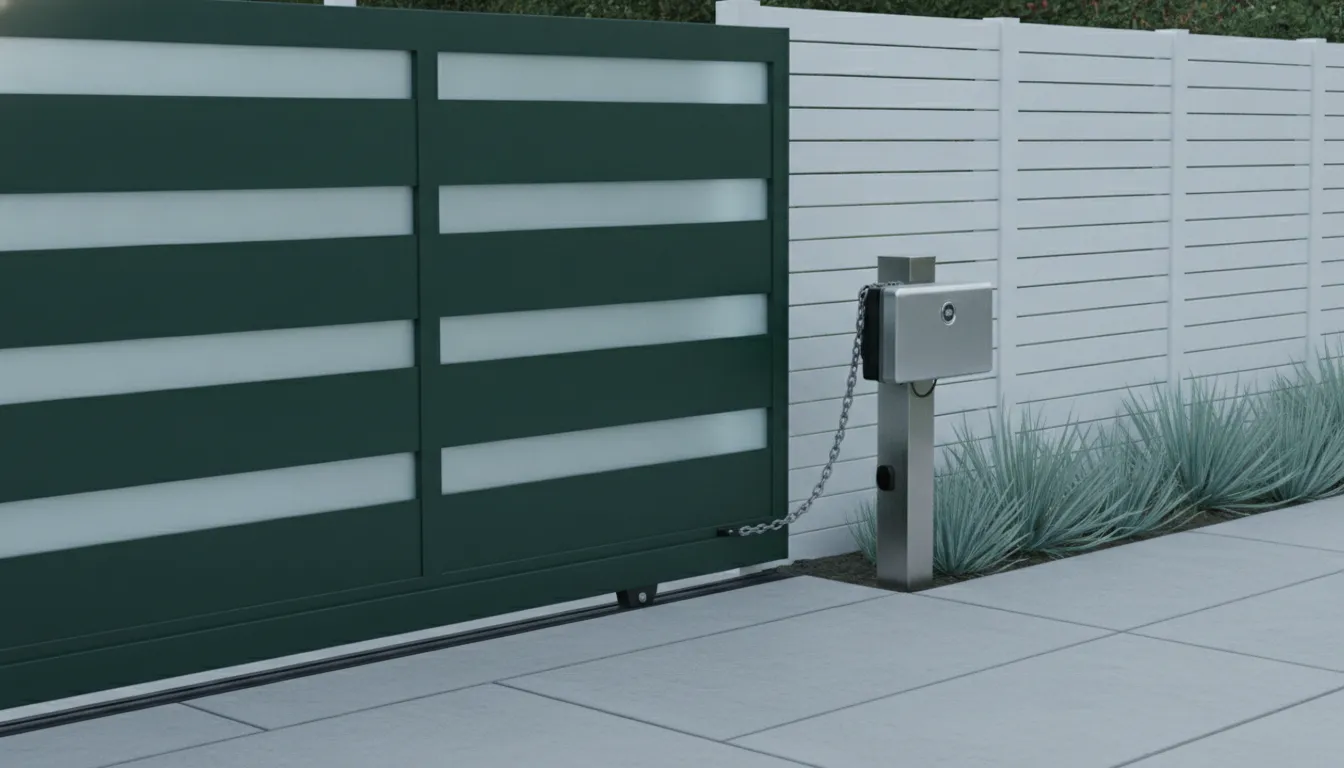
Chain drive sliding gate operators move an existing gate along a fixed chain. The operator is only one part of the system. Gate weight, travel distance, track condition, alignment, terrain, traffic frequency, available power, access controls, and safety equipment all affect the installation. For Los Angeles homeowners, property managers, and commercial owners, professional selection begins with the complete gate and site rather than a product label.
Contact InteleGates to discuss a professional sliding gate operator assessment.
Professional installation of chain drive sliding gate operators connects a motor and sprocket to a fixed chain so an existing gate travels parallel to the fence line. A technician evaluates the gate, travel path, mechanical resistance, daily use, controls, power, and safety requirements before recommending a compatible automation system.
InteleGates installs electric gate motors and access-control systems on existing gates for residential and commercial properties across Los Angeles and Orange County. The company does not install gates or fences. For broader planning context, review the gate automation guide for existing driveways, then use the sections below to understand what makes a chain-drive installation suitable for a specific site.
How Chain Drive Sliding Gate Operators Move an Existing Gate
A chain-drive sliding gate operator uses an electric motor and sprocket to pull a gate along a fixed chain. The chain spans the gate's travel path and is anchored at both ends. As the sprocket turns, it engages the chain and transfers motion to the operator and gate. The gate then travels parallel to the fence line instead of swinging across the driveway.
The fixed chain provides a defined route, but it does not support the gate by itself. The gate still relies on its track, rollers, guides, frame, and other mechanical components. If those components bind, sit out of alignment, or encounter debris, the motor may face resistance that is unrelated to its rated capability. That is why a technician evaluates the gate's movement before selecting an operator.
What the chain does and does not control
The chain transfers the motor's movement to the gate. It does not determine whether the gate is level, whether the track is sound, or whether the gate has enough clearance to complete its travel. It also does not replace photoelectric sensors, obstruction detection, access controls, or other parts of a complete automated gate system.
A reliable installation therefore treats the operator, chain, track, rollers, controls, sensors, and power supply as one working system. InteleGates' electric gate motor service focuses on automation and access equipment installed on an existing gate. A site assessment can show whether a chain-drive arrangement matches the gate's mechanical condition and the property's daily access needs.
Why Chain-Drive Operators Can Fit Residential and Commercial Sites
A sliding gate can preserve approach space when a property does not have room for a gate to swing inward or outward. The gate travels beside the fence line, which may suit a narrow driveway, a shared residential entrance, a parking area, or a commercial access point. The layout is not automatically right for every property, however. The travel path and gate condition still have to support controlled movement.
For a residence, the assessment may consider vehicle clearance, pedestrian visibility, landscaping, driveway slope, remote controls, and the number of daily cycles. For an apartment community, office, warehouse, or parking facility, it may also consider shared access, traffic patterns, telephone entry, keypads, card readers, or other access-control equipment. The operator should be selected around how the property actually uses the gate.
| Site factor | Why it matters | What a technician evaluates |
|---|---|---|
| Gate movement | The operator must work with the existing travel path. | Track, rollers, alignment, chain condition, resistance, and clearance. |
| Daily use | Traffic patterns affect duty-cycle requirements and controls. | Residential, shared, parking, or commercial access activity. |
| Power and controls | The motor must integrate with the property's operating needs. | Available power, control equipment, sensors, and user visibility. |
| Site conditions | Terrain and exposure can change how the gate moves. | Slope, drainage, debris, weather exposure, and surrounding obstacles. |
Noise, safety, and operating conditions
Chain engagement can produce mechanical noise when the chain is loose, dry, worn, or out of alignment. Noise can also come from track, roller, or motor problems. It should be evaluated as a symptom of the complete system rather than treated as an unavoidable characteristic of every installation.
Safety planning includes obstruction detection, reversal protection, sensor placement, exposed-roller guarding, and clearances around moving parts. The U.S. Consumer Product Safety Commission participates in the ANSI/UL 325 safety standard for door and gate operators, which covers entrapment protection for automatic gate systems. Review the CPSC gate-operator safety standard overview as general background, then have a qualified technician evaluate the specific gate and surroundings.
What Professional Chain-Drive Installation Includes
Professional installation starts with the existing gate and the conditions around it. InteleGates evaluates the opening, travel path, traffic, power, control requirements, and safety needs before configuring the automation system. The installation process generally includes the following stages.
- Site assessment. A technician reviews the gate opening, terrain, available space, travel distance, traffic flow, and customer requirements. The gate's weight and mechanical resistance are considered with the rest of the system, not as isolated selection criteria.
- Mechanical review. The existing track, rollers, guides, frame, chain path, alignment, and clearances are checked for conditions that could interfere with consistent travel. An operator should not be expected to compensate for a damaged or obstructed gate path.
- System selection. The technician matches the operator and chain-drive components to the gate, expected use, power availability, access controls, and safety equipment. Manufacturer specifications and the operator's rated capacity must be appropriate for the actual application.
- Operator installation. The motor and related chain-drive components are mounted for the existing sliding gate. Mounting position, chain alignment, and the relationship between the sprocket and chain affect how the gate transfers motor movement.
- Controls and integration. Remote controls, keypads, telephone entry, card readers, or other access equipment are configured for the property's intended users. Controls should be placed where users can see the gate operating and remain clear of moving equipment.
- Safety devices and clearances. Sensors, obstruction detection, reversal response, exposed rollers, hazardous gaps, and user sight lines are reviewed for the completed system. The exact equipment and placement depend on the gate and site.
- Testing. The system is tested through its operating cycle. Testing confirms that the gate, operator, controls, and safety mechanisms respond as intended before the installation is treated as complete.
InteleGates' electric gate motor installation service covers automation work on existing gates. It does not include fabrication or installation of a gate or fence. A professional assessment keeps the project focused on compatible motor, controls, safety equipment, and existing-gate conditions.
How Gate Weight, Capacity, and Duty Cycle Shape Selection
Gate weight matters, but it is not enough to select an operator. A technician must compare the gate's actual load and movement with the operator's manufacturer-rated capacity, duty cycle, travel requirements, and installation conditions. A motor that appears powerful enough by weight alone may still be a poor match if the gate binds, travels uphill, operates frequently, or requires controls and safety equipment that the system cannot support.
Rated capacity is a starting point, not a shortcut
Manufacturer-rated capacity is a boundary for the application, not a target to exceed. The selection should account for the gate's structure, rollers, track, slope, wind exposure, friction, and starting resistance. The technician also considers how much of the day the gate operates and whether traffic arrives in occasional residential cycles or repeated commercial cycles. Those factors influence duty-cycle requirements and the appropriate operator class.
For that reason, the installer should confirm the operator specifications against the measured gate and site. Do not infer a suitable model from a general product description or from the gate's appearance. Two gates with similar dimensions can impose different loads when one has poor alignment, a rough track, heavier construction, more daily traffic, or a more demanding approach.
Travel and mechanical resistance change the application
The gate must travel along its intended path without excessive resistance. A damaged track, loose guide, worn roller, misaligned chain, debris, or uneven support can make the motor work harder and affect movement. The site review also considers where the gate stops, how much clear travel is available, and whether the operator can be mounted without creating unsafe contact points.
InteleGates can evaluate the motor, track, chain, sensors, control board, power supply, and access controls as related parts of one system. The electric gate system maintenance service provides relevant context for track condition, alignment, moving components, sensors, safety mechanisms, and electrical connections.
Which Chain-Drive Operator Brands Can InteleGates Service?
Brand selection should follow the gate and site assessment. A brand name alone does not establish compatibility with the existing gate, chain arrangement, controls, sensors, power supply, or expected traffic. The technician should compare the operator's specifications with the measured application and confirm that the complete system can be configured and tested for the property.
InteleGates provides LiftMaster gate operator installation and service, along with service for other electric gate motor brands. Brand-specific equipment can be appropriate when its specifications match the application. But the recommendation should remain grounded in the existing gate and operating conditions rather than a generic list.
When a chain-drive system is not operating correctly, diagnosis may cover the motor, control board, sensors, power supply, track, rollers, chain, and gate movement. This broader review helps identify whether the problem is electrical, mechanical, or related to the existing gate before replacement is recommended. InteleGates diagnoses the problem before recommending replacement.
Most gate problems can be diagnosed during the initial service visit. Repair time depends on the cause of the problem, parts availability, and the condition of the gate and operator. If a chain-driven system is making unusual noise, moving slowly, stopping early, or failing to respond, electric gate system repair service can address the operator and related gate-system conditions together.
We recommend professional gate-system maintenance at least every six months. Actual service attention should also reflect use, site conditions, equipment requirements, and the manufacturer's guidance. A maintenance review can include the track, chain movement, alignment, sensors, safety mechanisms, electrical connections, and access controls.
Contact InteleGates to review your chain-drive sliding gate operator installation requirements.
Frequently Asked Questions
What is a slide gate operator?
A slide gate operator is a motorized system that moves an existing gate horizontally along its track, parallel to the fence line. A chain-drive version uses a motor and sprocket to pull the gate along a fixed chain. It can suit a driveway, apartment entrance, parking area, office, or commercial property when the gate, track, available space, and traffic demands are compatible.
What is the best motor for a sliding gate?
There is no single best motor for every property. Selection depends on the gate's weight and movement, the operator's rated capacity, duty cycle, travel distance, terrain, available power, control requirements, safety equipment, and the condition of the existing gate and track. A professional assessment helps match the operator to the application instead of choosing by weight alone.
What capacity should a chain-drive sliding gate operator have?
The operator's manufacturer-rated capacity should meet the measured gate application with appropriate allowance for mechanical resistance and expected use. A technician should also check duty cycle, travel, slope, rollers, track alignment, chain condition, traffic frequency, and the available power and controls. Do not select an operator from a gate-weight estimate alone or exceed the manufacturer's application limits.
What safety features should a sliding gate system include?
A properly planned system should include obstruction detection and reversal, suitable safety sensors, accessible controls, and appropriate clearances. The CPSC describes sensing devices that reverse an automatic gate when an obstruction is detected, along with measures for exposed rollers and unsafe gaps. The final equipment and placement should be evaluated for the specific gate and surroundings.
How often should a chain-drive gate operator be serviced?
We recommend professional gate-system maintenance at least every six months. Service timing should also reflect use, site conditions, and the manufacturer's requirements. A service review can include the track, alignment, chain and mechanical movement, sensors, safety mechanisms, and electrical connections.
Ready to Discuss Your Sliding Gate Operator?
Contact InteleGates to discuss a professional chain-drive sliding gate operator assessment.