
InteleGates Guide
Electric Gate Maintenance for Property Managers
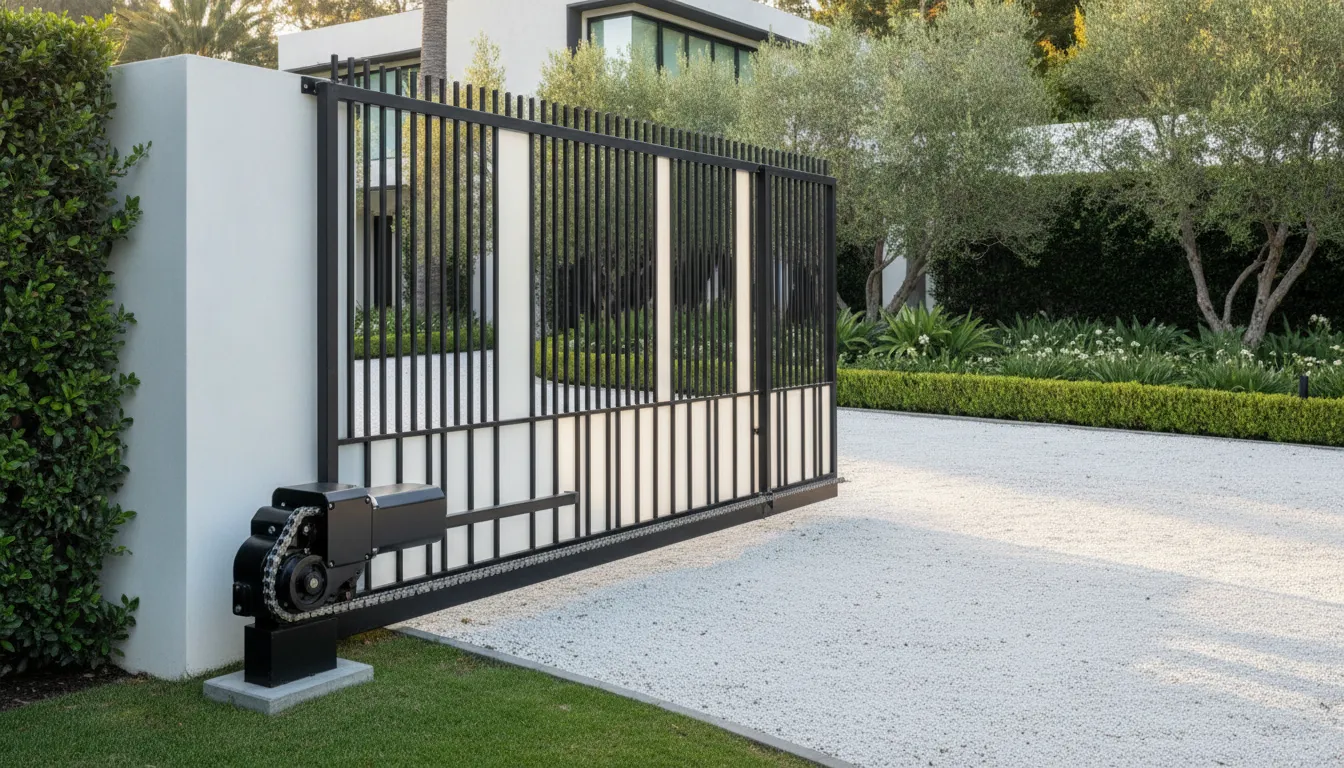
An electric gate operator rarely fails without warning. Changes in speed, noise, sensor response, or backup power can point to wear developing inside the system. These changes matter at high-use entrances and properties exposed to dust, moisture, or heavy daily traffic.
Electric gate maintenance keeps the motor, controls, sensors, tracks, chain, and access equipment working as one system. Professional service can identify developing faults, verify safe operation, and establish an inspection schedule based on cycles, environment, equipment condition, and operating demands.
For Los Angeles and Orange County estate owners, property managers, and commercial operators, planned service is more dependable than waiting for an entrance to stop working. The first step is understanding how regular care protects reliability and preserves access.
Contact InteleGates for professional electric gate maintenance planning.
Why Electric Gate Maintenance Matters for Reliability
An electric gate system is only as dependable as its motor, operator, controls, and supporting components. When those parts work together, residents can enter, guests can be admitted, vendors can reach service areas, and property managers can maintain normal access without reacting to an unexpected failure. Planned maintenance helps preserve that consistency by identifying developing problems before they interrupt daily operations.
Reliability depends on more than the gate moving
A gate may still open and close while the operator is already showing signs of wear. Changes in movement, unusual noise, inconsistent stopping, sensor interruptions, or delayed response can point to issues involving the motor, control board, power supply, backup battery, tracks, chain, or access-control equipment. A professional inspection considers the complete operating system rather than treating the visible gate movement as the only measure of performance.
This matters across sliding gates, swing gates, barrier arms, and vertical lift systems. Each configuration places different demands on its operator and controls. Usage frequency, environmental exposure, equipment condition, and the number of connected entry devices all influence how quickly wear develops. A customized plan is more useful than a rigid schedule that ignores how the system is actually being used.
Planned care protects access continuity
For an estate owner, an unreliable driveway operator can disrupt household routines and create difficulty for visitors or service providers. For a property manager, the impact can extend across vehicle entrances, pedestrian gates, keypads, RFID readers, intercoms, telephone entry systems, remotes, and vehicle detection equipment. A problem at one part of the system can affect the experience of everyone who depends on that entrance.
Professional maintenance keeps attention on the conditions that support dependable access. Service may include inspecting tracks and moving components, checking alignment, cleaning and calibrating sensors, testing system components, reviewing software, and optimizing operation. These checks are intended to keep small changes from becoming a larger interruption and to give decision-makers a clearer record of the operator's condition.
Preventive service supports better repair decisions
Maintenance is not a promise that an electric gate motor will never fail. It is a way to understand the system before failure forces a rushed decision. When a problem appears, InteleGates evaluates the motor, controls, power, wiring, sensors, and mechanical components together. We diagnose the problem before recommending replacement, so the next step is based on the actual cause and condition of the equipment.
Most gate problems can be diagnosed during the initial service visit. Repair time depends on the cause of the problem, parts availability, and the condition of the gate and operator. For systems that need attention, professional electric gate maintenance services provide a practical starting point for protecting reliability and planning future service.
What a Professional Maintenance Visit Includes
A professional maintenance visit examines the electric gate system as a complete operating unit. The motor or operator is central, but dependable movement also depends on power, controls, sensors, mechanical travel, and the access devices connected to the system. The inspection should reflect how the gate is actually used, whether it serves a private driveway, an estate, a commercial property, or a multi-unit community.
Operator, power, and control checks
The visit begins with an inspection of the operator, control board, power supply, wiring, and backup battery where applicable. The technician looks for symptoms that may explain slow movement, intermittent operation, failure to start, or unexpected stops. Control inputs and software settings are reviewed as part of the system assessment, without treating a single component as the automatic cause of every problem.
We diagnose the problem before recommending replacement. That approach helps distinguish a worn component from a power issue, sensor fault, control-board problem, or condition elsewhere in the system. It also supports a more appropriate maintenance plan for the equipment and its operating demands.
Sensors and safety devices
Sensors are inspected for condition, alignment, cleanliness, and reliable response. The technician checks whether safety devices communicate correctly with the operator and whether their behavior is consistent during operation. Vehicle detection, loops, photo sensors, and related equipment may be relevant to commercial or multi-unit entrances. Sensor calibration and cleaning are part of the available maintenance scope when the system requires them.
Mechanical movement and operator load
Maintenance also covers the parts that influence how much resistance the motor must overcome. Depending on the system, this can include tracks, chains, hinges, rollers, and other moving components. The technician evaluates alignment, movement, lubrication needs, unusual friction, and signs of wear. Sliding, swing, barrier arm, and vertical lift gate motors each have different movement patterns, so the inspection is tailored to the equipment rather than handled as a generic checklist.
Professional service may include lubrication of moving parts, alignment checks and adjustments, track inspection, component testing, and system optimization. These actions are performed as part of a controlled service visit, not as a homeowner repair project.
- Inspect the operator, power supply, controls, sensors, and moving components.
- Test the system under representative operating conditions.
- Document findings and identify the appropriate maintenance or service path.
Access control and final testing
A maintenance visit can include the entry equipment that tells the operator when and how to move. For a property manager, that may mean checking keypads, RFID readers, intercoms, telephone entry, remote controls, vehicle detection, pedestrian entrances, and service access. The goal is to evaluate the relationship between the access-control device and the gate operator, not just test the gate in isolation.
After inspection and service, the system is operated through representative cycles. The technician verifies movement, sensor response, controls, and access functions, then documents observed conditions, completed maintenance, and recommended follow-up. For ongoing electric gate maintenance services, those records help property owners and managers plan future visits around usage, environmental exposure, and equipment condition.
| Maintenance focus | Why it matters |
|---|---|
| Operator and power | Helps identify motor, control, wiring, and backup-power concerns. |
| Sensors and access control | Supports dependable commands, safety response, and entry continuity. |
| Tracks and moving parts | Helps reduce excess load caused by wear, friction, or alignment changes. |
| Testing and records | Creates a clearer baseline for future maintenance planning. |
How Often Should Electric Gates Be Serviced?
There is no single service interval that fits every automated entrance. The right schedule depends on operating cycles, conditions around the equipment, operator age and condition, and the importance of continuous access. A private driveway used a few times a day has different demands from an apartment entrance, commercial parking area, or estate gate serving residents, staff, deliveries, and visitors.
For this reason, a service interval should be established from the property's actual use and equipment history. A professional can assess the motor, controls, sensors, moving parts, power supply, and access devices, then recommend a maintenance rhythm based on cycle demands and observed condition. Environmental exposure, recent modifications, intermittent behavior, and the consequences of an access interruption all deserve consideration.
This article keeps the focus on program management rather than presenting a rigid calendar or a complete inspection checklist. Property managers who need a service-visit outline, seasonal inspection details, or a lifespan review should treat those as separate maintenance-planning topics. In every case, early professional evaluation is appropriate when a gate moves slowly, shakes, stops unexpectedly, responds inconsistently, or behaves differently after weather changes. Most gate problems can be diagnosed during the initial service visit. Repair time depends on the cause of the problem, parts availability, and the condition of the gate and operator.
What Are the Signs an Electric Gate Motor Needs Attention?
An electric gate operator often shows changes in performance before it stops working completely. Treat those changes as useful service signals, particularly when the gate protects a busy driveway, serves multiple residents, or controls a commercial entrance. A motor that is slow, uneven, noisy, or unpredictable may be responding to a problem elsewhere in the system, such as a worn component, track condition, sensor, control board, power supply, wiring, or backup battery.
Changes in movement or sound
A gate that opens or closes more slowly than usual, shakes during travel, hesitates, or struggles at a particular point deserves professional attention. Unusual grinding, humming, clicking, or straining sounds can also indicate that the operator is working under abnormal load. These symptoms can develop in sliding, swing, barrier arm, and vertical lift systems, although the likely causes vary by equipment type and installation.
Continued operation may place additional stress on the motor and related components. A professional inspection can evaluate the operator together with the moving hardware, alignment, tracks, chains, and safety devices rather than treating the motor as an isolated part.
Stopping, intermittent access, or remote problems
An operator that stops before completing its cycle, reverses unexpectedly, or works only some of the time should not be dismissed as an occasional glitch. Intermittent remotes, keypads, telephone entry, or other access-control functions may point to a control, power, signal, or programming-related issue. Because several parts of the system can produce similar symptoms, repeated resets or substitutions may hide the underlying fault instead of resolving it.
Photocells and vehicle-detection loops can also affect whether an operator starts, continues, or reverses movement. If the gate behaves differently depending on a vehicle's position, daylight, weather, or the presence of a person near the entrance, qualified service can assess the sensors and related controls as part of the complete system.
Unexpected opening or power symptoms
A gate that opens by itself is a serious reliability concern. It may involve an access-control signal, receiver, control board, wiring, or another system condition that requires prompt evaluation. Likewise, a motor that loses power, performs weakly, or behaves differently during an outage may need checks of its power supply, wiring, and backup battery. Do not attempt electrical or motor repairs based on a symptom alone.
InteleGates provides electric gate motor repair with system inspection, fault diagnosis, motor testing, sensor and access-control troubleshooting, electrical checks, mechanical adjustments, and final testing. We diagnose the problem before recommending replacement. Most gate problems can be diagnosed during the initial service visit. Repair time depends on the cause of the problem, parts availability, and the condition of the gate and operator.
Electric Gate Maintenance for Property Managers and Estate Owners
For an estate owner or property manager, an electric gate is part of the property's daily access system. A motor problem can affect residents, guests, vendors, deliveries, and emergency access at the same time. A maintenance plan should therefore cover the complete operator and access-control setup, not only the visible gate.
Start by documenting each entrance and its operating role. A property may have a vehicle entrance, a pedestrian entrance, a service area, and a separate barrier arm or garage approach. Each location may use a different combination of motor, keypad, remote control, intercom, telephone entry, RFID reader, or vehicle-detection loop. Recording that equipment gives a technician a clear baseline and helps the property team identify which access point needs attention.
Usage is one of the most important planning factors. A private estate driveway that opens a few times each day experiences a different duty cycle from a multi-unit property with continuous resident and visitor traffic. Commercial properties may also have concentrated periods of activity when the operator, sensors, and access controls work repeatedly in a short window. Maintenance intervals should reflect those operating patterns rather than follow an arbitrary calendar alone.
Build a useful service record
A practical service record can note the operator brand and model, access-control equipment, observed symptoms, inspection findings, adjustments, parts that need monitoring, and the date of the next recommended visit. This history helps distinguish a new issue from a recurring condition. It also gives a property manager a clear way to communicate with owners, residents, vendors, and the service company.
Environmental conditions belong in the same record. Coastal air, dust, heavy rain, landscaping debris, heat, and moisture can influence sensors, electrical connections, moving components, and the operator enclosure. A system that works reliably in one setting may need a different inspection rhythm in another. A professional can use the property's actual conditions and operating history to shape a maintenance plan.
Continuity planning matters as well. Property teams should know how to reach the service provider when a gate stops responding, a sensor interrupts operation, or access control behaves inconsistently. InteleGates supports electric gate motors and access-control systems throughout Los Angeles and Orange County, with maintenance planning and professional service for residential, estate, commercial, and multi-unit properties. Explore the electric gate maintenance services available for your system.
How to Organize an Electric Gate Maintenance Program
A useful maintenance program gives the property team a repeatable way to identify equipment, record changes, request service, and confirm that an entrance is ready for normal use. It is not a do-it-yourself repair checklist. The technician handles inspection, testing, adjustment, and diagnosis, while the property team supplies accurate operating context and keeps the service record available.
Start with an entrance-by-entrance inventory
Record each vehicle and pedestrian entrance separately. Note whether it uses a sliding gate motor, swing gate operator, barrier arm opener, or vertical lift operator. Add the connected keypad, intercom, telephone entry system, RFID reader, remote controls, loop detector, and safety sensors. Include the operator brand and model when that information is available. This inventory helps a service professional understand how one entrance relates to the others and prevents a recurring issue from being described only as a general gate problem.
A property manager can also note the entrance's role. A primary resident entrance, delivery entrance, parking access point, and emergency access route may have different operating demands. The service plan should account for those differences. If the property is updating its automation or access equipment, the gate automation service page provides additional context about coordinated operator systems.
Track symptoms in operational language
Service records are most useful when they describe what people observe. Note whether the gate moves slowly, stops at the same point, reverses unexpectedly, responds only to some remotes, or behaves differently after rain or a power interruption. Record when the symptom occurred, which entrance was affected, and whether the issue was continuous or intermittent. Avoid guessing which component failed. A clear symptom record gives the technician better information without turning the property team into a repair crew.
For larger properties, connect the record to a simple communication process. Residents, security staff, vendors, and onsite teams should know where to report an access problem and what information to include. A consistent report can reduce duplicate calls, clarify whether more than one entrance is affected, and help the service provider compare a new symptom with previous findings.
Coordinate service around property operations
Maintenance planning should reflect traffic patterns and access requirements. A busy residential entrance may need service coordination that avoids peak arrival periods. A commercial or managed property may need advance communication with staff, tenants, delivery teams, or security personnel. The service visit should leave a clear record of the system condition, observed symptoms, completed work, and recommended follow-up.
A program can also include a post-visit confirmation. The property representative and technician can review whether the operator completed representative cycles, whether access devices responded correctly, and whether any follow-up work remains. This is especially useful when the gate serves several groups or when a maintenance visit covers multiple entrances. Reliable records help the next service visit begin with the property's actual history rather than a fresh guess.
Review the plan after changes or recurring symptoms
A new access-control device, a change in traffic, landscaping near the gate, construction, weather exposure, or a recurring sensor alert can change the demands on an operator. Review the maintenance plan when those conditions change. Repeated symptoms should also trigger professional evaluation instead of being carried forward as a normal characteristic of the entrance.
InteleGates can assess the motor, operator, access controls, sensors, power, wiring, and moving components as one system. For properties that rely on intercoms, keypads, RFID entry, or telephone entry, the access-control service information can help owners and managers consider the entry equipment alongside the gate motor. The goal is a maintenance plan that reflects the real property, the real equipment, and the way people use the entrance.
What Affects Electric Gate Motor Lifespan?
There is no reliable single lifespan number for an electric gate motor. Two operators of the same model can experience very different service demands because their cycle counts, operating conditions, installation quality, and maintenance histories are not the same. The useful question is not simply how old the motor is. It is whether the complete operator system is being asked to work within appropriate conditions and whether developing problems are identified early.
Usage, alignment, and mechanical load
Every opening and closing cycle places demand on the motor, controls, drive components, and safety devices. A private driveway with limited daily traffic has a different duty pattern from an apartment entrance, commercial parking area, or service gate that operates throughout the day. Frequent cycling increases wear and makes regular inspection more important.
Alignment also affects how hard the operator must work. A gate that drags, binds, or moves unevenly transfers extra load to the motor and related components. For sliding systems, track condition and chain condition matter. Swing systems require attention to movement, hinges, and operator travel. When the gate is not moving as it should, continuing to operate it can turn a correctable mechanical issue into a broader operator problem.
Environment and electrical quality
Moisture, dust, debris, heat, and coastal exposure can affect sensors, control boards, connections, batteries, and moving parts. Los Angeles and Orange County properties can have very different conditions, from dusty driveways and landscaped entrances to exposed coastal locations. A maintenance plan should reflect the actual environment instead of relying on a generic calendar.
Power quality is another important factor. Wiring problems, unstable power supplies, battery deterioration, and control-board faults can produce symptoms that look like motor failure. A professional inspection checks the electrical system and the operator together, rather than assuming replacement is the answer.
Operator condition, access controls, and maintenance records
The operator must be properly suited to the gate's operating demands and kept in serviceable condition. Sensors, keypads, RFID readers, intercoms, telephone entry, remotes, vehicle detection, and other access-control devices can add operating activity or create repeated commands when they are not functioning correctly. On a property with multiple entrances, these systems should be considered part of the overall maintenance picture.
Good records help identify changes before they become disruptive. Note service dates, recurring symptoms, component testing, sensor or access-control issues, and environmental changes. Professional electric gate maintenance services can include alignment checks, track inspection, sensor cleaning and calibration, component testing, software updates, lubrication, and system optimization. The goal is dependable operation, not a fixed age milestone. When service is needed, InteleGates diagnoses the problem before recommending replacement.
When Maintenance Becomes Repair or Replacement
A routine maintenance visit does more than keep an electric gate operator moving smoothly. It can reveal whether a symptom is the result of normal wear, a correctable adjustment, an electrical fault, or equipment that no longer provides dependable service. The right decision starts with evidence, not assumptions.
We diagnose the problem before recommending replacement. A technician can inspect the motor, control board, sensors, power supply, wiring, backup battery, tracks, chain, and other related components. A gate that moves slowly, stops intermittently, or fails to respond may have a worn component, a sensor issue, an alignment problem, or a power-related fault. Replacing the operator without identifying the cause can leave the underlying problem unresolved.
When repair is the appropriate next step
Repair is often practical when the operator is in serviceable condition and the fault can be isolated to a specific component or system issue. Professional service may include fault diagnosis, motor testing, electrical checks, sensor and access-control troubleshooting, mechanical adjustments, and final testing. Maintenance findings such as worn parts, poor alignment, dirty or miscalibrated sensors, or a weak backup battery can point toward targeted service rather than a complete system change. See the electric gate motor repair service for more detail on this diagnostic approach.
When replacement deserves consideration
Replacement becomes a more reasonable conversation when the equipment's overall condition is poor, multiple major components are failing, or the operator cannot reliably support the property's operating demands. Parts availability also matters. If essential parts are unavailable or difficult to source, a repair may not provide a dependable long-term solution. The decision should account for the condition of the existing equipment, the gate's usage pattern, the access-control requirements, and whether the current system can be safely tested and maintained.
Repair timing should also be described honestly. Most gate problems can be diagnosed during the initial service visit. Repair time depends on the cause of the problem, parts availability, and the condition of the gate and operator. A qualified service visit gives property owners and managers a clearer path, whether that means maintaining the existing system, completing a focused repair, or planning an equipment replacement with fewer surprises.
Contact InteleGates for professional diagnosis and electric gate maintenance planning.
Frequently Asked Questions
Should electric gates be serviced?
Yes. Scheduled service helps identify wear, alignment problems, sensor issues, power concerns, and operator strain before they interrupt access. The right interval depends on usage frequency, environmental conditions, equipment condition, and operating demands. Estate owners and property managers can use a customized maintenance plan rather than relying on a rigid calendar.
What are the most common electric gate problems?
Common problems include slow or uneven movement, unusual noise, intermittent operation, sensor faults, control-board issues, power or backup-battery problems, and worn tracks or chains. A professional inspection checks the complete system, including the motor, controls, access devices, electrical components, and moving parts, so the underlying cause is addressed instead of replacing a component based on symptoms alone.
How is an electric gate lubricated?
Lubrication is one part of professional maintenance, along with inspecting moving parts, checking alignment, examining tracks, cleaning and calibrating sensors, testing components, and optimizing the system. The correct service depends on the operator and gate design. Because lubrication does not correct electrical, control, alignment, or mechanical faults, a qualified technician should evaluate the system rather than treating it as a standalone fix.
When does a maintenance issue require professional repair?
Arrange professional service when the gate stops unexpectedly, reverses or fails to complete its cycle, moves slowly, operates intermittently, makes new sounds, or shows access-control or sensor problems. InteleGates diagnoses the problem before recommending replacement. Most gate problems can be diagnosed during the initial service visit, while repair time depends on the cause, parts availability, and the condition of the gate and operator.
Schedule Professional Electric Gate Maintenance
Regular service can help identify motor, sensor, power, and access-control issues before they disrupt daily entry. InteleGates can help property owners and managers plan maintenance around the equipment, operating demands, and condition of the system.