
InteleGates Guide
Electric Gate Maintenance Service Visit: What to Expect
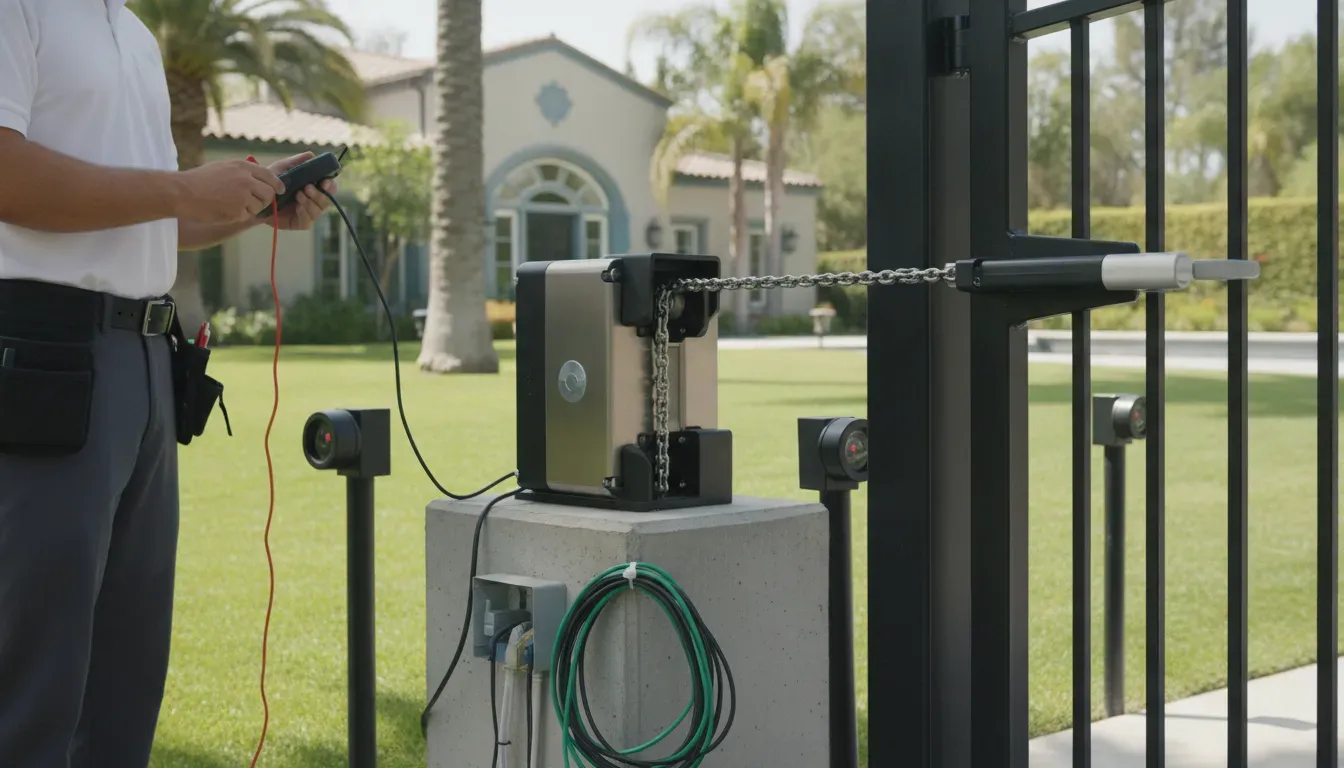
An electric gate maintenance service visit is a professional inspection and performance check of the operator, moving components, safety devices, controls, and access equipment that work together at an entrance. The technician looks for developing problems, services the system where appropriate, tests operation, and records what the property owner or manager should know next.
This visit is the practical, on-site companion to InteleGates' guide to regular electric gate maintenance: it turns general maintenance goals into observations about one property's equipment and operating conditions.
Schedule a professional electric gate maintenance service visit with InteleGates.
Knowing what happens during the appointment helps homeowners, estate owners, and property managers prepare useful information and understand why a motor-focused visit covers more than watching the gate open and close once. InteleGates serves electric gate and access-control systems throughout Los Angeles and Orange County.
What happens during an electric gate maintenance service visit?
Professional maintenance helps evaluate an electric gate operator before a small change becomes a disruptive access problem. The motor is central, but its performance depends on the drive arrangement, power supply, control board, sensors, limits, safety response, and the mechanical movement of the existing gate. A service visit considers those relationships instead of assuming that every symptom comes from the motor.
Usage and site conditions also shape the inspection. A private driveway, a managed residential entrance, and a busy commercial access point place different demands on an operator. Dust, moisture, heat, debris, traffic volume, and recent changes to access control can affect how a system behaves. A technician uses the property's actual operating context to identify what deserves attention.
InteleGates' approach is straightforward: we diagnose the problem before recommending replacement. Preventive service is not a promise that equipment will never need repair. It is a way to understand the condition of the system and make the next service decision from observed evidence.
A typical appointment follows a clear sequence, although the technician adapts it to the installation rather than treating every gate as identical:
- Review the site and reported symptoms. The technician identifies the entrance, gate type, operator, access devices, recent changes, and conditions noticed by the owner or property team.
- Inspect the connected system. The operator, power, controls, safety devices, and mechanical movement are evaluated together so the source of a symptom is not assumed in advance.
- Service and test as appropriate. Suitable lubrication, adjustments, cleaning, and operating checks are performed according to the equipment and its condition.
- Document findings and next steps. The owner or manager receives a clear distinction between work completed during the visit, items to monitor, and repairs that may need a separate recommendation.
This sequence gives property owners a useful answer to a common question: maintenance is not simply a quick visual check or a replacement pitch. It is a condition assessment followed by equipment-appropriate service and documented recommendations.
What is inspected during the service visit?
A professional visit starts with the electric gate operator and expands to the components that control, support, and protect its movement. The technician may inspect the following areas, based on the gate type, operator, access equipment, and symptoms reported:
- Operator and motor: The enclosure, mounting, drive arrangement, operating behavior, and visible signs of wear are reviewed.
- Power and wiring: The service visit includes an assessment of the power supply, connections, control wiring, and backup power where the system has it.
- Controls and limits: The technician reviews commands, travel limits, control-board behavior, and the way the operator starts, stops, and responds.
- Safety devices: Photo sensors, safety edges, vehicle detection, and related devices are checked for condition, alignment, and response as applicable.
- Mechanical movement: Tracks, chains, rollers, hinges, and other moving components are evaluated for alignment, friction, wear, and conditions that may place excess demand on the operator.
- Access equipment: Remotes, keypads, intercoms, telephone entry systems, RFID readers, and other connected devices may be tested when they communicate with the gate system.
The exact sequence varies by installation. A sliding gate operator does not move like a swing gate operator, and a barrier arm has different operating behavior from either one. The inspection should follow the actual equipment rather than a generic checklist.
If the inspection identifies a failed or unreliable component, the next step may be a focused electric gate system repair rather than routine maintenance alone. When the symptom involves keypads, readers, intercoms, or other entry devices, the technician may also evaluate the access-control system as part of the diagnosis.
The technician also considers how the entrance is used. A residential driveway may have long periods of low activity, while an apartment entrance, commercial property, or industrial facility may cycle throughout the day. Traffic volume, delivery timing, pedestrian access, and the consequences of a failed entrance all help determine which observations deserve attention. This context can change the maintenance recommendation even when two properties use similar operator models.
For a property manager, the service visit is also an opportunity to connect equipment condition with site records. Identifying the operator, entrance, access devices, and recurring symptoms makes later repair decisions easier. If several entrances are present, separate findings can help the team prioritize a vehicle gate, pedestrian gate, service entrance, or barrier arm without treating the property as one undifferentiated system.
What happens during operator and safety testing?
Testing shows how the system behaves under representative operating conditions. The technician observes starting, travel, stopping, reversing, sensor response, access commands, and completion of the operating cycle. The purpose is to compare actual behavior with the system's expected operation and identify symptoms that may not appear during a quick visual check.
Operational and load checks
The technician evaluates whether the operator is moving the existing gate smoothly and whether resistance, alignment, or worn components appear to be making the motor work harder than it should. Appropriate load or force testing may be performed using the equipment and test methods suitable for the system. The technician can then determine whether a concern relates to the operator, the gate movement, the controls, or another connected component.
Testing may also include repeated representative cycles when the property and equipment allow it. Repetition can help reveal intermittent behavior, delayed response, overheating symptoms, or a problem that appears only at a particular point in travel. The goal is not to run the system unnecessarily, but to gather useful evidence about the way it operates in service.
Safety and access-control checks
Safety devices must communicate correctly with the operator. The technician checks whether sensors respond as intended, whether the operator reacts appropriately to a detected obstruction, and whether access devices send consistent commands. A keypad, remote, intercom, telephone entry system, or vehicle sensor can create a symptom that looks like a motor issue, so the connected equipment deserves attention too.
Safety testing is not an optional add-on to a motor inspection. The U.S. Consumer Product Safety Commission maintains guidance and standards information for gate operators and related operator safety. A qualified technician should use equipment-appropriate methods and should not disable a safety device to make the gate operate.
These are professional checks. Homeowners and property teams can report unusual sounds, slow movement, incomplete cycles, or intermittent access, but internal settings, electrical connections, safety functions, and operator adjustments should be handled by a qualified technician.
Are lubrication and adjustments part of the visit?
Lubrication, alignment review, cleaning, and adjustments may be part of a maintenance visit when the system condition and equipment requirements call for them. The technician first identifies the relevant moving and supporting components, then determines which service actions are appropriate. This avoids treating every operator as though it has the same design, wear pattern, or maintenance requirement.
For a sliding gate, the review can include the track, chain, rollers, and the connection between the operator and gate movement. For a swing gate, the technician evaluates the operator, hinges, travel, and stopping behavior. Other systems, including barrier arms and vertical lift operators, require their own equipment-specific assessment.
Maintenance actions are intended to support reliable movement and reduce unnecessary demand on the motor. They are not a substitute for repairing a damaged component. If the technician finds a fault, the service record should distinguish completed maintenance from recommended repair or follow-up work.
Review InteleGates electric gate maintenance services for your existing gate system.
What is documented after a maintenance visit?
A useful service record gives the property owner or manager a clear picture of the system on the day it was inspected. Documentation may include the operator and gate type, reported symptoms, observed conditions, tests performed, maintenance completed, components that need monitoring, and recommended follow-up.
| Service record item | Why it helps |
|---|---|
| Operator and entrance | Identifies which motor and access point were reviewed. |
| Observed symptoms | Connects the service findings to changes reported by residents, staff, or the owner. |
| Inspection and testing | Shows which operating, safety, access, and mechanical checks were performed. |
| Completed maintenance | Separates the actions completed during the visit from future recommendations. |
| Follow-up guidance | Gives the property team a practical next step for monitoring or additional service. |
For a property with multiple entrances, entrance-by-entrance records are especially useful. They help a manager distinguish a resident driveway operator from a service entrance, pedestrian access point, or commercial barrier arm. They also make it easier to describe a recurring symptom accurately during the next service request.
How often should professional gate maintenance be scheduled?
For high-use gates, InteleGates recommends professional maintenance every six months; for residential systems, at least annual inspection is a practical baseline. The right schedule still depends on the property's operating cycles, equipment condition, environment, and access requirements. A high-use entrance or a system with recurring symptoms may need a more frequent service rhythm recommended by a technician.
Service should also be considered after a significant impact, an electrical event, a change to access-control equipment, construction near the entrance, or a noticeable change in movement. A gate that becomes slow, noisy, uneven, intermittent, or unable to complete its cycle should be evaluated rather than simply placed on the next routine appointment.
For more context on planning service intervals, read InteleGates' guide to how often an automatic gate should be serviced. The service-visit walkthrough in this article focuses on what a technician evaluates during the appointment, while that guide addresses scheduling considerations.
If the system includes a backup battery, maintenance planning should account for that component as well. A battery can affect operation during a power event, so property owners may also find InteleGates' gate battery backup guide useful when reviewing service findings.
How should a property owner prepare for the appointment?
Before the technician arrives, the property owner or manager can note which entrance is affected, what changed, when the symptom appears, and whether the behavior is continuous or intermittent. Useful observations include slow travel, unusual noise, stopping at the same location, inconsistent remotes, sensor interruptions, or behavior that changes after weather or a power event.
It also helps to identify the people who rely on the entrance and any access devices connected to it. A property manager may need to account for residents, staff, deliveries, visitors, pedestrian access, and vehicle detection. This operating context helps the technician evaluate the system in a way that reflects how the entrance is actually used.
Do not attempt to bypass safety equipment, adjust force settings, repair wiring, or open the operator to prepare for service. Report the symptom and leave technical inspection, testing, lubrication, adjustment, and diagnosis to the service professional.
Frequently Asked Questions
What does an electric gate maintenance service visit include?
A professional visit can include inspection of the motor operator, power, controls, safety devices, mechanical movement, and access-control equipment. The technician tests representative operation, performs appropriate maintenance, documents findings, and explains any follow-up service indicated by the system's condition.
Does maintenance include load testing?
When appropriate for the equipment, a technician can perform suitable load or force checks as part of evaluating operator performance and safety response. The method depends on the gate type, operator, installation, and applicable system requirements.
How often should an electric gate be professionally serviced?
High-use gates should generally be professionally maintained every six months, while residential systems should be inspected at least annually. The schedule can vary with operating cycles, environmental exposure, equipment condition, and the importance of continuous access at the property.
What should I tell the technician before the appointment?
Share the entrance location, the observed symptom, when it occurs, whether it affects all access devices, and any recent weather, power, impact, or access-control changes. Do not guess which component failed. Clear observations help the technician diagnose the system.
Can a service visit determine whether the motor needs replacement?
A professional assessment can help identify whether the issue is in the motor, controls, power, sensors, mechanical movement, or another connected component. InteleGates diagnoses the problem before recommending replacement, so the next step is based on the condition of the complete system.
Request professional electric gate maintenance service from InteleGates.