
InteleGates Guide
Electric Gate Motor Warning Signs to Watch For
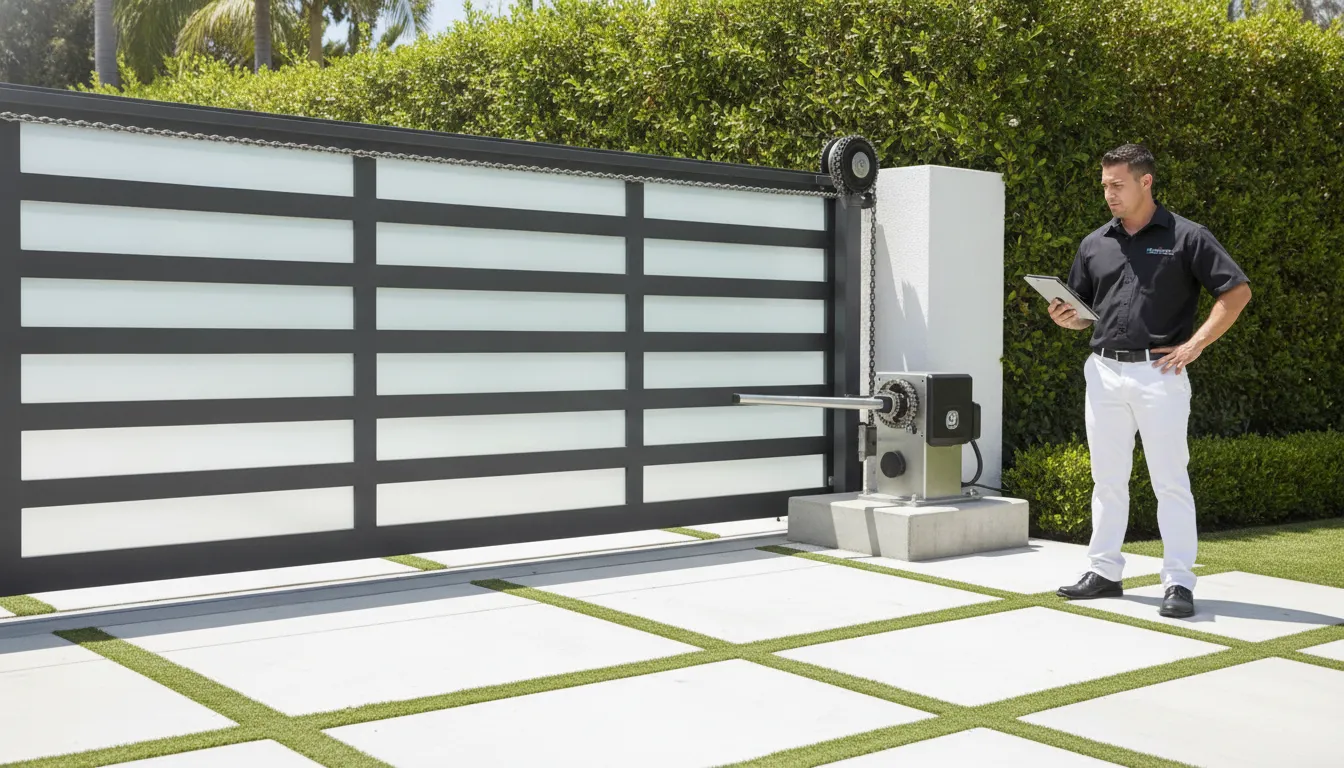
An electric gate motor rarely develops a serious operating problem without showing a change first. New noise, slower travel, inconsistent response, or stopping before the gate reaches its normal position can be electric gate motor warning signs. They are signals that the complete gate system needs professional diagnosis, not proof that the motor alone has failed.
What are the most important electric gate motor warning signs? The most useful signs are a new or worsening sound, slower or uneven movement, intermittent response, partial travel, unexpected opening, and abnormal safety behavior. A technician must inspect the operator, power supply, controls, sensors, and gate mechanics to identify the cause before recommending repair or replacement.
That distinction matters because an electric gate is a system. A motor can be affected by resistance in the gate, a track or chain issue, a safety sensor, an access-control command, a control board, or an electrical condition. InteleGates diagnoses the problem before recommending replacement, and the company services existing gate systems throughout Los Angeles and Orange County.
Contact InteleGates about electric gate motor warning signs
Which Electric Gate Motor Warning Signs Should You Notice First?
The first clue is often a change from the gate's normal behavior. A system that has operated smoothly for months or years may begin to sound different, move at a different speed, respond inconsistently, or stop at a repeatable point. Record what changed and when it happens. That information can help a technician compare the symptom with the operator's response, the gate's movement, and the condition of related components.
| Observed change | What it may tell a technician |
|---|---|
| New grinding, humming, clicking, or straining | The operator or another system component may be working under an abnormal load or responding incorrectly. |
| Slower or uneven travel | Resistance, alignment, power, controls, or operator performance may need to be evaluated. |
| Intermittent response | The power supply, access device, sensor, control board, or operator may be contributing to an inconsistent cycle. |
| Stopping before fully open or closed | The travel path, safety equipment, gate load, controls, or operator may require diagnosis. |
| Opening without an expected command | An access-control signal, detection device, control condition, or wiring issue may be involved. |
A single unusual event may be difficult to interpret. A repeated pattern deserves attention, especially when it is becoming more frequent or affects access, closing, or expected safety behavior. Do not bypass a safety device, change force settings, handle wiring, or keep operating a gate that behaves unpredictably. Those actions can create risk and can make the original fault harder to identify.
Track the pattern, not just the symptom
For a service visit, note whether the problem occurs when the gate starts, during the middle of travel, or near the open or closed position. Note whether it happens with a remote, keypad, telephone entry system, card reader, or another command. Also note whether the gate behaves differently after repeated cycles or after exposure to weather. These observations are not a substitute for diagnosis, but they provide useful context.
The same visible symptom can have different causes. A gate that stops at the same point each time may lead a technician to examine that part of the travel path or the load placed on the operator. A gate that stops at different points may direct attention toward sensors, controls, power, or an intermittent operator condition. The distinction is why a complete inspection is more useful than assuming the motor is the source.
What Do Unusual Gate Motor Sounds Mean?
A new sound is one of the easiest changes for a property owner to notice. Grinding, humming, clicking, rattling, or straining can indicate that the operator or another component is no longer working under its usual conditions. The sound does not identify one failed part by itself. Its timing, repetition, and relationship to gate movement are more useful than the label given to the sound.
Grinding or scraping during movement
Grinding during travel can occur when the operator is working against unusual resistance or when a moving component is no longer operating smoothly. On a sliding gate, the chain, track, rollers, and related drive components may influence the load placed on the operator. On a swing gate, hinges, the gate load, and the operator mechanism can affect how much effort is required through the cycle.
If the sound appears only at one point, the technician may compare that point with the gate's travel path and mechanical condition. If it continues throughout the cycle, the operator and its drive arrangement may require closer evaluation. Either pattern should be treated as a diagnostic clue, not as a reason to order a replacement motor without an inspection.
Humming, clicking, or straining
Humming or straining can be associated with a difficult load, an electrical condition, a control response, or operator performance. A clicking sound may come from a relay, lock, control response, or another associated component rather than the motor. Pay attention to whether the click occurs when a command is sent, when the gate begins moving, or when it stops.
A repeated click followed by no movement is different from a click that occurs during a normal control sequence. A hum paired with slower travel is different from a brief sound while a command is processed. The full pattern helps a technician evaluate the power supply, controls, sensors, operator, and gate mechanics together.
InteleGates begins with inspection and fault diagnosis. The technician assesses motor performance, electrical conditions, sensors, access controls, and the gate's drive system before final testing. That process is designed to identify the source of the sound before a repair or replacement recommendation is made.
Why Does an Electric Gate Work Sometimes and Fail at Other Times?
Intermittent operation means the system does not respond consistently to a similar command or operating condition. The gate may open normally in the morning, hesitate later, and then work again after sitting for a while. It may respond to one access device but not another, or start moving and stop before completing the cycle. This is one of the more important electric gate motor warning signs because intermittent faults can become more disruptive while remaining difficult to isolate without testing.
Several components can produce intermittent operation
The power supply supports the operator and its controls. An unstable electrical condition can affect whether a cycle begins or completes. The control board interprets commands and coordinates the system, so a control issue can appear as a delayed response, inconsistent movement, or an incomplete cycle. Sensors and other safety devices can also change the way the operator responds when the system receives an unexpected signal.
An access device can create a similar impression. A remote, keypad, card reader, telephone entry system, or other control may send an inconsistent command even when the operator is functioning. This is why replacing or adjusting the motor without checking the command path can miss the source of the problem.
Operating conditions can change the load
The gate's physical condition also matters. A track, chain, hinge, roller, or alignment condition can increase resistance during part of the cycle. Debris, weather exposure, repeated use, or a change in the gate's load can make an existing weakness more noticeable. The operator should be assessed together with the existing gate system, not in isolation.
What does intermittent electric gate operation mean? It means the system is responding differently under conditions that should be similar. The cause may be electrical, electronic, mechanical, or related to an access-control device. A professional inspection is needed to determine whether the operator, controls, safety equipment, power, or gate mechanics are contributing.
Review InteleGates gate automation services for an existing gate system.
When Slow or Partial Movement Means the System Needs Attention
A gate that moves more slowly than usual, hesitates, or shakes is showing a meaningful change in performance. A gate that stops before reaching the open or closed position needs attention as well. Slow movement does not automatically mean the motor needs replacement. The cause may be a mechanical load, track or chain condition, electrical issue, sensor signal, control response, or operator fault.
On a sliding gate, resistance in the track, wheels, rollers, or chain can make the operator work harder. A swing gate may be affected by hinges, the gate load, alignment, or the operator mechanism. If the gate slows at the same point in every cycle, the travel path and the load at that point deserve attention. If it slows unpredictably, the technician may also examine sensors, controls, power, and intermittent operator performance.
Partial stopping and unexpected movement
Partial stopping can occur when the system receives a safety signal, loses a command, encounters resistance, or develops an operator or control problem. A gate that stops before closing should not be treated as a minor inconvenience when the pattern repeats. The open position, closed position, and safety response all provide information about how the system is operating.
A gate that opens without an expected command is also a service concern. Possible sources include an access-control signal, keypad, remote, telephone entry system, loop detector, sensor, control board, or wiring condition. Because the cause cannot be identified from the movement alone, keep the area clear and arrange professional evaluation rather than experimenting with settings.
Safety behavior is especially important. If a gate does not stop, reverse, or respond as expected around an obstruction or safety device, stop relying on normal operation until the system is assessed. Do not bypass a sensor or continue cycling a gate that is behaving unpredictably.
InteleGates evaluates the complete existing system, including the operator, power, sensors, access controls, and moving components. The company diagnoses the problem before recommending replacement. Electric gate system repair and diagnosis can establish whether the issue is in the motor, the gate mechanics, or another part of the system.
How Professional Diagnosis Separates a Motor Problem From a System Problem
A motor is only one part of an automated gate system. A useful assessment considers how the operator, gate, controls, safety devices, and power supply work together. This is particularly important when several symptoms appear at once, such as a new sound paired with slow movement or an intermittent command followed by partial stopping.
A complete assessment follows the symptom through the system
- Inspect the existing gate system. The technician reviews the gate type, operator, movement pattern, access controls, and changes reported by the property owner.
- Diagnose the fault and assess operator performance. The system is observed during operation so the symptom can be compared with the operator's response.
- Evaluate sensors, access controls, and electrical conditions. These components can create symptoms that look like a motor problem when the operator is not the source.
- Examine relevant mechanical conditions. The gate's travel path, chain, track, hinges, rollers, alignment, and load may affect how the operator performs.
- Test after appropriate professional service. Final testing helps confirm that the identified condition has been addressed and that the system responds as expected.
Diagnosis also prevents a common mistake: treating every symptom as evidence that a complete motor replacement is necessary. A control, sensor, power, or mechanical issue may be the actual source. Conversely, a motor that has a confirmed performance problem should be evaluated in the context of the gate and its intended use. The recommendation should follow the findings.
Most gate problems can be diagnosed during the initial service visit. Repair time depends on the cause of the problem, parts availability, and the condition of the gate and operator. InteleGates services sliding, swing, barrier-arm, and overhead gate operators on existing gate systems across Los Angeles and Orange County.
How Maintenance Can Help Identify Electric Gate Motor Warning Signs Earlier
Professional maintenance gives a technician an opportunity to look for changes before they become a complete access failure. Maintenance is not a guarantee that a system will never need repair. It is a way to evaluate the operator, gate movement, controls, sensors, electrical conditions, and related components as part of a planned service visit.
During an assessment, the technician can compare current operation with the system's normal behavior. Look for developing resistance, and note symptoms such as new noise, slow travel, or inconsistent response. The findings can help property owners plan service around the condition of the existing system rather than waiting for an avoidable interruption.
We recommend professional gate-system maintenance at least every six months. The appropriate service approach also depends on gate type, cycles, exposure, access-control equipment, and the condition of the operator. If a warning sign has already appeared, a repair diagnosis should take priority over simply waiting for the next maintenance interval.
For related system care, see InteleGates electric gate system maintenance. For a persistent symptom, use the electric gate system repair service page to request professional diagnosis.
Request professional help for a gate motor or operator problem
Frequently Asked Questions
What are the most common electric gate motor warning signs?
The most common signs include a new grinding, humming, clicking, or straining sound; slower or uneven movement; intermittent response; stopping before the gate is fully open or closed; unexpected opening; and unusual safety behavior. These symptoms can come from the operator, sensors, controls, power supply, or gate mechanics. A complete professional diagnosis is needed before deciding what service is appropriate.
Does slow gate movement mean the motor needs to be replaced?
Not necessarily. Slow movement can be related to the motor, power supply, track, chain, rollers, hinges, alignment, gate load, sensors, or control system. A technician should inspect the complete existing gate system and test the operator before recommending repair or replacement. InteleGates diagnoses the problem before recommending replacement.
Why does an electric gate work sometimes but not every time?
Intermittent operation can involve an unstable power condition, control board, sensor, access device, wiring, operator, or mechanical resistance. The pattern may change with repeated cycles or with the position of the gate. Because several components can create the same symptom, a technician should inspect the command path, safety devices, operator, and gate mechanics together.
What should I do if an electric gate stops partway?
Keep people and vehicles clear of the moving area and stop relying on a gate that behaves unpredictably. Do not bypass safety equipment or change wiring and force settings. Arrange professional service so the operator, power, controls, sensors, and moving components can be inspected and tested.
How often should an electric gate system be professionally maintained?
We recommend professional gate-system maintenance at least every six months. The system's gate type, use, exposure, access controls, and condition may affect the service plan. Maintenance does not replace repair diagnosis when a new sound, slow movement, intermittent response, or partial stopping has already appeared.
Contact InteleGates About Electric Gate Motor Warning Signs
New sounds, slow or partial movement, inconsistent commands, and unexpected operation all deserve attention. These symptoms can involve more than the motor, so the right next step is a complete professional assessment of the existing gate system.
Contact InteleGates to schedule professional gate-system diagnosis