
InteleGates Guide
Electric Gates for Driveways: Planning the Right System
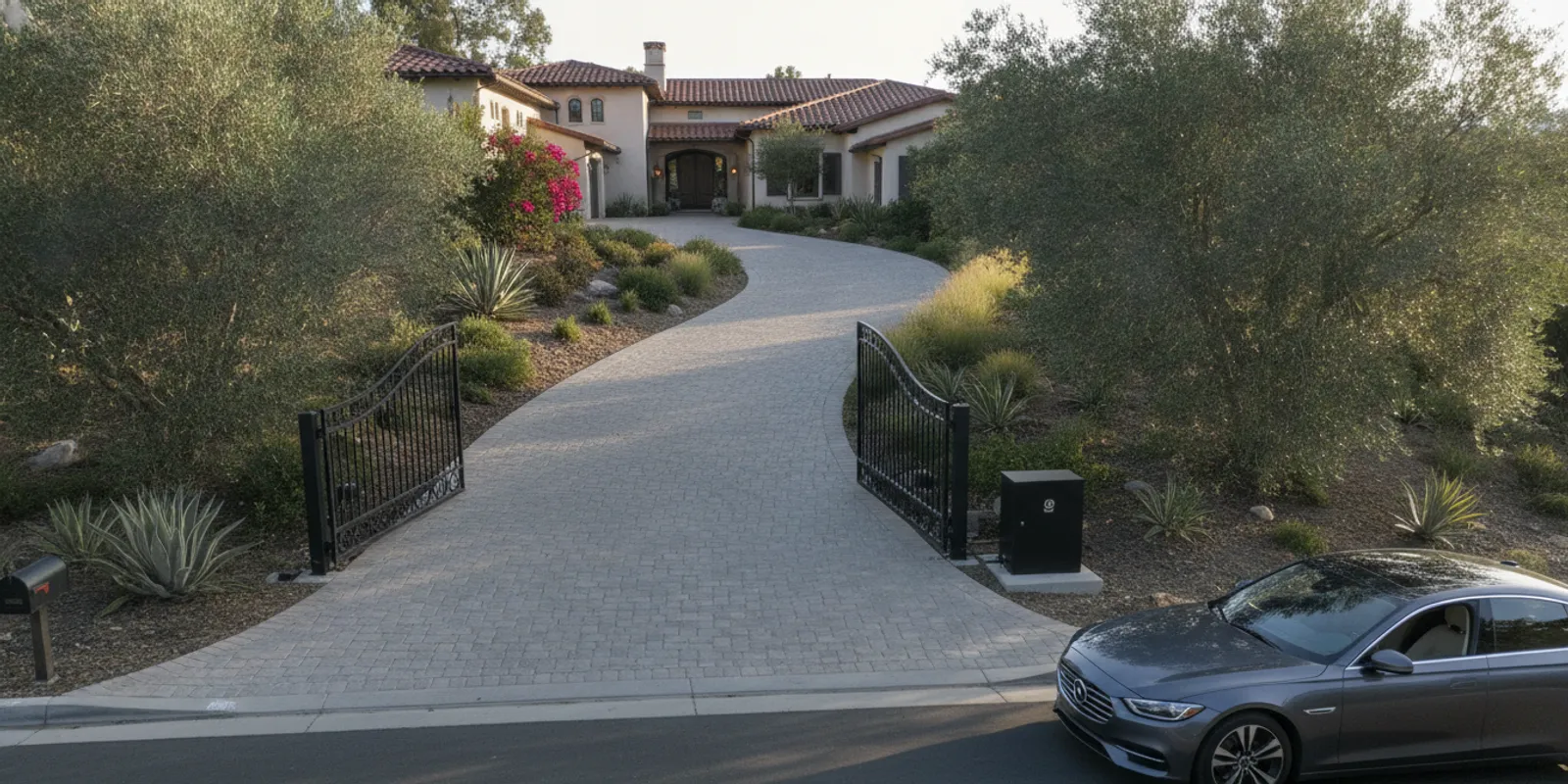
Planning electric gates for driveways starts with the entrance itself, not with choosing a motor by appearance. The driveway’s slope, available clearance, gate movement, daily traffic, and access needs all affect which automation approach can work well. A careful assessment helps owners and property managers describe the site accurately and identify questions to resolve before installation.
Request an installation assessment
What should you look at before planning electric gates for driveways?
Walk the approach from the street toward the property and observe how vehicles enter, stop, and turn. Note the gate’s current condition and how it moves. Automation is intended for an existing gate and its associated operator and controls; it does not replace an assessment of the gate’s physical fit and operation.
- Clearance: Check whether a vehicle can wait clear of traffic while the gate opens, and whether the gate has room to move without striking a parked car, wall, landscaping, or other obstruction.
- Grade: Look for a slope or uneven surface near the gate. A change in elevation can affect the movement path and the space needed for the gate to operate.
- Turning space: Consider whether drivers need to turn sharply or reverse while waiting. Larger vehicles may need a different approach than passenger cars.
- Pedestrian path: Identify where residents, visitors, delivery workers, or employees walk. The vehicle route should not be treated as a pedestrian route.
- Existing equipment: Record visible operator and control equipment, but do not open electrical enclosures or try to adjust components.
Photographs taken from outside the movement area can help explain the entrance. Include a wide view of the approach, a view of the closed gate, and a view of the area where the gate travels. Do not stand in the path of a moving gate to take pictures.
How does driveway layout affect the movement choice?
Gate movement determines how much room the system needs. A sliding gate travels along the opening, so the property needs a clear side area for the gate to move. A swing gate moves through an arc, so the driveway and adjoining area need clearance for that arc. A barrier arm or vertical lift arrangement has different movement and application considerations.
Use this comparison as a starting point, not as a final selection. Site conditions and the existing gate can change what is suitable.
| Movement approach | Space to evaluate | Questions for the assessment |
|---|---|---|
| Sliding | Clear travel area beside the opening | Is the travel path unobstructed, and can the gate move fully without conflict? |
| Swing | Arc of movement in front of or behind the opening | Does the arc clear vehicles, walls, landscaping, and changes in grade? |
| Barrier arm | Vehicle lane and arm clearance | Does the entrance serve a defined lane or controlled vehicle point? |
| Vertical lift | Overhead and vertical clearance | Is there adequate room above and around the gate throughout its movement? |
A gate that appears to have adequate space when closed may encounter an obstruction while moving. For a more detailed overview of gate automation for existing systems, consider how the operator works with the gate rather than treating the motor as a stand-alone choice.
What should you consider about slope and the approach?
Driveway grade matters both at the opening and along the gate’s travel route. A sloped approach may change how a swing gate clears the ground. A sliding gate also needs a suitable, unobstructed path. Changes in grade, drainage channels, paving edges, and debris can all be useful details to point out during an assessment.
Observe the entrance in ordinary conditions. Note where water collects after rain, whether leaves or gravel accumulate near the movement path, and whether vehicles are likely to stop on an incline. These observations do not determine the equipment by themselves, but they give the technician a clearer picture of the site.
Do not force a gate that binds or drags. Do not attempt to modify hinges, tracks, or the gate structure to make an operator fit. InteleGates focuses on electric gate motors, automation, repair, and access-control equipment, rather than manufacturing or installing gates and fences. If the gate itself appears damaged or unstable, explain that before discussing automation.
How should daily traffic and access needs shape the plan?
Think about who uses the entrance and how often. A private driveway used by a household has different patterns from a shared residential entrance or a commercial vehicle lane. List the expected users, the types of vehicles, peak arrival periods, and whether visitors need a way to request entry.
- For a residence, consider how household members enter when arriving by car or on foot.
- For a shared property, consider how tenants, guests, delivery drivers, and service providers request access.
- For a commercial site, describe vehicle flow, lane use, and any periods when several vehicles may arrive close together.
- For all properties, identify how a driver can request entry and how an authorized user will operate the gate.
Access features may include keypads, telephone entry, intercoms, card readers, remote controls, or other compatible systems. The right arrangement depends on the property and how it is managed. For example, a shared entrance may need a different visitor process from a private driveway. Review relevant options such as gate keypad systems, telephone entry, and buzzer systems as you describe the access routine.
Which parts of the existing system should be reviewed?
An operator must work with the gate and its controls as a system. During planning, gather what you can identify safely: the operator brand or model label if visible, the gate’s movement type, any control devices in use, and a brief description of symptoms or limitations. A photo of a label is more useful than guessing at a model name.
Also note whether remotes, keypads, intercoms, or other entry devices already operate the gate. If a specific operator brand is installed, the LiftMaster repair information can help you understand the service focus for that equipment. An assessment can determine whether the existing components fit the planned use or need attention.
Keep people and vehicles clear while the gate operates. Do not reach into the movement path, bypass safety devices, or leave a gate in a condition that could move unexpectedly. For general safety information about automated gates, consult the U.S. Consumer Product Safety Commission at Automatic Gates safety guidance.
How do the planning needs differ by property?
For a single-family home, the central questions are often where a vehicle waits, how the gate opens without blocking the driveway, and how household members and visitors gain entry. For a multi-unit property, managers may also need to coordinate resident credentials, guest access, and delivery procedures. A commercial site may need to describe vehicle volume, the lane arrangement, and how authorized users request service access.
In every case, separate the gate’s physical movement from the access-control process. One describes how the gate opens and closes; the other describes who can request or authorize entry. Making both clear early can prevent an installation plan from overlooking a practical part of daily use.
Service availability depends on location. InteleGates serves areas in Los Angeles County south of the SR-134 corridor and west of I-605 to the coast, and Orange County north of San Juan Capistrano, with some exclusions. Check the service area information before arranging an assessment.
What should you prepare before requesting an assessment?
A concise site summary makes the first conversation more useful. Prepare these details:
- The property location and whether the entrance is residential, shared, or commercial.
- Whether the gate slides, swings, lifts, or uses a barrier arm.
- Any slope, tight turn, overhead restriction, or obstruction near the travel path.
- How many kinds of users need access and how visitors request entry.
- Known operator or access-device brands, plus any visible model labels.
- What the current system does and when the issue or limitation occurs.
- Clear photos of the entrance and movement area, taken from a safe position.
Do not dismantle equipment to find a model number. If the gate is stuck, moving unpredictably, or making unusual sounds, keep clear and describe the situation rather than trying to troubleshoot powered components yourself. For an existing system that needs attention, see the guidance on electric gate repair and gate system maintenance.
Frequently asked questions
Can an electric operator be added to an existing driveway gate?
Automation planning begins with an existing gate and an assessment of its movement, condition, available space, and intended use. The assessment helps establish whether the existing setup is appropriate for the requested automation work.
Does a steep driveway rule out an automated gate?
Not necessarily. Slope is one of several site details that affect movement and clearance. Share where the grade changes and how the gate travels so a technician can assess the specific entrance.
Should I choose access controls before the operator?
Describe the entry routine early, even if you have not chosen a device. The system plan should account for both gate movement and the way residents, staff, or visitors request access.
What if the gate already has an operator but does not work reliably?
Explain the symptoms, when they happen, and any visible brand information. A repair assessment can help distinguish an operator or control issue from a problem with the gate’s movement.
What is the next step?
Once you have documented the approach, movement path, traffic pattern, and entry needs, you can discuss a practical installation plan. For additional information, visit the driveway gate installation page, then share your site details to request a quote.
For a worked example, imagine a narrow approach with a sloped apron and a shared household entrance. The useful first questions are not which operator looks most powerful, but whether drivers can wait without blocking the road, where the gate can travel without crossing a footpath, and how each household member and visitor will request access. A wide site photo plus a note about the grade change and peak arrival times can make those questions concrete. If vehicles queue during a short morning period, describe that pattern; if only occasional guests arrive, explain the visitor process instead. The two situations can call for different control arrangements even when the physical gate is identical.
How can you compare the site details systematically?
A simple planning worksheet can keep the discussion grounded in observable facts rather than assumptions. Record each condition, where it occurs, and what it means for use. This is not a substitute for a technical assessment; it helps ensure the assessment starts with the right context.
| Observation | What to record | Why it matters |
|---|---|---|
| Approach | Where a vehicle can wait, turn, or reverse | Shows whether entry can happen without blocking traffic or a walkway |
| Movement path | Direction of travel and nearby objects | Highlights possible conflicts while the gate is opening or closing |
| Surface and grade | Slope changes, drains, loose gravel, and water collection | Gives context for clearance and consistent movement |
| Users | Residents, staff, visitors, deliveries, and expected arrival patterns | Clarifies access-control needs and user instructions |
| Existing equipment | Visible labels and devices, without opening enclosures | Helps identify what the assessment should review |
For example, a property manager might note that delivery vehicles arrive in the afternoon, while residents use individual remotes throughout the day. That is more actionable than saying only that the gate gets frequent use. Likewise, “water pools beside the track after heavy rain” gives a more useful location and condition than “the entrance gets messy.” Avoid estimating technical capacity or diagnosing electrical faults. Describe what you can see and let a qualified service visit determine what the equipment requires.
What questions should you ask during an installation discussion?
Use the conversation to confirm how the proposal accounts for both the gate and daily routines. Ask the technician to explain what was observed, which assumptions remain unverified, and whether any existing movement or control issue should be resolved before automation work proceeds.
- How does the gate move, and what parts of its route need to remain clear?
- What observations suggest the existing gate needs attention before an operator plan is finalized?
- How will residents or staff operate the entrance, and what process will visitors follow?
- Which existing controls can be evaluated for compatibility, and what information is still needed?
- What should users do if the gate stops responding or behaves unexpectedly?
Clear answers help distinguish the physical installation plan from decisions about access devices and user administration. For a residence, the owner may manage remotes and guest instructions. At a shared property, a manager may need a process for adding or removing authorized users. At a commercial site, staff may need consistent instructions for delivery and service access. Raising these topics early helps prevent the final setup from being technically described but confusing in everyday use.
How should you plan for safe daily operation?
Think through ordinary and less common situations before the system is used. Identify where a vehicle should stop, how a pedestrian can pass without entering the gate’s path, and who should be contacted if movement becomes irregular. Keep the operator and gate path clear of stored items, vegetation, and anything that could interfere with movement.
Make sure household members, employees, or residents understand the intended controls and do not treat a moving gate as a signal to rush through. Visitors should have a clear way to request entry and enough room to wait safely. Avoid sharing access credentials casually; agree on who manages them and how former users are removed when appropriate. The specifics depend on the equipment and property, so have the service provider explain the controls that apply to the installed system.
When an issue occurs, note whether it happens every time or only under particular conditions, such as after rain or during a busy arrival period. Keep a simple record of the symptom and the time it occurred. Do not repeatedly trigger the gate to test it, bypass a sensor, or reach into a moving mechanism. If the gate appears unsafe or unpredictable, keep people clear and request service.
How do you prepare for a useful site visit?
Before the visit, arrange access to the entrance and make sure the person who understands daily use can explain it. If the system serves several groups, ask a manager or representative to gather their needs in advance. Have any safe photos, visible equipment labels, and the site worksheet ready.
During the assessment, point out conditions that may not be obvious at first glance: a vehicle that must make a three-point turn, a pedestrian shortcut across the movement area, a delivery schedule, a drainage channel, or a control device that works intermittently. Explain whether the current arrangement is being retained or whether users have asked for a different way to enter. These details allow the conversation to cover the real operating context, not just the equipment visible at the gate.
Afterward, review the proposed scope in plain language. Confirm which existing components are included for assessment, what access devices are being considered, and what work is outside the motor or control scope. InteleGates handles automation, motors, repair, maintenance, and access-control equipment for existing gates; it does not build or install gate or fence structures. If structural work appears necessary, clarify that separately before proceeding.
Request a quote for your driveway
A site-specific assessment is the best way to determine how an existing driveway gate can be automated to suit the property’s layout and access routine.