
InteleGates Guide
Gate Opener Battery Backup: Keep Your Gate Working
A power outage is inconvenient enough without discovering that your driveway gate will not move. In Los Angeles and Orange County, an automatic gate may be the main route in and out of a home, estate, apartment property, or commercial site. When utility power drops, the opener can stop responding unless its backup power system is charged, compatible, and maintained.
Get your gate opener battery backup inspected before the next outage.
A gate opener battery backup keeps the operator available when the electrical grid is down, allowing the gate to continue opening and closing for a limited number of cycles. How long it lasts depends on the battery capacity, gate size, opener setup, and how often the gate is used. Ready.gov recommends planning alternative power sources, including batteries, for essential needs during an outage: power outage guidance.
This is primarily about convenience and dependable access. A backup can help you leave, return, or keep normal vehicle flow moving while utility service is restored. It is not a universal solution: an aging battery, incorrect voltage, or a charging problem can leave the gate stuck in place. First, it helps to understand what the backup is doing for the opener and why its condition matters.
Why a Gate Opener Battery Backup Keeps Your Driveway Gate Working
A driveway gate is most useful when it responds immediately to a remote, keypad, or other access control device. During a power outage, that convenience can disappear unless the operator has a dependable backup power source, which is why pairing the opener with a matching access control setup matters. A gate opener battery backup allows the motor and controls to keep working when utility power is unavailable. So you can continue opening and closing the gate without relying on a manual release every time.
This matters for both sliding and swing gates across Los Angeles and Orange County. Outages can follow storms, equipment failures, planned utility work, or local emergencies. If the grid does drop, an emergency gate repair team is ready when an outage leaves a gate stuck. Even a short interruption can be inconvenient when a resident needs to leave for work. A property manager needs to coordinate access, or a commercial operator needs to keep vehicles moving. Ready.gov recommends planning for batteries and other alternative power sources when the power goes out, particularly for devices that are needed during an outage: ready.gov's power outage guidance provides that general preparedness principle.
What happens when the grid goes down
Without a backup, the gate opener stops receiving the electrical power it needs to run. Depending on the timing of the outage, a sliding gate or swing gate may remain closed, remain open, or stop partway through its travel. You may still be able to use the operator's manual release, but that requires getting to the equipment, disengaging the motor correctly, and moving the gate by hand. For a large or heavy gate, that is slow and impractical, especially when multiple people or vehicles need access.
A battery backup keeps the normal operating controls available during that interruption. You press the remote, the operator supplies power to the motor, and the gate completes its cycle as designed. The exact number of cycles depends on the operator, battery condition, gate size, and usage. So a backup should be selected and maintained for the specific system rather than treated as a universal accessory.
Convenience that depends on the whole system
The battery is only one part of reliable gate automation. The charger, control board, motor, safety devices, and wiring all need to work together. A weak battery, a failed charging circuit, or a motor that is drawing excessive current can shorten the available backup time or prevent operation altogether. Modern systems commonly monitor battery levels and use a charging circuit to keep the backup ready, but periodic testing is still important. Ready.gov also recommends checking backup power systems so they function when needed: its outage planning guidance supports making that test part of routine preparation.
For an LA or OC property, the practical goal is straightforward: keep automatic access available when the grid is not. Choosing the correct backup and confirming that the operator can handle it helps prevent a stuck gate from turning an ordinary outage into a driveway problem.
How Long Can a Gate Opener Battery Backup Last During a Power Outage?
A gate opener battery backup does not have one fixed runtime. It is a small reserve system, and its performance depends on how much energy the battery stores. How hard the operator must work, and how frequently the gate cycles while utility power is unavailable.
As a practical, qualified guideline, many residential systems can provide roughly 10 to 20 open-and-close cycles during an outage. If the gate is left closed and used only occasionally, the backup may remain on standby for up to about 24 hours. These figures are estimates rather than guarantees. Actual results vary by equipment, battery condition, temperature, and the size and weight of the gate.
Battery capacity affects available cycles
Capacity is commonly described in amp-hours, or Ah. A higher Ah rating generally means the battery can supply energy for longer, although the operator must be designed to use that battery. Most gate opener systems operate on 12-volt battery power, and deep-cycle batteries are built to provide a steady supply over time. The rating alone does not tell the whole story, because an aging battery may hold substantially less charge than it did when new.
Some operators use two batteries in a 24-volt arrangement. A dual-battery setup can extend available runtime or provide the voltage required by a particular operator, but it is not automatically a longer-lasting solution in every installation. The batteries, charger, control board, and motor must all be compatible. Installing a larger or additional battery without checking the operator specifications can create charging and reliability problems.
Gate size and usage change the estimate
A heavy gate, a long sliding gate, or a gate that encounters friction requires more effort per cycle than a lighter, well-balanced gate. Frequent operation also uses the reserve quickly. During an outage, opening the gate for every vehicle, delivery, or visitor may reduce the number of available cycles far faster than occasional household use.
For dependable access, test the system under battery-only power before an outage occurs. If the gate moves slowly, stops partway, triggers a low-battery alert, or provides fewer cycles than expected, the battery or the operator may need attention. A technician can check the battery, charging circuit, motor load, and gate movement together rather than replacing parts by guesswork.
| Factor | Effect on backup runtime |
|---|---|
| Battery capacity (amp-hours) | Higher Ah generally means longer reserve before the backup depletes. |
| Gate size and weight | Heavier or ill-balanced gates draw more power per cycle and shorten runtime. |
| How often the gate is used | Every open-and-close cycle consumes reserve; frequent use drains it faster. |
| Battery age and condition | An aging battery holds less charge, so runtime shrinks even if cycles feel normal. |
For reliable access, make sure your gate automation system and its backup reserve are working together as a matched pair.
Gate Opener Batteries: 12V Systems, Deep Cycle Types, and Amp-Hours
Most automatic gate operators use a 12-volt battery as their backup power source. The battery is connected to the operator's control board, where it can provide power when the main electrical supply is interrupted. That lets the opener continue handling normal open and close commands instead of leaving the gate immobile during an outage.
The battery type matters. A gate opener is not normally asking for one short, high-output burst like a vehicle starter. It needs a smaller, steady supply that can support repeated operation over time. That is why deep cycle batteries are commonly used in these systems. Deep cycle batteries are rated in amp-hours, written as Ah, which describes how much electrical capacity the battery can provide over a period of time. A higher Ah rating generally provides more reserve, although actual runtime also depends on the operator, gate size, weather, and how often the gate is used.
Deep cycle construction is also different from a starting battery. A starting battery is designed for a brief surge, while a deep cycle battery is designed to be discharged and recharged repeatedly. Industry guidance for gate-opener applications commonly describes deep cycle batteries as capable of being discharged up to 80 percent without damage when used correctly. That does not mean every battery should routinely be run completely flat. Proper charging, compatible settings, and periodic testing still matter.
What 7 to 8 Ah means for a typical operator
A common gate opener battery is 12 volts with a capacity of roughly 7 to 8 amp-hours. This size is found in many residential and light-duty operator systems. Some equipment uses two batteries together. In those arrangements, the operator may be configured as a 24-volt system with approximately 14 to 16 amp-hours of combined capacity. The numbers alone do not determine compatibility, however. Voltage, battery chemistry, physical dimensions, connectors, charging requirements, and the operator manufacturer's specifications all need to match.
Do not substitute a battery simply because it fits the compartment. Using the wrong voltage can damage the control equipment, while using an incompatible capacity or battery type can prevent the charging circuit from maintaining the backup properly. When the original battery label is missing or unreadable, the operator model and control-board specifications are the safest starting points.
Modern operators frequently include a built-in charging circuit. The control system monitors the battery and engages that circuit to maintain the battery's charge, as described in the NIST record on safety standards for gates and enclosures: NIST gate and enclosure safety guidance. That circuit keeps the gate opener battery backup ready between outages, but it does not eliminate the need for inspection and testing.
Intele Gates performs electric gate power supply and battery work under its electric gate system repair services. A professional can confirm the right battery type and capacity for your specific operator rather than relying on a fit that may look correct.
How Often Should You Test Your Gate Opener Battery Backup?
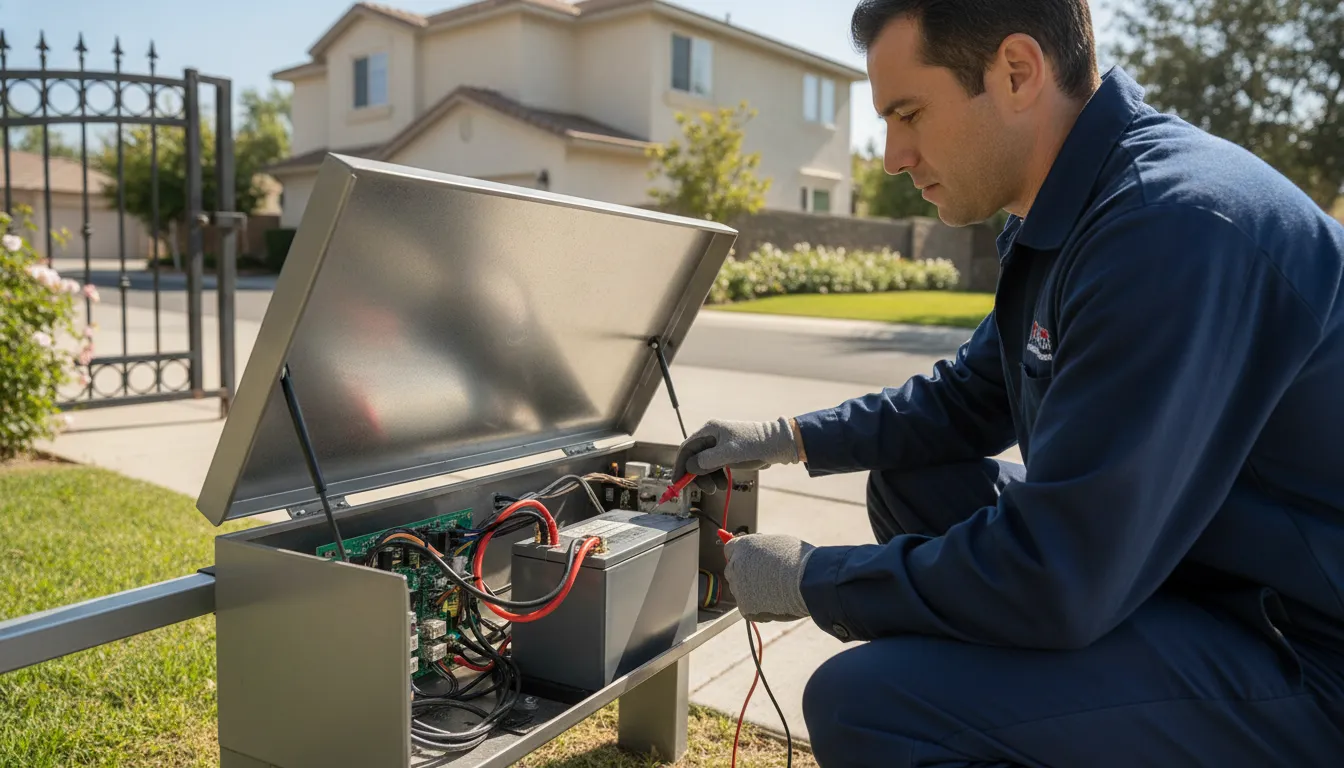
A backup battery should be tested before an outage exposes a weak connection or exhausted cell. Manufacturers commonly suggest checking the system every few months, but your opener manual should take priority if it gives a different interval. Regular testing helps confirm that the battery holds a charge and can operate the gate when utility power is unavailable, an approach consistent with Ready.gov's power outage guidance.
- Tell everyone involved and clear the gate area. Let household members, staff, or visitors know that you are testing the opener. Keep people, vehicles, pets, and loose items away from the gate's travel path. Check that the gate can move freely and that no one needs to pass through while the test is underway. Do not bypass safety sensors, interlocks, or other protective devices.
- Confirm normal operation first. With utility power still on, open and close the gate using its normal control. Listen for unusual sounds and watch for hesitation, scraping, or uneven travel. If the opener already struggles on AC power, stop there and arrange service rather than treating the battery test as a diagnosis.
- Safely disconnect AC power to the opener. Follow the manufacturer's instructions to switch off the dedicated disconnect or unplug the operator when that method is approved. Do not open energized electrical compartments or handle exposed wiring. If you cannot identify the correct disconnect, have a qualified technician perform this step.
- Cycle the gate manually through its controls. Use the remote, keypad, or other normal access control to open and close the gate several times on battery power. Keep the cycles controlled and remain ready to stop the gate if movement becomes erratic. A healthy system should respond consistently without requiring repeated commands.
- Watch and listen for weak performance. Note slow movement, shortened travel, stalling, grinding, or a motor that sounds strained. One unusual cycle may reflect an obstruction, but repeated weakness while AC power is off points toward a discharged battery, poor connection, charging issue, or another opener fault. Do not continue cycling if the gate becomes unsafe.
- Check the low-battery indicator or alarm. Inspect the operator's status light, display, or audible warning according to the manual. A low-battery alert during a brief, controlled test deserves attention, especially if the battery was recently charged. Record what you observe so a technician can compare it with the opener's specifications.
- Restore power and verify charging. Reconnect AC power using the approved procedure. Confirm that the opener returns to normal operation and that its charging indicator shows the battery is being maintained. Modern control systems often monitor battery level and engage a charging circuit to maintain capacity. But a visible charging response does not replace a service check when performance remains weak. For properties that depend on reliable access control systems, arrange professional testing if any step fails.
Keep a simple record of the test date, observed symptoms, and indicator status. That history makes gradual battery deterioration easier to spot and helps keep automatic access dependable between scheduled electric gate system maintenance visits.
What Are the Signs Your Backup Battery Needs Replacing?

A backup battery can seem fine until the gate has to operate without its normal electrical supply. Because battery performance declines gradually, small changes in movement or runtime are worth noticing. Testing the system periodically, including during a planned outage simulation. Helps identify a weak battery before it leaves the gate stuck in place or interrupts the convenience of automatic access.
The gate moves slowly on battery power
One of the clearest warning signs is sluggish movement when the opener is running on battery alone. The gate may open or close more slowly than usual, hesitate during travel, or sound as though the motor is working harder. Compare the gate's battery-powered operation with its normal movement, rather than judging it only by whether it completes one cycle. A battery that can still move the gate once may not have enough capacity for dependable repeated use.
The gate fails during a test outage
Cutting power briefly and operating the gate is a practical way to check the backup. If the opener does not respond, stops partway through a cycle, or cannot complete the movement, the battery may no longer be holding a usable charge. The problem can also involve the charger, wiring, or control board. So a failed test should be diagnosed rather than treated as proof that the battery is the only faulty component. Restore normal power after testing and follow the operator manufacturer's instructions.
A low-battery alert stays on
A persistent low-battery light, display message, or audible alert deserves attention. An occasional alert after extended use may clear while the battery recharges. If the warning remains after the system has had time to charge, the battery may be aged, discharged, or unable to accept a full charge. Do not silence the alert and assume the backup is ready for the next outage.
Runtime has become noticeably shorter
Keep track of how the gate performs during battery operation. A backup that once handled several normal openings and closings but now runs down quickly is losing capacity. Frequent cycles, heavy gate movement, charging problems, and age can all contribute. The exact runtime depends on the opener and installation, so a technician should evaluate the system rather than relying on a generic cycle count.
The battery is several years old
Most opener batteries have a service life measured in a few years, not indefinitely. If yours is several years old, replacement may be sensible even when no dramatic symptom has appeared. Age, heat, charging conditions, and use all affect performance. For a practical routine, see our electric gate maintenance tips. Have a qualified professional check the battery, charger, connections, and opener compatibility, then replace the battery with the correct type and rating when needed. That simple maintenance keeps automatic access convenient when normal power is unavailable. A technician through electric gate system repair can confirm the right replacement.
Can You Add a Battery Backup to an Existing Gate Opener?
In many cases, yes. A modern automatic gate opener can often be fitted with a retrofit battery backup kit instead of being replaced entirely. The kit connects to the operator's control board and supplies power when the electrical service is interrupted, allowing the gate to continue opening and closing during an outage.
That answer is not universal, however. Compatibility depends on the opener model, the system's operating voltage, the battery type and capacity it supports, and the design of the control board. Some operators are built for a dedicated backup module. Others may need a compatible external battery enclosure, a replacement control board, or a broader operator upgrade. The gate's size, weight, travel distance, and daily use also affect whether the selected backup can perform reliably.
What should you check before buying a retrofit kit?
Start with the operator's exact model and revision, not just the brand name. Two openers from the same manufacturer may use different voltage requirements or connection points. A technician can verify the control board terminals, charging circuit, battery compartment, and available space before recommending a kit. This prevents a common mistake: buying a battery that physically fits but does not match the operator's electrical requirements.
Modern gate operator systems frequently include a built-in battery charging circuit. The control system monitors the battery and engages the charging circuit to keep the backup ready for use. According to the National Institute for Occupational Safety and Health Science Board record on safety standards for gates and enclosures. That does not make every battery interchangeable. The charger still needs to match the battery chemistry, voltage, and capacity specified for the operator. Review the referenced gate and enclosure safety standard record for the technical context.
A professional assessment is especially useful for older operators, gates that move slowly, systems with recurring electrical faults, or properties that depend on automatic access throughout the day. The technician can test the operator under normal conditions, confirm that the manual release works, and verify that the backup takes over when utility power is removed. They can also identify a weak battery or failing control board before it leaves the gate stuck during an outage.
When is an upgrade a better choice?
A retrofit is not always the best long-term answer. If the existing opener has worn gears, an unreliable control board, damaged wiring. Or a motor that struggles with the gate, adding a battery may only preserve an underlying problem. Battery power cannot compensate for excessive friction, poor alignment, or a mechanical issue that already makes the operator work harder than it should.
The installation should also account for the location of the operator and battery. Outdoor equipment needs protection from moisture, heat, and accidental damage, while the wiring must be routed and secured correctly. A qualified technician can confirm that the backup remains accessible for future testing and replacement without interfering with the gate's normal movement.
For a home or property in Los Angeles or Orange County, the right solution may be a straightforward retrofit, a battery replacement, or a gate automation upgrade. The goal is dependable convenience: press the remote and keep moving, even when the grid is temporarily down.
Contact Intele Gates about gate opener battery backup
Frequently Asked Questions
How long does a gate opener battery backup last during a power outage?
Runtime depends on battery capacity, gate size, opener condition, temperature, and how often the gate is cycled. A properly matched system can provide useful standby time and multiple open-and-close cycles, but the exact result varies by installation. An inspection can confirm what your current battery should deliver.
Do I need a battery backup for my automatic gate opener?
A backup is a practical choice if you need the gate to keep operating when utility power fails. It helps maintain normal entry and exit instead of leaving the gate dependent on power restoration or manual release. It is especially useful for homes, properties, and businesses where reliable automatic access matters.
How do I know if my gate opener battery needs to be replaced?
Watch for slow gate movement, a low-battery warning, reduced cycle capacity, or failure when the opener runs on battery power alone. A battery that no longer holds a charge may also cause intermittent operation. Have the battery and charging circuit tested together before replacing either component.
Can I install a battery backup on an existing gate opener?
Many modern operators can accept an external backup kit, but compatibility depends on the opener model, voltage, control board, battery compartment, and charging system. The correct upgrade may be a matched battery, retrofit kit, or operator replacement. Verify the model before ordering parts.
How often should I test my gate opener battery backup?
Test it periodically by disconnecting utility power and confirming that the gate opens and closes normally on battery power, then restore power and verify charging. Regular testing helps identify a weak battery before an outage. Ready.gov recommends periodically testing backup power systems so they work when needed.
Contact us to keep your gate working through outages
A properly matched battery backup helps keep your automatic gate dependable when the power is out, and regular testing confirms it stays ready when needed. Intele Gates can assess your operator and handle battery backup installation, testing, or replacement for properties throughout Los Angeles and Orange County. If you want a practical recommendation for your system, contact the team to get started.