
InteleGates Guide
How Gate Loop Detectors Work: The Coil Under Your Driveway
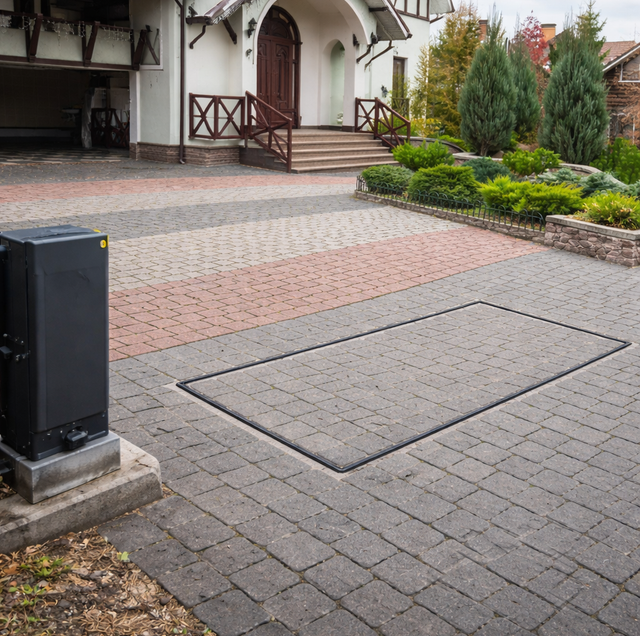
Quick Answer: A loop detector is a coil of wire cut into the driveway that senses a vehicle by the change in the coil's inductance when a large metal mass passes over it. The buried loop connects to a detector module, which watches for that change and signals the gate operator that a car is present. Loops detect vehicles only. Separate photo-eyes and safety edges are what protect people and pets.
Your automatic gate opens the moment your car rolls up to it, and it holds open until you have cleared the opening. It never asks you to press a button on the way out, and it never tries to close on the hood of your car. That behavior does not come from a camera watching the driveway. It comes from a coil of wire buried a few inches under the pavement, quietly sensing the metal mass of your vehicle. That coil is a loop detector, and it is one of the most reliable pieces of the whole access system.
The Inductive Sensing Principle
Everything a loop detector does rests on one idea from basic electronics: a coil of wire carrying a current builds a magnetic field, and that field resists sudden change. The measure of that resistance is called inductance. The detector module feeds a small alternating current through the buried loop, which makes the loop oscillate at a set frequency, tens of thousands of cycles per second.
A car is a large mass of steel and iron. When it rolls over the loop, the metal interacts with the loop's magnetic field and lowers the loop's inductance. Lower inductance shifts the oscillation frequency upward. The detector module is built to watch for exactly that shift. When the frequency climbs past a threshold, the module concludes that a vehicle is sitting over the loop and closes a relay, sending a signal to the gate operator. When the car pulls away, the inductance returns to its resting value, the frequency drops back, and the relay releases.
The loop does not care about color, shape, weight, or heat. It responds to the electrical effect of conductive metal. That is why a person walking across the loop does not trigger it, and neither does a plastic trash can, a leaf pile, or a dog. There is not enough conductive mass to move the frequency. A loop is a vehicle sensor in the truest sense, and that specificity is both its strength and its limit.
The Three Jobs A Loop Does At A Gate
A single gate can have several loops, each cut into a different spot and wired to its own detector channel. Each placement gives the loop a distinct job.
The exit loop, also called a free-exit loop, sits on the inside of the property, behind the gate. Its job is to open the gate automatically for a car that wants to leave. You do not need a remote or a code to get out; you simply drive up, the loop senses the car, and the operator swings or slides the gate open. This is the loop that makes a gated driveway feel effortless on the way out.
The safety loop, also called a reversing loop, sits directly under the path the gate travels. Its only job is to make sure the gate never closes on a vehicle. If a car is stopped over this loop while the gate is trying to close, the detector holds the gate open, and if the gate is already moving, it stops or reverses. A long delivery truck that straddles the opening for a moment is exactly the case this loop is built for.
The shadow loop, sometimes called a close loop, sits close to the gate on the entry side and works with the safety loop to close the gate promptly once a vehicle has fully passed. It keeps the gate from sitting open longer than it should after a car clears the threshold, which tightens control without risking a strike on the vehicle. On a busy commercial driveway, a well-tuned shadow loop is what keeps the opening from lingering wide after every pass.
How The Loop, Detector, And Operator Work Together
The buried loop is only the sensor. On its own, it does nothing. Three parts have to talk to each other for the system to behave.
The loop is the wire itself, typically several turns of stranded wire laid into a saw-cut groove in the pavement and sealed with a flexible loop sealant. The number of turns and the size of the loop are chosen for the job; a wider driveway or a high vehicle like a truck may call for a different geometry than a compact residential loop.
The detector module is a small unit mounted inside the gate operator's control enclosure. It energizes the loop, reads the frequency, and decides when a vehicle is present. It has sensitivity settings and often a frequency setting so that two loops sitting near each other do not interfere. When it senses a car, it closes a relay contact.
The operator is the gate's motor and control board. It watches the detector's relay the same way it watches a keypad or a remote. A closed contact on the exit-loop input tells it to open; a closed contact on the safety-loop input tells it to hold or reverse. The operator does not know or care that the signal came from a buried coil. It only sees a contact open or close, which is why loop detection integrates cleanly with almost any commercial or residential operator.
Why Loops Beat Other Sensors For Vehicles
For sensing a car specifically, an inductive loop has advantages that surface-mounted sensors struggle to match. It sits below the pavement, so nothing can knock it out of alignment, splash it, or block its view. It does not rely on line of sight, so fog, rain, glare, and darkness do not degrade it the way they can degrade an optical sensor. It ignores small objects and living things, which means blowing debris and passing pedestrians do not cause false triggers. And because it responds only to a real vehicle-sized mass, it holds the gate reliably for a long truck without needing the driver to do anything.
That same selectivity is the reason a loop must never be treated as a safety device for people. A loop cannot sense a child standing in the gate's path, a pet crossing the opening, or a person on foot, because none of them move the loop's frequency enough to register. Protecting people and pets from a closing gate is the job of photo-eyes and safety edges, which are the required non-contact and contact safety devices. A gate that relies on a loop alone to know when to close is a crushing hazard. Loops handle vehicle presence; photo-eyes and edges handle human and animal safety, and both belong on the same gate.
A loop cannot sense a child standing in the gate's path, a pet crossing the opening, or a person on foot, because none of them move the loop's frequency enough to register. A gate that relies on a loop alone to know when to close is a crushing hazard. Protecting people and pets from a closing gate is the job of photo-eyes and safety edges.
Common Loop Problems And What Causes Them
Because the loop lives in the pavement, most of its failures trace back to the harsh place it sits.
A cut or broken loop is the most common failure. The wire is embedded in the driveway, so any movement of the pavement can sever it. A crack that opens through the saw cut, a slab that heaves or settles, tree-root pressure, or heavy equipment rolling over a weak spot can all break the loop. Once the wire is open, the detector reports a fault, and the loop stops working entirely.
Water intrusion happens when the sealant over the saw cut cracks or was never fully filled. Moisture reaching the wire can shift the loop's electrical behavior and cause erratic detection, where the gate triggers at random or fails to hold when it should.
A failing detector module can mimic a bad loop. Age, a power surge, or heat inside the control enclosure can leave the module unable to read the loop correctly, so the symptoms look the same even though the buried wire is fine. Swapping in a known-good module is how a technician tells the two apart.
Sensitivity set wrong is a setup problem rather than a break. Set too low, the detector may miss a small car or a high-clearance vehicle whose metal sits far from the loop. Set too high, it may hold on a passing bicycle frame or chatter from a nearby loop. Correct sensitivity is a balance found during commissioning and worth rechecking after any related repair.
A loop system is low-maintenance by design, but it is not maintenance-free. For a quick functional test, drive a vehicle onto each loop and confirm the gate behaves correctly. The exit loop should open the gate, and the safety loop should keep the gate from closing while the vehicle sits over it. Most detector modules have an indicator light that comes on when the loop senses a vehicle.
Physical inspection of the driveway matters too. Cracks forming along the saw-cut lines, sealant that has crumbled or pulled away, and standing water over a loop are all early signs worth addressing before the wire fails outright. Inside the enclosure, the detector should be seated firmly with clean connections, and its sensitivity and frequency settings should match what the installation called for.
Because loop repair means cutting into pavement and re-terminating wire at a live operator, and because the loop shares an enclosure with the safety wiring that protects people in the gate path, loop work and operator wiring belong with a trained gate technician. InteleGates diagnoses the detector, loop, controller, and safety inputs together so the repair addresses the actual fault.
Frequently Asked Questions
Can one detector module run more than one loop?
Some detector modules are dual-channel, meaning a single unit reads two separate loops on independent circuits, such as an exit loop and a safety loop. Each channel has its own sensitivity setting and its own relay output. Where two loops sit close together, technicians also set each channel to a different frequency so the coils do not cross-talk and cause phantom detections.
Does a motorcycle or small trailer reliably trip a loop?
It depends on the metal mass and how the loop is tuned. A motorcycle has far less steel than a car, so a loop set for average vehicles can miss one, especially if the bike stops off-center. Installers sometimes use a tighter loop pattern, such as a diagonal or quadrupole layout, in motorcycle-heavy driveways to raise sensitivity to small vehicles without causing false trips.
Will a loop detector work if the power goes out?
No. The detector energizes the loop from the operator's power supply, so during an outage the loop is dead and cannot sense anything. This is one reason a battery backup or a manual release is important on an access gate, since the free-exit loop that normally lets you drive out will not respond until power returns.
How deep is the loop wire buried?
The wire is not buried in soil; it is set into a saw-cut groove roughly a quarter to a half inch wide and typically one to two inches deep in the existing pavement, then sealed flush. That shallow placement keeps the coil close enough to the vehicle's underside to sense it while protecting the wire from surface traffic and weather.
Why does my gate sometimes close too soon behind me?
That usually points to the shadow or close loop, or to the timer settings working with it. If the close loop drops the vehicle signal a beat early, or the auto-close timer is set aggressively, the gate can begin moving sooner than expected. Adjusting the close-loop sensitivity or the timer, not disabling the safety loop, is the correct fix.
Can tree roots or nearby metal cause false readings?
Roots themselves are not conductive enough to trigger a loop, but the pavement damage they cause can crack the loop wire and produce faults. Large fixed metal near the loop, such as a steel plate, rebar-heavy concrete, or a metal grate, can also shift a loop's baseline, which is why installers test the resting frequency before setting sensitivity.
Have a gate that misses your car or closes too soon? Book a loop and detector diagnosis with technicians who know access systems inside out. InteleGates Inc. serves Los Angeles, Long Beach, and Orange County. Call (833) 468-4283.