
How Often Should an Automatic Gate Be Serviced? A Real Schedule
Quick Answer: Most residential automatic gates should be serviced about twice a year. High-traffic gates at apartments, offices, and industrial yards often need service every three to four months, and some busy commercial installs monthly. The real driver is cycle count, not the calendar: a gate that opens and closes 200 times a day wears its rollers, chain or belt, and operator far faster than a home gate that cycles a dozen times. A service visit covers lubrication, roller, track, and hinge inspection, chain or belt tension, battery backup, safety-sensor and reversing tests, limit settings, and hardware torque. Book service sooner if you hear grinding, see slow or hesitant travel, or the gate works only intermittently.
An automatic gate looks like a fixed part of the property, but it is really a machine that runs a full mechanical cycle every time it opens and closes. A motor turns, a chain or belt pulls, rollers ride a track or hinges swing a leaf, and a small computer inside the operator counts limits and watches for obstructions. Every one of those parts is wearing a little on each pass. Left alone, that wear does not announce itself politely. It shows up as a gate stuck open at the worst possible moment, or a safety sensor that has quietly stopped protecting the people walking through.
The real answer to how often a gate needs service is that it depends on how hard the gate works, but the ranges are predictable and worth planning around.
Why an Automatic Gate Needs Routine Service at All
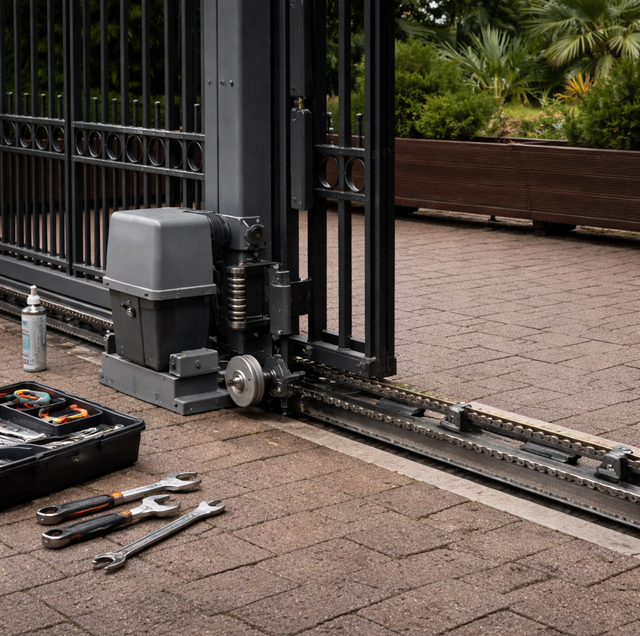
A gate operator is a high-cycle machine in the same family as a commercial garage door opener, and it deserves the same respect. Consider the parts that carry the load. On a sliding gate, steel or nylon rollers ride a track, and every grain of grit that lands on that track becomes an abrasive under a wheel that may weigh several hundred pounds of gate. On a swing gate, hinges and pivot bearings take the full cantilevered weight of the leaf, so any play there multiplies into sag at the latch end. Between the motor and the moving gate sits a drive chain, a belt, or a rack-and-pinion set, and all three stretch, loosen, or wear teeth over thousands of cycles.
Then there is the operator itself: a gearbox, a motor, a control board, limit switches that tell the gate where to stop, and usually a battery backup so the gate still works during a power interruption. Around the opening live the safety devices, photo-eyes that see a person or car in the path and reversing edges that feel contact and back off. None of this is set-and-forget hardware. Lubricant migrates and dries out, fasteners loosen under vibration, batteries lose capacity, and sensor alignment drifts a few degrees until the beam misses its target. Routine service is how each of those slow failures gets caught while it is still a five-minute adjustment instead of a callout.
Temperature swings push on the same parts from both directions across the year. Heat thins grease and can let it run off a chain, while cold thickens it and stiffens the same hinge, and the daily expansion and contraction of a long metal gate works fasteners loose regardless of the month. A gate that is checked on a schedule rides through those swings without complaint.
How Usage Volume Sets the Interval
The single biggest factor in how often a gate needs service is not its age or its brand; it is the number of cycles it runs. One open-and-close is one cycle, and manufacturers rate operators in cycles because that is what actually consumes the machine.
A home gate that opens for the family a dozen or so times a day lives a gentle life. A gate at a busy apartment complex might run 200 to 400 cycles a day, and a gate on an industrial yard or a paid lot can run more. The math adds up quickly: at 300 cycles a day, a commercial gate passes 100,000 cycles in under a year, a number a residential gate might take a decade to reach. The parts do not know what year it is; they know how many times they have moved, so the maintenance interval has to track cycles rather than the calendar.
That is why the same piece of hardware carries very different schedules depending on where it lives. It also explains why counting matters. Many modern operators keep a running cycle count on the control board, and reading it is one of the quiet, useful things a service visit does, because it turns a guess about wear into a measurement.
A workable cadence by traffic level
- Residential gate, light use: roughly twice a year, spaced about six months apart.
- Busy residential or small multi-unit: about every four months.
- Commercial, apartment, or gated-community entrances: every three to four months as a baseline, moving toward monthly as daily cycle counts climb.
- Heavy industrial or high-volume paid access: monthly checks, with lubrication and safety tests never stretched past that.
What a Real Service Visit Covers
A service visit worth the name is a checklist, not a squirt of oil and a wave. A complete visit runs through the whole machine in a set order.
Lubrication: Chains, rollers, hinges, and pivot points get cleaned of old grease and grit and re-lubricated with the right product for each, since a chain wants a different lubricant than a sealed bearing.
Rollers, track, and hinges: Rollers are checked for flat spots and play, the track is cleared and inspected for bends, and swing-gate hinges and bearings are checked for wear that would let the leaf sag.
Chain or belt tension: A drive chain or belt is set to the correct tension, because a loose one snatches and jerks while an over-tight one grinds bearings.
Battery backup: The backup battery is load-tested, not just eyeballed, because a battery can read a normal voltage at rest and still collapse under the current the motor draws.
Safety sensors and reversing test: Photo-eyes are cleaned and re-aligned, and the reversing function is deliberately triggered to confirm the gate stops and backs off when something enters the path.
Limit settings: The open and close limits are verified so the gate stops in the right spot without slamming or straining against its stops.
Hardware torque: Bolts on the operator mount, the gate frame, and the drive hardware are checked and brought back to spec, since vibration walks fasteners loose over time.
Cycle Count, the Number Behind the Schedule
If service intervals feel arbitrary, cycle count is the number that makes them concrete. Because operators are engineered and rated in cycles, the wear on the drive train is close to proportional to how many times the gate has run. A technician who reads the board's cycle counter, or estimates it from traffic, can tell whether a gate is cruising or coming due for heavier attention, and can flag a chain or roller for replacement before it strands the gate. Tracking that number across visits turns maintenance from a hopeful calendar habit into something closer to reading a fuel gauge.
Signs a Service Is Overdue
A gate on a schedule rarely surprises anyone, but a gate that has been left alone tends to signal trouble before it quits outright. Grinding, scraping, or a new squeal usually means dry or worn rollers, hinges, or chain, and the noise is the sound of metal removing metal. Slow, hesitant, or uneven travel, where the gate lugs or pauses partway, points to friction, a tired motor, or a stretched drive component. Intermittent operation, where the gate works sometimes and ignores the remote or keypad at other times, often traces to a fading battery, a loose connection, or a sensor drifting in and out of alignment. A gate that has started reversing for no visible obstruction is telling you a safety device needs attention, not that it should be bypassed. Any of these means the next service is already late.
Why the Safety Tests Matter Most of All
Everything else on the checklist protects the gate. The safety tests protect people. An automatic gate is a heavy, powered machine that closes on an opening people and cars pass through, which is exactly why photo-eyes and reversing edges exist, to stop or reverse the gate before it contacts a person, a pet, or a vehicle. Those devices drift out of alignment, collect dirt on their lenses, and occasionally fail, and unlike a worn roller, they give no daily hint that they have stopped working. That is what makes the periodic reversing test the most important thing a service visit does.
It is also the clearest line between owner upkeep and professional work. A homeowner can safely keep the track swept clear of leaves and gravel, wipe a photo-eye lens, and watch and listen for the warning signs above.
Adjusting the operator, tensioning or replacing a drive chain, working on spring hardware or high-voltage wiring, and setting the safety limits are professional tasks, because the forces and voltages involved are seriously hazardous. A safety sensor is never disabled to make a nuisance stop go away. One rule holds no matter who is doing the work: a safety sensor is never disabled to make a nuisance stop go away. If a sensor keeps tripping, the fix is to find why, not to switch it off.
Frequently Asked Questions
You can help, within limits. Keeping the track and the area around the rollers swept clear of leaves, gravel, and dirt really does extend roller and track life, and it is safe to do with the gate powered down. Using the wrong lubricant, though, can backfire: heavy grease on an exposed slide track can collect grit and turn into a grinding paste, so many techs prefer a dry-film or light chain lubricant there. Anything involving the operator housing, the drive chain tension, spring hardware, or wiring should wait for a technician.
The mechanical side follows the same cycle-based schedule, but a solar operator adds two items. The panel needs its surface kept clean, since a film of dust can cut charging enough to leave the gate short of power by evening, and the charge-control battery bank works harder than a mains-fed backup because it is the sole power source, not an emergency reserve. Those batteries are typically checked and replaced on a tighter interval than the backup battery on a plug-in operator.
A quality operator that is serviced on schedule commonly runs well beyond a decade, and the motor and gearbox are usually not the first thing to go. The wear items, rollers, chains or belts, hinges, and the backup battery are consumables that get replaced along the way, and a battery in particular often needs swapping every three to five years regardless of how the rest of the gate is doing. Maintenance mostly protects the expensive core by retiring the cheap parts on time.
For a high-cycle commercial or multi-unit gate, a scheduled contract usually costs less over time than reactive repairs, because most catastrophic failures start as a small problem that a routine visit would have caught. A stretched chain replaced on a visit is minor; the same chain snapping mid-cycle can bend the gate frame and strand vehicles. Contracts also keep the safety tests on a fixed rhythm rather than leaving them to whenever someone remembers.
Watch one full open-and-close and use your senses. The travel should be smooth and even end to end, with no lugging, pausing, or change in speed partway. The sound should be a steady hum, not grinding, scraping, or a rhythmic clunk that repeats each cycle. Then wave a foot or a broom handle through the photo-eye path as the gate closes, from a safe distance, and confirm it reverses. A gate that fails any one of those three should be looked at.
Many operator manufacturers tie their warranty coverage to evidence of routine maintenance, so a failed board or gearbox can be denied if there is no service history behind it. Beyond the warranty, an unmaintained gate that injures someone because a safety sensor was dirty or misaligned becomes a liability question, which is a strong reason for commercial owners to keep dated service records. Keeping the paperwork is as much a part of maintenance as the wrench work.
Book a gate service check before a small wear item becomes a stranded gate — keep your entrance running safely and on schedule. InteleGates Inc. serves Los Angeles, Long Beach, and Anaheim. Call (833) 468-4283.
