
InteleGates Guide
How to Size a Gate Operator for an Existing Gate
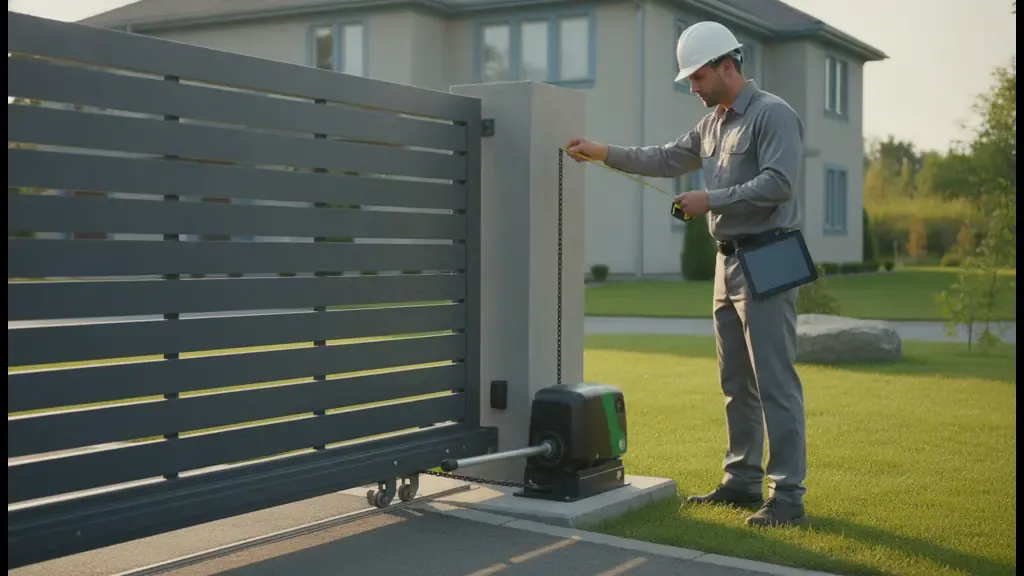
Choosing an operator for an existing gate is not a matter of matching one number on a product label. The right selection depends on how the gate moves, how much load the operator must move, how often the system cycles, and whether the gate and its hardware are in suitable condition. A professional gate automation assessment brings those factors together before an installation or replacement is recommended.
Ask InteleGates to assess your existing gate and recommend the right operator
What does gate operator sizing mean?
Gate operator sizing is the process of matching an operator's application, capacity, duty rating, and control features to the existing gate system. The operator must move the gate consistently without being overloaded, while the gate must remain aligned, supported, and protected by the required safety devices.
For an existing gate, the assessment starts with the complete system rather than the motor alone. A technician considers the gate type, clear opening, construction, approximate weight, travel path, hinges or rollers, track, slope, wind exposure, power supply, traffic pattern, and access-control equipment. The objective is a compatible system that operates reliably under the property's real conditions.
That is why a larger-looking motor is not automatically the correct answer. If a sliding gate binds on its track, or a swing gate has worn hinges, the added resistance can make an otherwise suitable operator perform poorly. InteleGates follows the diagnostic principle: we diagnose the problem before recommending replacement.
The main factors that determine operator size
| Factor | What a technician checks | Why it matters |
|---|---|---|
| Gate movement | Sliding, single swing, dual swing, barrier arm, or vertical lift movement | Each movement requires a different operator arrangement and installation approach. |
| Load and dimensions | Gate length, approximate weight, height, materials, and balance | The operator must have suitable capacity for the real moving load, not only the visible size. |
| Mechanical condition | Track, rollers, hinges, wheels, guides, stops, and alignment | Friction, binding, or sag can increase the force required to move the gate. |
| Use pattern | Residential, shared residential, commercial, or industrial cycles | The duty rating must match how often the gate opens and closes during busy periods. |
| Site conditions | Slope, wind exposure, drainage, clearances, and available power | Environmental and site conditions can change the load and installation requirements. |
| Controls and safety | Remotes, keypads, intercoms, loops, photo-eyes, edges, and emergency release | The operator must work with the complete access and safety system. |
Gate type and direction of travel
A sliding gate travels along a track or another supported path. The operator must be compatible with the gate's drive arrangement and have a stable mounting location. A swing gate rotates on hinges, so the operator must suit a single or dual leaf, the hinge geometry, the available mounting points, and the gate's travel arc. Barrier arms and vertical lift gates have different movement patterns again.
The gate type determines more than the operator body. It affects the drive connection, clearances, safety zones, release method, and how access controls communicate with the operator. A technician should identify the movement before comparing models. If the gate's current movement is unusual or the opening is restricted, the assessment may also identify a better way to arrange the automation without replacing the existing gate itself.
Gate length, height, and approximate weight
Gate length and height help establish the scale of the installation, while weight and balance affect the moving load. A wide gate with open infill may place different demands on an operator than a smaller gate with dense material. For sliding systems, the full moving assembly matters, including the frame, infill, wheels, and any hardware carried by the gate.
Weight should not be guessed from appearance. A technician can assess the construction and use the manufacturer's capacity information for the proposed operator. For a swing gate, the leaf dimensions and hinge position also affect the force needed at the operator connection. A dual swing system may require two coordinated operators and a control board designed for that arrangement.
Manufacturer capacity is a starting point, not permission to ignore the gate. The operator must have a suitable capacity margin for the application, and the completed system must still move smoothly through its full travel. This is one reason a site assessment is more dependable than choosing a replacement by the old motor's label.
Track, rollers, hinges, and alignment
Mechanical condition is central to sizing an operator for an existing gate. A sliding gate should travel smoothly along its track without dragging, lifting, or stopping at one location. The technician checks the rollers, guides, end stops, mounting surface, and operator connection. Debris, damaged wheels, a distorted track, or a gate that has shifted out of alignment can make the operator appear undersized.
A swing gate requires a comparable review of hinges, posts, stops, leaf alignment, and the space around the opening. Sagging or binding changes the force required during the swing. If the gate is not mechanically ready, the correct service decision may involve repair or adjustment before a new operator is selected. Installing a larger operator to overcome a mechanical problem can transfer stress to other parts of the system.
How duty cycle changes the selection
Duty cycle describes how much use an operator is expected to handle over time. A private residence with a small number of evenly distributed openings has a different use pattern from a multi-unit property, office, parking facility, or loading area. The number of vehicles, peak arrival periods, entry and exit controls, and expected operating schedule all matter.
Ask how the gate is actually used, not just whether it is described as residential or commercial. A residential property with several households may have concentrated traffic in the morning and evening. A commercial gate may cycle repeatedly during a shift. A system that is suitable for light use may not be appropriate for frequent cycles, even if the gate itself is not especially heavy.
Duty-cycle selection also affects the control equipment, cooling requirements, battery-backup expectations, and maintenance plan. A professional installer can compare the use pattern with the manufacturer's application and duty information, then recommend an operator category that fits the site.
Why slope and wind exposure matter
Slope can add resistance to a sliding gate's travel and change the force required throughout the opening. The effect is not always obvious from a quick look at the driveway. A technician checks the gate path and how the gate behaves across the full travel, including whether it rolls or settles when released under controlled conditions.
Wind exposure is especially important for a tall or enclosed gate. A gate with solid infill presents a different wind load from an open design. Coastal exposure, a long driveway, nearby structures, and the direction of prevailing wind can all affect the operating environment. For swing gates, wind can influence the movement of the leaf and the holding forces at the operator. The operator and safety system must be selected for the actual opening, not an idealized version of it.
These conditions also influence the mounting surface and long-term alignment. If a gate shifts, flexes, or meets resistance at one point, the operator may need more than a capacity adjustment. The underlying gate and supporting hardware may need service first.
What access-control and safety equipment must be included?
Operator sizing is only one part of a complete automated gate system. The operator must be compatible with the way authorized users will open the gate and with the devices that protect people and vehicles around the moving gate. Common controls include remote controls, keypads, telephone entry, intercoms, key cards, RFID entry, and vehicle detection loops. A property may use one control or several coordinated systems.
Safety planning should be part of the assessment from the beginning. The UL overview of gate operators explains that vehicular gate operators are evaluated for applications such as sliding gates, swing gates, and barrier arms, with requirements related to entrapment protection. The ASTM F2200 specification for automated vehicular gate construction addresses multiple gate types and application classes, and notes the relationship between automated gate construction and UL 325.
In practical terms, the installer should evaluate photo-eyes, reversing edges, loops, warning devices, physical clearances, emergency release, and the gate's travel zones. The exact devices depend on the gate type, layout, operator, and applicable requirements. Safety devices are not optional add-ons to solve an undersized operator. They are part of a system that needs to be planned and tested together.
For properties adding a keypad, intercom, telephone entry system, or other access method, review the access control system service options at the same time as the operator. A property that uses vehicle detection may also need an underground loop sensor assessment so the entry sequence works with the operator. This prevents a motor replacement from leaving the property with incompatible or incomplete entry controls.
Schedule a professional operator assessment and installation plan for your existing gate
How a professional assessment works
A useful assessment documents the gate as a working system. The technician typically reviews the following areas:
- Movement and layout: Identify the gate type, direction of travel, opening width, clearances, stops, and mounting locations.
- Gate construction: Review the frame, infill, height, length, approximate weight, balance, and any signs of flexing or damage.
- Mechanical resistance: Check track, wheels, rollers, hinges, guides, posts, and alignment across the complete travel.
- Use pattern: Discuss daily activity, peak traffic, user groups, access schedules, and whether the property needs light or higher-cycle operation.
- Site conditions: Note slope, wind exposure, drainage, weather exposure, available electrical service, and conduit or wiring conditions.
- Controls and safety: Review existing remotes, keypads, intercoms, loops, sensors, edges, warning devices, and emergency release requirements.
- Operator compatibility: Compare the findings with manufacturer instructions and the proposed operator's application and duty information.
The result should be a clear recommendation, not simply a model number. It may be appropriate to repair the existing gate hardware, replace the operator, improve the control system, or address more than one issue before final testing. InteleGates installs on existing gates and focuses on the operator, automation, and access-control systems rather than gate fabrication.
Signs the current operator may be mismatched
Several symptoms can point to a sizing or compatibility problem, although they can also come from wear, alignment, wiring, or control faults. Call for an assessment when the gate moves slowly, stops before the normal position, strains at one part of its travel, overheats during repeated use, reverses unexpectedly, or works inconsistently after changes to the gate.
Repeated trips, unusual noise, a need to assist the gate by hand, or failure during busy periods are also useful details to report. Do not keep cycling a gate that is binding, shaking, or failing to stop correctly. Continuing to operate a malfunctioning system can worsen the underlying problem and create an unsafe condition.
InteleGates can diagnose the system before recommending replacement. If repair is the better path, the team can address operator components, track or chain issues, sensors, controls, and related electrical problems. See the electric gate system repair service for examples of issues that can affect operator performance. If replacement is appropriate, the recommendation should account for the gate's actual movement and use rather than assume the previous operator was correctly selected.
What property owners should prepare for the assessment
Property owners can make the visit more useful by noting what changed before the problem appeared. Record when the issue occurs, whether it affects opening or closing, whether all remotes or access devices behave the same way, and whether the problem is worse during high traffic or windy conditions.
If available, gather the current operator's model information, service history, remote-control details, and any records showing previous gate repairs. Do not remove covers, bypass sensors, adjust force settings, alter wiring, or attempt to reprogram the operator. These systems contain moving parts and electrical components, and an incorrect adjustment can hide the real fault.
A professional can use the information to focus the inspection while still testing the gate and operator as a complete system. For ongoing reliability after the selection is complete, InteleGates recommends professional gate-system maintenance at least every six months. The electric gate maintenance service can be matched to the gate's use and site conditions.
Get a professional recommendation for the right gate operator for your existing gate
Frequently Asked Questions
Can I size a gate operator using the gate's weight alone?
No. Weight is important, but it does not describe the full application. Gate movement, dimensions, balance, slope, wind exposure, mechanical resistance, duty cycle, access controls, and safety equipment also affect the recommendation.
Does a heavier operator solve a gate that drags?
Not necessarily. Dragging may indicate a damaged track, worn rollers, poor alignment, sagging, hinge resistance, or another mechanical issue. A technician should diagnose the cause before selecting a larger operator.
Does an existing gate need to be replaced before automation?
Not always. Many existing gates can be assessed for automation, but the gate and its hardware must be suitable for the intended movement and operating load. InteleGates installs on existing gates and can explain whether service, adjustment, or operator replacement is appropriate.
How does gate use affect operator selection?
A gate that opens occasionally for one residence has a different duty requirement from a shared entrance with concentrated traffic or a commercial property with repeated cycles. The real use pattern should be compared with the operator's application and duty information.
What information should I give a gate automation company?
Share the gate type, approximate dimensions, recent symptoms, daily use pattern, slope or wind concerns, existing operator information, access devices, and any recent repairs. Photos of the gate and operator can help with initial planning, but they do not replace an on-site assessment.
When should I stop using the gate and request service?
Request service when the gate binds, shakes, reverses unexpectedly, fails to stop, makes unusual sounds, or cannot complete its normal travel. Avoid bypassing sensors or adjusting force settings to keep a malfunctioning system running.