
InteleGates Guide
Swing Gate Operators for Estate Properties
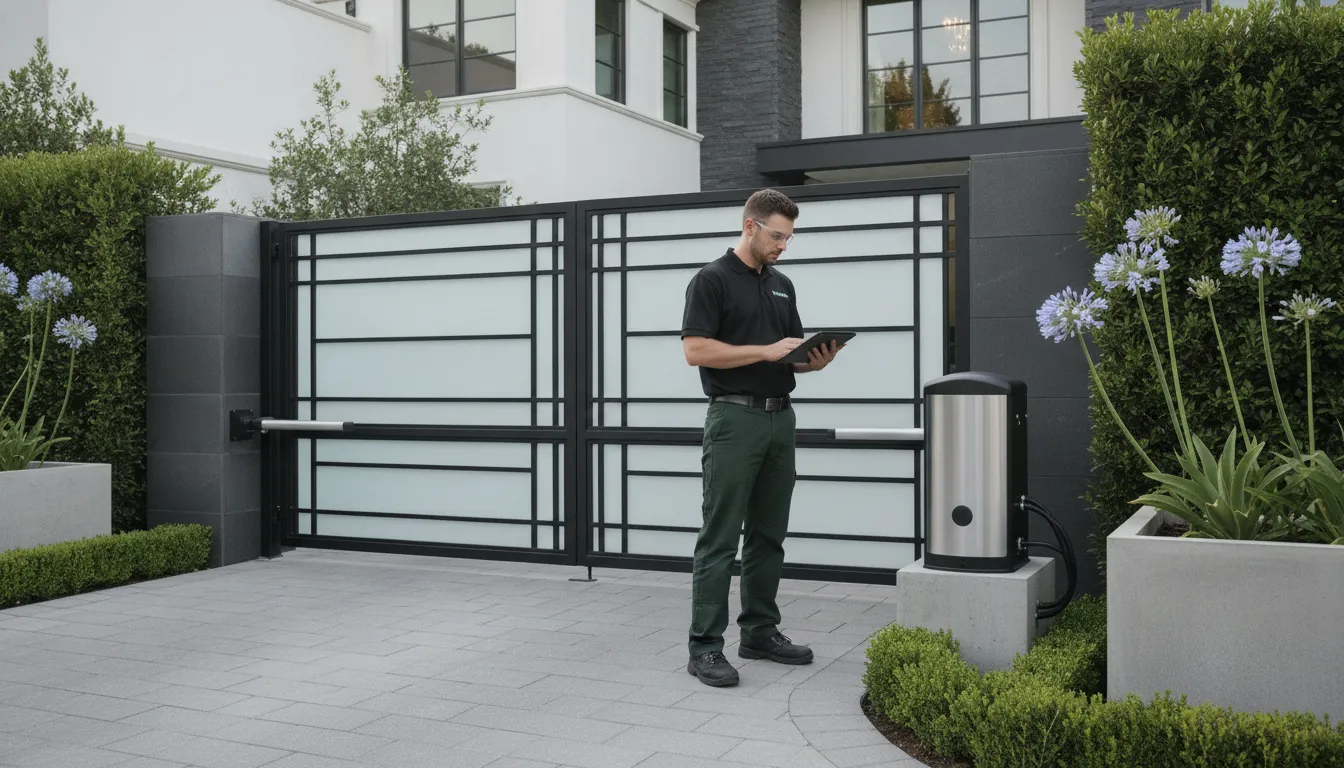
A swing gate can look straightforward from the driveway, but the operator has to work with the gate's leaves. Hinges, terrain, traffic flow, and control system as one complete setup. The right choice starts with the existing gate, not a product label.
Swing gate operators are hydraulic or electromechanical actuators that open and close a single-leaf or double-leaf gate in a door-like arc. They are a practical fit when the property has the clearance and layout for that movement. But the correct arrangement depends on gate weight, width, hinge condition, use frequency, power, and access-control requirements. A professional assessment should confirm those conditions before equipment is selected.
InteleGates provides gate automation services and installs automation on existing gates, not gates or fences. The first decision is whether the property layout supports swing movement and how the gate will be used day to day.
Talk with InteleGates about your existing gate automation.
When are swing gate operators the right choice for a property?
A swing gate operator is the motorized equipment that opens and closes a hinged gate leaf. It does not replace the gate, hinges, or a separate mechanism that holds the gate closed. The U.S. Department of Agriculture describes an electric gate operator as a device designed to open and close the gate, not to secure it or hold it closed. That distinction matters when planning the complete system.
Swing gate operators move the gate in an arc, much like a door, rather than moving a gate along a track. That motion can suit a residential entrance when the property has enough clear space for the gate leaf to travel inward or outward without striking a vehicle. Wall, landscaping, or another obstruction. Swing gates are commonly used at residential entrances, including homes, condominiums, and apartment buildings, according to the federal gate safety standard.
For an estate or larger residential property in Los Angeles or Orange County. The right fit depends on the existing gate and the driveway layout, not simply on the gate's appearance. A professional assessment should account for:
- Whether the entrance uses one gate leaf or two.
- The gate's weight, width, hinge condition, and travel path.
- Slopes, uneven terrain, drainage, and clearance near the opening.
- How often residents, guests, deliveries, and service vehicles use the entrance.
- Available power, control preferences, and the placement of safety equipment.
These factors help determine whether the operator can move the existing gate consistently without forcing an unsuitable system to compensate for binding hinges, poor alignment, or restricted clearance. InteleGates installs automation on existing gates and can assess the operator, controls, and related components as one system. For foundational context, review how automatic gate operators work before comparing layouts.
This is an operator-selection question, not a general swing-versus-slide comparison. The useful question is whether the property's existing hinged gate has the space, structure, traffic pattern, and system conditions needed for swing automation to work properly. A technician can diagnose those conditions before recommending an operator or replacement.
Single or dual swing gate operators: what should you compare?
The first decision is whether the existing gate has one moving leaf or two leaves that meet at the center. That configuration affects operator placement, movement coordination, controls, and the electrical planning for the property. A single-leaf arrangement may suit a narrower entrance or a layout where one leaf has a clear travel path. A dual-leaf arrangement can suit a wider estate entrance, but it requires both leaves, hinges, stops, and operators to work together as one system.
| Decision area | Single-leaf configuration | Dual-leaf configuration |
|---|---|---|
| Gate movement | One operator moves one gate leaf through its opening and closing path. | Two operators coordinate the leaves so they move and meet correctly. |
| Controls | Controls must match one operator and the way vehicles and pedestrians approach the entrance. | Controls must coordinate both operators, including sequencing where the site requires it. |
| Usage and site layout | Useful where one leaf has adequate clearance and traffic flow does not require a wider opening. | Useful where the entrance, gate design, or traffic pattern calls for two moving leaves. |
| Power planning | Power and backup requirements are evaluated for one operator and its connected controls. | Power planning includes two operators, their coordination, and the property's available service. |
Product specifications should be treated as examples rather than universal rules. A professional assessment looks at the actual gate and site instead of assuming that a voltage, battery arrangement, or single- versus dual-leaf label applies to every property. The useful comparison is between the existing gate's movement and the operator system's documented requirements.
The explicit answer is that neither arrangement is automatically better. The right choice depends on the existing gate's weight, leaf width, hinge condition, terrain, opening frequency, traffic flow, available power, and control requirements. A professional assessment should confirm whether the gate moves freely, where each operator can be mounted. How the leaves should coordinate, and which safety and access-control components fit the site. InteleGates installs automation on existing gates and evaluates the complete system before recommending equipment.
What does a professional swing gate operator assessment involve?
A professional assessment looks at the complete gate system before anyone recommends an operator, adjustment, or replacement. InteleGates technicians diagnose the problem before recommending replacement. That matters because an operator must match the existing gate, its movement, the property layout, and the way people use the entrance.
- Inspect the gate, hinges, and mounting points. The assessment begins with the existing gate rather than a product catalog. The technician checks whether the gate leaves move correctly, whether hinges and attachment points are in suitable condition, and whether the structure creates binding or uneven movement. InteleGates installs automation on existing gates, not gates or fences, so the condition of the gate is central to the recommendation.
- Evaluate weight, travel, and site conditions. Gate leaf count, approximate weight, width, opening direction, and available travel all affect operator selection. The technician also considers slopes, uneven terrain, clearance, vehicle flow, and the space available as the gate moves. Swing gate operators open and close the gate through a defined arc, so the operator and mounting arrangement need to suit that real movement.
- Review frequency, power, and controls. Residential use, property traffic, and expected operating frequency help determine the appropriate system arrangement. The assessment also reviews available electrical power, backup requirements where applicable, and how users will operate the gate. Controls should be positioned so the user can see the gate move, consistent with the federal gate safety standard. Access devices and automation can then be coordinated through access control systems.
- Check safety devices and movement. A professional assessment includes testing the operator's response, not simply confirming that the gate moves. CPSC guidance describes two entrapment-prevention mechanisms. Including a device that reverses movement when it encounters an obstruction and a secondary mechanism such as an electric eye or edge sensor. The technician also looks for pinch points and exposed hazards that require guarding or correction.
- Test, adjust, and document the system fit. After evaluating the gate and controls, the technician tests operation and makes appropriate adjustments to travel, timing, alignment, and connected safety equipment. An electric gate operator is designed to open and close the gate, not to serve as the gate's sole method of holding it closed, as explained by the USDA operator guidance. The final recommendation should reflect the existing gate, site conditions, usage, and control needs, rather than assuming one operator fits every property.
Underground or pillar-mounted: which swing gate operator layout fits?
Both layouts can automate an existing swing gate, but the better choice depends on the property, the gate structure, and the conditions around the hinges. A professional assessment should look beyond appearance before recommending an operator arrangement.
| Consideration | Underground layout | Pillar-mounted layout |
|---|---|---|
| Visibility | Places much of the operating hardware below the gate area, which may suit a property where a clear architectural view matters. | Keeps the operator accessible above grade, although the hardware may be more visible from the driveway or approach. |
| Construction access | Requires suitable below-grade space and careful consideration of the surrounding surface and structure. | May be more practical where the gate pillars provide a sound mounting location and below-grade work is limited. |
| Drainage and site conditions | Requires a thorough review of drainage, soil, water exposure, and the enclosure around the mechanism. | Still requires weather and surface-condition planning, but the assessment focuses more directly on the mounting structure and exposed components. |
| Service access | Service planning must account for access to equipment located below grade and the condition of its enclosure. | Often provides a more direct service path, subject to the gate design and available working space. |
How to make the fit-based decision
Choose an underground layout when preserving the property's visual design is a priority and the site can support the required below-grade installation conditions. Choose a pillar-mounted layout when accessible equipment and a suitable existing pillar are more important than concealing the operator. Neither arrangement is automatically right for every estate.
The assessment should also confirm that the existing gate swings freely, the hinges and structure are appropriate. And the operator can work with the gate's weight, travel, traffic flow, and control requirements. InteleGates installs automation on existing gates, not gates or fences, and can evaluate which layout fits the complete system before equipment is selected.
How InteleGates matches swing gate operators to estate properties
For an estate property, the operator has to work with the gate that is already in place and with the way people use the entrance. InteleGates begins by assessing the existing gate, rather than recommending equipment from a catalog without reviewing the site. The assessment considers the gate's weight and width, the condition of its hinges, the terrain around the opening, and whether the property has a single or dual-leaf configuration.
Use frequency also matters. A private residence with occasional vehicle access has different operating demands from an estate with staff, deliveries, guests, and several daily vehicle movements. Traffic flow helps determine how the controls should function and where they should be located. The goal is an operator arrangement that moves the gate consistently without forcing the existing hardware to work beyond its practical capacity.
Matching controls to the property
Controls should reflect who needs access and how the driveway is approached. InteleGates reviews options for vehicle access, pedestrian entry, and property-management needs, then considers how those controls integrate with the operator and the rest of the access system. You can learn more about access control systems before discussing the right arrangement for a specific entrance.
Installation assessment also includes testing the gate's movement, control response, safety equipment, and adjustment after the system is installed. InteleGates installs automation on existing gates; it does not install gates or fences. Ongoing service matters as well. Professional maintenance can review operator mechanisms, electrical connections, sensors, safety mechanisms, and access-control components. InteleGates recommends professional gate-system maintenance at least every six months.
For a broader framework that places operator selection within the property layout, see this guide to choosing an electric gate system. InteleGates serves residential and estate properties across Los Angeles and Orange County, including communities such as Beverly Hills, Calabasas, Malibu, Newport Beach, Irvine, and Laguna Beach.
Frequently Asked Questions
What is the best gate operator?
The best operator is the one matched to the existing gate and property conditions, not simply the most powerful model. Selection should account for whether the gate has one or two leaves, the gate's weight and width. Hinge condition, terrain, frequency of use, traffic flow, available power, and control requirements. A professional assessment can identify the appropriate hydraulic or electromechanical arrangement.
Are swing gate operators suitable for large residential properties?
They can be suitable when the driveway layout allows the gate leaves to open like doors and there is adequate clearance for their travel. Estate properties may require additional attention to long gate leaves, uneven terrain, frequent vehicle movement, power access, and the integration of remotes, keypads, or other access controls. The existing gate must be evaluated before an operator is selected.
Should I use a single or dual swing gate operator?
A single operator is used with a one-leaf gate, while a dual arrangement coordinates two leaves. The right configuration depends on the gate design, opening sequence, available clearance, traffic pattern, and the operator system's control requirements. A technician should also check that the hinges and gate structure move properly before recommending automation.
What safety features should a swing gate operator system include?
A properly assessed system should address obstruction detection, reversal, secondary sensing such as electric eyes or edge sensors, visible control placement, and pinch-point protection. Safety testing should cover the complete gate system, including the existing gate, operator, sensors, controls, and travel limits. Installation, adjustment, and repair should be handled by a qualified professional rather than attempted as a do-it-yourself project.
Schedule Your Swing Gate Operator Assessment
Choosing an operator for an existing gate depends on the gate layout, movement, and how the property is used. An assessment gives you a clearer path toward a system that fits those conditions. InteleGates can discuss your swing gate operator selection and the next steps for your property.