
InteleGates Guide
Swing Gate vs. Slide Gate: 5 Factors That Decide Your Driveway
Two driveways can look nearly identical from the street and still call for opposite gate designs. One has room for a panel to arc open like a door; the other has a wall, a slope, or a car parked six feet from the opening, making swinging impossible. The gate style you can install is mostly determined by the shape and grade of the ground you already have, not by which one you prefer in a photo. Understanding what each style physically needs before you decide keeps you from buying a gate that fights your driveway every day.
Quick Answer: A swing gate pivots open on hinges and needs clear arc space plus fairly level ground along that arc. A slide gate rolls sideways parallel to the fence and needs clear side room, handling slopes and short driveways where a swing would block the drive.
How a Swing Gate Actually Moves
A swing gate is a hinged panel, or two panels in a bi-parting double configuration, that pivots on posts set at the sides of the opening. It travels through a quarter-circle path the same way an interior door does, sweeping an arc equal to roughly its own width. That arc is the main thing a swing gate demands from a site.
Two conditions have to hold. First, the arc has to be clear, whether the gate opens inward toward the driveway or outward toward the street, with nothing parked, planted, or built inside the sweep. Second, the ground along that arc has to be reasonably level. A swing gate opening uphill runs straight into the rising grade partway through its travel, because the bottom rail stays at a fixed height while the ground climbs to meet it. On a driveway that slopes up from the road, that contact point can stop the gate well before it finishes opening.
There are ways around a slope. Swinging the gate outward, away from the rising drive, sidesteps the grade if the street side has room. Rising-hinge hardware lifts the gate as it opens, so the bottom edge clears the climb. Both add installation complexity, which is worth knowing before you assume a swing gate will fit any lot. On level or gently graded ground with open space beside the opening, a swing gate is mechanically simple and has few moving parts.
How a Slide Gate Actually Moves
A slide gate does not pivot at all. It rolls sideways, parallel to the fence line, parking the panel alongside the fence when open. Because it moves horizontally rather than sweeping an arc, it needs a different kind of space: a clear run of fence beside the opening, at least as long as the gate itself, for the panel to retract into. Trade a swing gate's arc for a slide gate's side room, and you have the core distinction between the two.
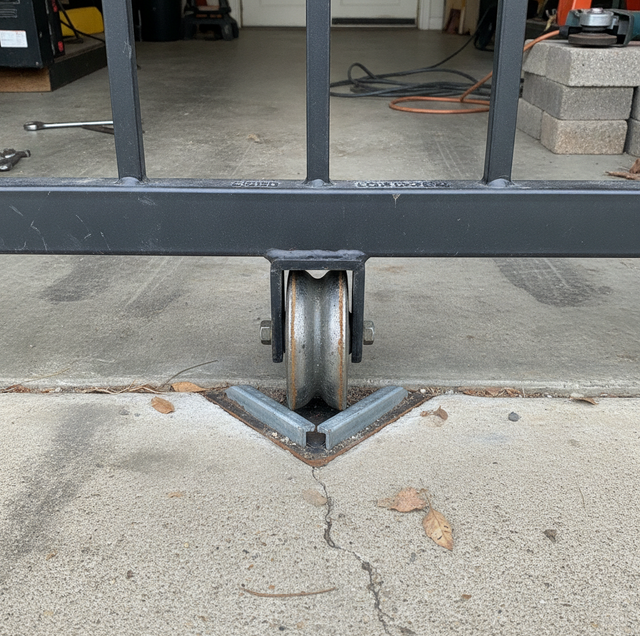
Slide gates come in two main builds. A V-track slide runs on a grooved wheel that rides in a metal track set into the driveway surface, which carries the gate's weight along the ground. A cantilever slide carries no ground track at all: the gate is counterbalanced and rides on rollers mounted to one side of the opening, so the panel floats across the gap with nothing touching the driveway below it. That difference matters for upkeep. A ground track can be packed with leaves, ice, gravel, or debris and needs to be kept clear to roll smoothly, while a cantilever avoids the track entirely and the cleaning that comes with it.
Because a slide gate ignores the ground it passes over, it handles a sloped driveway that would stop a swing gate. The rolling hardware sits on level mounts to the side, and the panel travels across the opening without caring what the grade does underneath. A slide gate also fits a short driveway, where there simply is not room for a panel to swing without blocking the drive.
The Five Factors That Decide It
Once you understand how each gate moves, the choice comes down to five things about your specific driveway.
Available space is the first filter. Do you have a clear arc for a panel to swing through, or a clear run of fence beside the opening for a panel to park into? You need one or the other, and the space you actually have often makes the decision for you.
Driveway slope is the tie-breaker on graded lots. Flat or gently sloped ground keeps both options open. A driveway that climbs from the street pushes you toward a slide gate, or toward a swing gate that opens outward or uses rising hinges.
Driveway length matters more than people expect. On a short driveway, an inward-swinging gate sweeps into the only space a car has to wait, so a vehicle pulling up close gets caught inside the arc. A slide gate parked along the fence leaves that space open.
Control level shapes the build. Both styles can be built heavy and tall, but the panel weight, height, and infill you choose to meet a given control need directly determine which gate and which operator make sense.
Maintenance splits based on wear points rather than favoring one gate. A swing gate loads its hinges, which take the panel's full weight and can let the gate sag over the years. A slide gate wears its rollers, and a V-track version requires its track to be kept clear. Neither is maintenance-free; they simply age at different rates.
| Factor | Swing Gate | Slide Gate |
|---|---|---|
| Space needed | Clear arc (about the gate's width) | Clear side run along the fence |
| Slope | Best on level ground | Handles sloped driveways |
| Driveway length | Wants room; can block a short drive | Works on short driveways |
| Track | None; pivots on hinges | V-track in ground, or none (cantilever) |
| Best for | Level, open lots with swing clearance | Slopes, tight lots, no arc room |
What Automation Adds to the Choice
Both gate styles automate. An operator sized to the panel's weight and length opens and closes the gate via remote, keypad, or sensor, and neither style is off-limits for automation. But the way each gate moves changes how the space around it gets used once a motor is doing the work.
A swing gate's arc becomes a live zone every time the gate cycles. A vehicle that pulls up close to an inward-swinging automated gate can sit right inside the path the panel needs, blocking its travel until the driver backs up. On a busy or short driveway, that stall repeats daily. A slide gate has no arc to block, so a car can wait close to the opening without interfering with the gate's motion.
Automation also brings a safety obligation that applies to both. An automated gate carries real force and creates entrapment zones: the gap a swing gate closes into, or the space between a slide gate and its posts as the panel passes. For that reason, an automated driveway gate needs entrapment-protection devices, typically photo-eye sensors or contact edges, that stop and reverse the gate if something is in its path. Under the UL 325 safety standard that governs automated gate operators, this is a requirement of a compliant install, not an add-on you can skip. Sizing the operator, positioning the sensors, and setting the reversing behavior correctly is work for a qualified installer, because a gate that fails to reverse can injure a person or pet.
A Simple Way to Picture the Difference
Picture parking a car in a driveway versus a parallel spot on the street. Pulling straight into a driveway requires open depth in front of you, just as a swing gate needs an open arc in front of the opening. Parallel parking needs a clear length of curb beside you to slide into, the way a slide gate needs a clear run of fence to retract along. The car is the same in both cases; the space each maneuver requires is what differs, and that is exactly how a swing gate and a slide gate differ on your driveway.
Frequently Asked Questions
How do I know which one my driveway can fit?
The operator each style uses helps decide. A swing gate is driven by a linear-actuator arm or an articulated arm mounted at the hinge, so it needs the swept arc, roughly the gate's width traced as a quarter circle, kept clear. A slide gate runs on a chain-drive operator, so it needs a flat run of fence beside the opening at least as long as the gate to park into. Whichever of those two spaces you actually have on your lot decides which gate you can install.
Which handles a sloped driveway better?
A slide gate avoids the problem entirely because it moves sideways on hardware mounted to the side of the opening and ignores the grade it crosses. A swing gate opening uphill runs its bottom rail into the rising ground partway through its travel. That can sometimes be worked around with a drop-rod or step at the bottom, or a bottom cut that clears the grade, but a slide gate sidesteps the issue rather than compensating for it.
What's the difference between a cantilever and a V-track slide gate?
A V-track slide rolls on a wheel that runs in a track set into the driveway surface, so the gate's weight is carried along the ground. A cantilever gate is counterbalanced instead and rides on rollers, with no track on the ground at all. That counterbalance needs a run behind the opening roughly half the gate's width, so a cantilever eats more room off to the side than a V-track, but in exchange, it has no ground channel to pack with leaves, ice, or gravel.
Is a short driveway a problem for a swing gate?
It can be, and the math is simple: an inward-swinging gate needs clear depth equal to its leaf length to open, so a 12-foot leaf sweeps a full 12 feet into the drive. A car waiting inside that space blocks the gate. On a short driveway with little room between the gate and the garage or street, a slide gate that parks alongside the fence usually works better, since it leaves that limited waiting space clear.
Which needs more maintenance?
Neither is maintenance-free; they wear at different points. A swing gate places its load on the hinges, which support the panel's full weight and can cause the gate to sag over the years if not adjusted. A V-track slide gate needs its ground track swept and cleared of gravel and debris so the wheel keeps rolling true, while a cantilever's rollers are periodically checked and greased instead. Each style has its own upkeep rather than being carefree.
Do both work with automation and safety sensors?
Yes. Both styles automate with an operator sized to the gate's weight and length. Both also require entrapment-protection sensors, either photo-eyes or contact edges, so the gate reverses if something is in its path when it moves. That reversing safety feature is a requirement for a compliant automated gate, not an optional extra, which is why professional installation matters for either style.
Schedule a driveway assessment — get the gate style that fits your space and grade the first time. InteleGates Inc. serves Los Angeles, Long Beach, Anaheim, and the surrounding area. Call (833) 468-4283 for a consultation.