
InteleGates Guide
Barrier Arm Gate Operator Guide for Commercial Sites
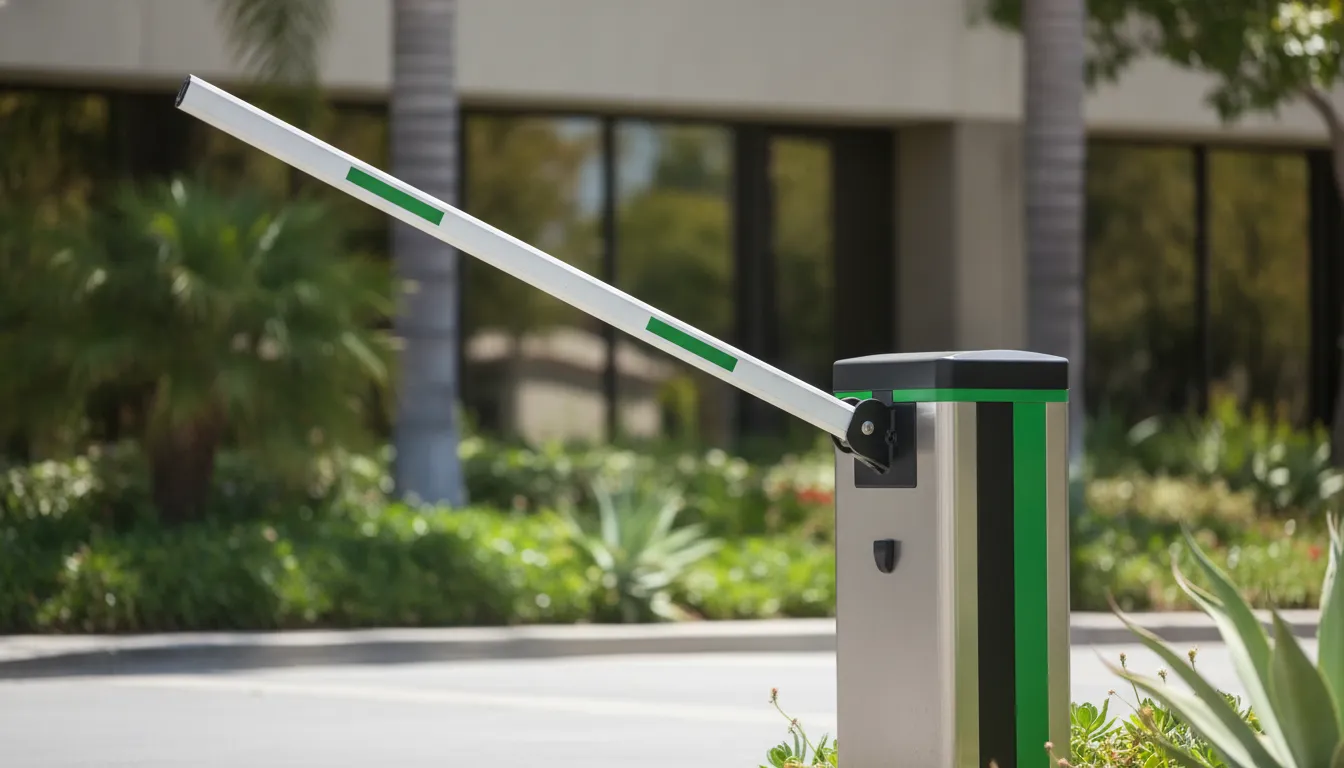
In a busy commercial entrance, every vehicle interaction depends on a clear handoff between access controls, the operator, and the lane. A barrier arm system provides that visible point of control by lifting a horizontal arm for an authorized vehicle and returning it to its lowered position after passage. Parking lots, garages, and multifamily communities in Los Angeles and Orange County can benefit from a system planned around the property's daily traffic pattern.
Talk with InteleGates about your commercial barrier arm system
A barrier arm gate operator is the motorized equipment that raises and lowers a horizontal barrier arm to regulate vehicle movement through a lane. It typically works with a controller and may coordinate with card readers, keypads, remote controls, or vehicle detection, so access decisions and arm movement support one another.
The operator itself is only one part of a dependable entrance. Lane layout, traffic volume, access method, detection, clearance, and service needs all influence how the system should be planned. Understanding what the operator does is the first step toward evaluating the complete setup.
What Is a Barrier Arm Gate Operator?
A barrier arm gate operator is an electric traffic-control system that regulates vehicle movement through a defined lane. Instead of moving a full gate panel, the operator raises and lowers a horizontal arm. The arm stays down until the system receives an authorized-entry signal, then lifts to allow a vehicle through before returning to its resting position.
The motor cabinet moves the arm
The main equipment sits inside a protective motor cabinet. This cabinet contains the electric motor, the controller interface, and the mechanical support that connects the drive system to the arm. The horizontal arm extends across the lane from that cabinet. When the controller receives the proper signal, it energizes the motor and rotates the arm upward from horizontal to vertical. The arm then lowers after the vehicle has cleared the controlled passage.
This arrangement gives commercial properties a clear way to manage vehicle entry without requiring an attendant at every lane. The operator, rather than the arm alone, is the core of the system. Its motor, controls, detection equipment, and related access components must work together for dependable traffic movement.
How an entry and exit cycle works
An authorized-entry signal can come from an access-control device or a lane-management system. Depending on the site, that signal may be associated with a card reader, keypad, remote control, or another approved method. The controller evaluates the signal and directs the motor to raise the arm. Vehicle-detection equipment can then help determine when the vehicle has passed, allowing the controller to begin the exit cycle and return the arm to horizontal.
That sequence matters at busy entrances. The system should recognize an authorized vehicle, open the lane, monitor vehicle movement, and close at the appropriate time. Professional planning also considers how controls and detection coordinate with the operator, so the system supports orderly movement rather than treating the arm as an isolated piece of equipment.
Where barrier arm operators are used
InteleGates lists barrier arm systems for parking lots, toll booths, and restricted-area entrances. They can be a practical fit where a property needs controlled vehicle flow through a lane, including commercial facilities and other managed access points in Los Angeles and Orange County. The right setup depends on the entrance layout, access method, traffic pattern, and service requirements. InteleGates installs and services the electric motor systems and access controls that make the barrier arm operate as part of a complete entrance system.
For the federal description of barrier-gate components and operation, see the FHWA overview of toll-gate systems.
Where Barrier Arms Fit in Commercial and Multifamily Traffic Plans
A barrier arm gate operator is often a practical fit when a property needs to manage vehicle movement through a defined lane. It does this without requiring a full-width gate panel. The horizontal arm gives drivers a clear visual signal, while the electric motor and control system coordinate when the lane is released. That makes barrier arms useful for properties where predictable circulation matters as much as access control.
Parking lots and parking structures
In surface parking lots, a barrier arm can organize entry and exit lanes for employees, tenants, visitors, or permit holders. In a parking structure, the operator can support a controlled approach at the entrance or exit while preserving the turning space vehicles need near the ramp. The planning question is not simply whether an arm can block a lane. It is whether the cabinet, arm position, controls, and detection method support the way vehicles actually queue, turn, enter, and leave.
Property owners should consider peak arrival periods, lane visibility, pedestrian movement, and how attendants or managers will respond when a credential does not work. A well-planned system keeps the operator visible to approaching drivers and gives the property team a clear path for access management and service.
Office, warehouse, and commercial entrances
Office campuses may use barrier arms to coordinate employee parking, visitor access, or scheduled deliveries. At a warehouse or commercial entrance, the priority may be orderly movement through a busy driveway, with controls suited to staff, vendors, and fleet vehicles. In each setting, the arm operator should be evaluated as part of the complete lane plan rather than as an isolated motor. Card readers, keypads, remote controls, and vehicle detection can be selected around the property's operating needs.
For a broader equipment decision, review barrier arm versus sliding gate. That comparison addresses the differences between the two arrangements. This article's focus is narrower: applying barrier-arm planning to active commercial sites and multifamily traffic patterns.
Multifamily communities
Multifamily entrances need a balance between resident convenience, visitor handling, delivery access, and consistent vehicle flow. A barrier arm can define the entry lane while allowing property managers to coordinate credentials and temporary access through the selected controls. Clear operator visibility is especially important when residents, guests, and service vehicles use the same approach.
For Los Angeles and Orange County properties, site conditions vary widely between compact urban lots, larger communities, and mixed-use facilities. A local assessment helps align the barrier arm gate operator with lane geometry, traffic patterns, power, controls, detection, and future service access. InteleGates installs and services barrier arm openers for commercial property owners and managers, with recommendations centered on dependable day-to-day operation.
How Do Barrier Arms Coordinate With Access Control and Vehicle Detection?
A well-planned entrance works as a coordinated system rather than a collection of separate devices. A card reader, keypad, remote control, telephone entry system, or approved vehicle credential provides an input. The controller evaluates that input and sends an operating command to the barrier arm operator. The operator's motor then raises the arm so the authorized vehicle can proceed.
InteleGates supports this type of coordination through access control system installation, including access-control equipment and underground LOOP vehicle detection. The right arrangement depends on the property's lane layout, traffic pattern, user groups, and existing equipment. A commercial entrance serving employees may use card access, while a multifamily property may combine resident credentials with telephone entry for visitors.
From credential to controlled movement
The signal path is straightforward at a high level. First, a driver presents an authorized credential or uses an approved entry device. The access-control system passes an authorization signal to the controller. If the entry request is accepted, the controller activates the barrier arm operator. The horizontal arm rotates upward, creating a clear lane for the vehicle.
This coordination helps property managers create a predictable entry experience without asking every driver to make a separate decision at the arm. It also creates a useful point for reviewing access permissions and identifying unusual traffic patterns. A properly planned system can support orderly movement while keeping the operator, controls, and detection equipment working together.
Why LOOP detection matters after the arm rises
Underground LOOP sensors detect when a vehicle is positioned in the lane. That information helps the controller understand whether the vehicle has entered or cleared the arm's operating area. Detection can influence when the arm remains open and when it returns to its resting position. Federal Highway Administration guidance describes detection devices adjacent to a barrier as part of the sequence that returns an arm after a vehicle is no longer detected.
Vehicle detection is especially important where multiple vehicles use the same lane in close succession. It can help the system distinguish an occupied lane from a cleared lane, supporting safer operating decisions and more consistent throughput. It does not replace attentive drivers or thoughtful traffic design. Tailgating awareness still matters, because one authorized opening may be followed by another vehicle before the system can confirm a separate authorization.
Safety decisions belong in the system plan
Controls should be positioned and configured so users can understand the arm's movement and use the entrance as intended. Detection, visibility, access permissions, and the operator's response should be considered together during professional planning. Because wiring, programming, and safety-device selection vary by equipment and site, installation and integration should be handled by a qualified service provider rather than improvised in the field.
Which Site Factors Shape Barrier Arm Selection?
Selecting a barrier arm gate operator starts with the lane, not a product catalog. The right system must fit the available drive path, manage the expected traffic pattern, coordinate with access controls, and remain serviceable after installation. A professional assessment also considers how vehicles and pedestrians move through the entrance, where the operator can be mounted, and how the equipment will be exposed to weather.
| Factor | Why it matters | What a professional assesses |
|---|---|---|
| Lane width and arm span | The arm must cover the intended lane without creating an awkward vehicle path. | Clear lane dimensions, turning geometry, arm reach, and the space needed for the arm to move safely. |
| Traffic volume and pattern | Frequent cycling places different demands on the operator than occasional access. | Peak arrival periods, queue length, direction of travel, and whether one or multiple lanes need control. |
| Mounting side and clearance | The cabinet position affects lane use, visibility, maintenance access, and arm movement. | Left or right mounting options, nearby curbs or structures, overhead clearance, and vehicle sightlines. |
| Power and weather exposure | The operator and controls need an appropriate electrical supply and a suitable environment. | Available power, conduit planning, drainage, sun, wind, moisture, and the enclosure's placement. |
| Controls and vehicle detection | Credentials, remote commands, loop sensors, and safety devices must work as one entrance system. | Card readers, keypads, remote controls, underground LOOP detection, photo eyes, and controller compatibility. |
| Pedestrian movement | People may cross or walk near a vehicle lane, requiring a plan that keeps movements visible and coordinated. | Walkways, crossing points, sightlines, control locations, and separation between pedestrian and vehicle paths. |
| Future service access | Routine inspection and responsive repair are easier when the cabinet and related equipment remain reachable. | Technician approach space, removable obstructions, equipment records, and room for future control changes. |
Manufacturer product pages can illustrate why selection is site-specific. For example, one manufacturer presents different arm-span options and left- or right-hand mounting for a particular operator. Those are examples of that manufacturer's product line, not specifications for every barrier arm gate operator or a promise about an InteleGates installation. The useful takeaway is to measure the lane and evaluate the complete operating environment before choosing equipment.
Safety planning belongs in the same conversation. Federal guidance describes barrier equipment as a cabinet, motor, controller interface, arm support, and arm, while detection devices can coordinate arm movement with vehicle presence. Controls should be positioned so users can see the operation and remain clear of moving equipment. In Los Angeles and Orange County, a professional site review brings these details together with the access-control and service requirements of the property.
What Happens During Professional Barrier Arm Installation?
A commercial barrier arm installation starts with planning around the property, not simply placing a motor beside a lane. The operator, controls, vehicle detection, power, and traffic pattern must work together so the entrance supports daily operations. Coordinated planning is especially important for parking lots, garages, offices, warehouses, and multifamily communities where several users may approach the lane at once.
- Site assessment and traffic review
An installer evaluates the entrance layout, lane direction, available clearance, mounting position, traffic volume, power access, and the location of vehicles and pedestrians during normal operation. This assessment helps identify how the arm will move through its cycle and where controls and detection should support orderly traffic flow. For commercial properties in Los Angeles and Orange County, the review also provides an opportunity to account for the site's operating schedule and access requirements.
- Feature selection and system planning
Next, the installation plan matches the barrier arm operator to the entrance's functional needs. The team may coordinate card readers, keypads, remote controls, or other access-control equipment with the motor and controller. Underground LOOP vehicle detection can also be considered where vehicle presence needs to be recognized as part of the operating sequence. The goal is a complete system plan rather than an isolated piece of equipment.
- Ground preparation and motor installation
The installation team prepares the mounting area and establishes a stable location for the operator cabinet and arm assembly. Electrical and control pathways are addressed as part of the broader site plan. Proper placement gives technicians appropriate access for future service while keeping the equipment aligned with the lane and its intended movement. InteleGates' electric gate motor installation service covers this type of coordinated project work.
- Control setup and integration
Once the operator is installed, the controls are connected and configured to communicate with the access system. The installer verifies that an approved access signal reaches the controller and that detection devices support the intended sequence. Control locations and visibility are reviewed so authorized users can interact with the system appropriately without creating avoidable conflicts in the lane.
- Testing and performance optimization
The completed system is tested through its operating cycle. The team checks arm movement, control response, vehicle detection, access-device interaction, and the relationship between entry activity and the next cycle. Any adjustments are made during commissioning so the barrier arm gate operator performs consistently within the site's real traffic conditions. The property manager receives a system that has been reviewed as a coordinated installation, with service considerations accounted for from the beginning.
How Do You Keep a Commercial Barrier System Dependable?
Dependability comes from treating a barrier arm gate operator as part of a complete traffic-control system, not as an isolated motor. Planned professional maintenance gives a technician the opportunity to review the operator, arm support, controls, detection equipment, and access-control connections before a small irregularity disrupts a commercial entrance.
Schedule inspections around real site conditions
A useful maintenance plan reflects how the entrance is used. A busy parking facility, multifamily property, warehouse, or office may place different demands on the operator and its controls. Professional service should account for traffic volume, lane layout, weather exposure, mounting conditions, and the way credentials or vehicle detection authorize passage.
The inspection should cover the motor and operator assembly, the arm's movement, control interfaces, and the devices that coordinate vehicle presence with opening and closing. InteleGates also provides underground vehicle detection using LOOP sensors, which may be part of a broader entrance-control review. Safety-related sensing and visibility deserve attention as well. The Federal Highway Administration describes detection devices that help return a barrier arm to its horizontal position after a vehicle is no longer detected. While the Consumer Product Safety Commission has emphasized the role of sensing and reversing mechanisms on automatic gate systems.
Keep access control and detection working as one system
A credential reader, keypad, remote control, controller, loop sensor, and operator must exchange the right signals at the right time. If one component is changed without considering the rest of the system, the entrance may behave inconsistently even when the motor itself appears serviceable. Professional coordination helps property managers evaluate the complete sequence, from an authorized request through arm movement and vehicle clearance.
Service records make that coordination easier over time. Documenting inspections, repairs, control changes, and observed operating conditions gives the next technician useful history and helps a property manager identify recurring patterns. It also supports clearer recommendations when equipment needs adjustment, repair, replacement, or integration with updated access control.
Respond early when performance changes
Do not wait for a commercial entrance to stop operating before requesting professional attention. Unusual operation, inconsistent access signals, or changes in vehicle detection are reasons to schedule an evaluation rather than attempt DIY troubleshooting. InteleGates installs, repairs, and maintains electric gate motors and access control systems throughout Los Angeles and Orange County. Learn more about gate automation installation and repair or arrange electric gate system repair with a technician who can assess the operator and the connected controls together.
Planning Barrier Arm Service in Los Angeles and Orange County
For a commercial property owner or multifamily manager, barrier arm service is part of keeping vehicle access coordinated with daily operations. A parking entrance in Los Angeles may handle office traffic, deliveries, residents, and visitors in the same lane. An Orange County property in Irvine, Anaheim, Santa Ana, Newport Beach, or Yorba Linda may have different traffic patterns, equipment layouts, and access-control needs. The right service partner evaluates the complete electric operator system rather than treating the arm as an isolated component.
InteleGates is a family-owned, owner-operated electric gate motor and access control service company serving Los Angeles and Orange County. Ron Albert brings more than 25 years of hands-on experience to system planning, installation, repair, and maintenance. That direct owner involvement gives property managers a practical point of contact when they need to assess an aging operator. Coordinate access controls, or plan service for a busy entrance.
Match service to the property and its traffic pattern
A useful service assessment considers how vehicles approach and leave the lane, how credentials are managed, and how the operator communicates with card readers, keypads, remote controls, or vehicle-detection equipment. InteleGates also provides underground LOOP vehicle detection as part of its access-control capabilities. These details matter when a barrier arm gate operator must support consistent movement through a parking lot, garage, office entrance, warehouse, or multifamily community.
Professional support can cover the electric motor, controls, access equipment, detection, and related system performance. It can also help decision-makers plan maintenance before an entrance interruption affects tenants, employees, customers, or deliveries. InteleGates provides emergency gate repair six days per week, excluding Saturday, for property owners and managers who need responsive help with an operating system.
Whether the site is near the coast, in a dense commercial corridor, or spread across a larger Orange County property, local context helps shape a useful service plan. To discuss an operating issue or arrange professional support, contact InteleGates about emergency gate repair.
Schedule a professional barrier arm gate operator assessment
Frequently Asked Questions
How does a barrier arm gate operator work?
A barrier arm gate operator uses an electric motor and controller to raise a horizontal arm when an authorized access signal is received. The arm opens to allow a vehicle through, then vehicle detection and safety equipment help coordinate when it is appropriate to lower the arm. The operator, arm, controls, and detection devices work together as one lane-management system.
What can a barrier arm system coordinate with?
A commercial barrier arm system can coordinate with card readers, keypads, remote controls, and vehicle-detection equipment. An access device sends a signal to the controller, while an underground LOOP sensor can help identify a vehicle in the lane. The right combination depends on how drivers, residents, employees, visitors, and delivery vehicles are authorized to enter.
What site factors matter when selecting a barrier arm operator?
Important factors include lane layout, required arm span, traffic volume, mounting position, overhead and side clearance, available power, control devices, vehicle detection, pedestrian movement, weather exposure, and future service access. A site assessment connects these conditions to an appropriate operator and control plan rather than treating every commercial entrance the same.
When should a professional service a barrier arm system?
Contact a qualified professional when the arm behaves inconsistently, the operator or controls stop coordinating, vehicle detection does not respond correctly, or the system needs installation, repair, maintenance, or an access-control change. Professional service helps evaluate the motor, controller, detection, and safety components together without relying on guesswork or improvised repairs.
Ready to Plan Your Commercial Barrier Arm System?
A professional assessment can help clarify the right operator, controls, detection, and service approach for your commercial or multifamily entrance. InteleGates supports property owners and managers across Los Angeles and Orange County with barrier arm installation, repair, and maintenance. Schedule a professional barrier arm gate operator assessment to discuss your site and next steps.