
Solar vs. Hardwired Gate Opener: Which One Wins?
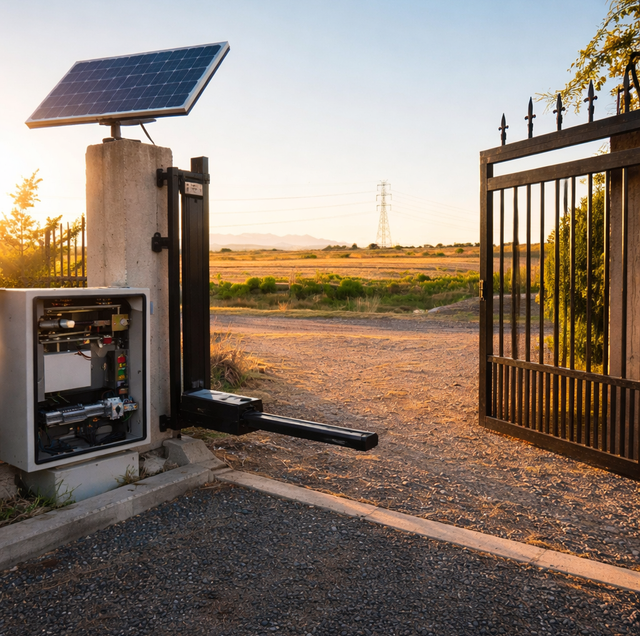
Quick Answer: Hardwired power suits high-traffic, heavy, or fast-cycling gates and gates close to an existing panel, because it delivers steady current no matter the weather. Solar suits lighter, lower-cycle gates set far from power where trenching would be costly, as long as the panel and battery are sized for the real number of daily open-close cycles. Both still need a backup battery and photo-eyes.
Every automatic gate comes down to one question that gets decided before the gate ever swings: where does the operator get its power? The motor that pulls a heavy panel open and closed hundreds of times needs a steady, reliable feed, and there are two common ways to supply it. One runs a buried electrical line out to the gate. The other stands a solar panel nearby and lets the sun do the work. Both can run the same operator well. They just fail in different ways when the site, the traffic, or the weather doesn't match the choice.
How Each Setup Actually Powers the Operator
A hardwired gate operator draws its power from the building's electrical system. An electrician runs a line, usually low-voltage or a dedicated circuit depending on the operator, through a buried conduit from the house or main panel out to the gate. That conduit protects the wire and carries steady alternating current to a control board at the gate, which charges an onboard battery and runs the motor. The wall power is doing the heavy lifting; the battery mostly rides along as a reserve.
A solar setup flips the source. A photovoltaic panel, mounted where it catches the most sky, feeds a charge controller that keeps a deep-cycle battery topped up. The operator never runs off the panel directly. It runs off that battery, and the panel's only job is to replace the charge the gate spends each day. On a good site, the battery stays full, and the gate never notices the difference. The sun is refilling a tank, and the gate is drinking from it.
That difference in source is the whole story. Hardwired power is continuous and indifferent to weather. Solar power is a daily budget that has to balance: charge in versus cycles out.
When Hardwired Is the Right Call
Hardwired shines wherever the gate works hard. Think apartment entrances, commercial yards, and busy driveways where the gate cycles constantly through the day and sometimes late into the night. A heavy slide gate or a large dual-swing operator pulls real current on every cycle, and steady AC power keeps up without ever running short.
Where hardwired earns its keep:
- High cycle counts, where a gate opens and closes many dozens of times a day
- Heavier gates and larger operators that draw more current per cycle
- Gates with power-hungry accessories such as cameras, intercoms, keypads, and vehicle loop detectors all running off the same system
- Sites where the gate sits close enough to the panel that the trench run stays short
The catch is the installation. Reaching the gate means a trench for the conduit, and that is real excavation. Call 811 before any digging so the underground utility lines get located and marked first. A conduit run that clips a buried gas or power line is exactly the outcome that a call prevents, and the trenching and electrical connection are licensed work, not a weekend project. The trenching and the electrical connection are licensed work, not a weekend project.
One more point that surprises people: hardwired gates still need a battery. When the grid goes down, a gate with no reserve is a gate you can't open or close, and for many properties that is both a control gap and a safety problem. The backup battery is what lets the gate finish its cycle and reach a safe position during an outage.
When Solar Makes More Sense
Solar's advantage is distance. Picture a gate at the far end of a long driveway or a ranch entrance a few hundred feet from the nearest power. Trenching that distance is a major undertaking, and every foot of conduit adds labor and disruption. A solar panel sidesteps the trench entirely. You mount the panel, wire it to the operator's battery and controller a short run away, and the gate has its own power source with no line back to the building.
Solar fits best on gates that don't work too hard. A residential gate that opens a handful of times a day, a lighter single-swing panel, a lower-traffic entrance: these spend little charge per day, so a modestly sized panel and battery keep up comfortably. The lighter the duty, the easier the sun keeps the tank full.
Where solar tends to win:
- Gates far from an existing power source, where trenching is expensive or disruptive
- Lighter gates and lower daily cycle counts
- Sites with reliably good sun exposure on the panel through the day
- Cases where you'd rather avoid tearing up a finished driveway or landscaping
The whole approach lives or dies on sizing. The panel has to generate more energy across a day than the gate spends, with margin left over to carry through cloudy stretches and the longest, busiest days. Get that math wrong, and the consequences are immediate.
Why Undersizing a Solar System Bites
A solar gate that is sized too small looks fine for weeks, then dies at the worst moment. The failure mode is simple. If the gate cycles more than the panel can recharge, or if several overcast days in a row cut the panel's output, the battery slowly drains below the level the operator needs. Then the gate stops mid-day, and it stays stopped until the sun catches the battery back up.
Two things drive that drain. The first is cycle count. A gate rated for a modest number of daily cycles will empty its battery fast if the household's real traffic runs double that, or if a delivery-heavy week spikes the count. The second is accessory load. Cameras, keypads, intercoms, and loop detectors all sip power around the clock, and every one of them shortens how long the battery lasts between good sun. A solar system that ignores the accessory draw is undersized before it's even installed.
Size a solar gate for the real duty cycle and the worst realistic weather, not the average day. That usually means a larger panel, a bigger battery, or both, and it starts by counting the gate's daily cycles and adding up every accessory drawing on the system.
Choosing Between Them
Set the two side by side, and the decision usually resolves quickly once you weigh the same handful of factors.
Distance to power: Short run to the panel favors hardwired. A long, costly trench pushes you toward solar.
Gate weight, traffic, and cycles per day: Heavy, busy, fast-cycling gates favor hardwired's steady current. Lighter, low-traffic gates give solar room to keep up.
Accessory load: A stack of cameras, intercoms, keypads, and loops adds up. Heavy accessory draw leans hardwired, or demands a generously sized solar system.
Sun exposure and climate: A panel shaded by trees, a building, or a north-facing mount will underperform its rating no matter how sunny the region is on paper. Solar only works where the specific mounting spot gets real sun across the day, and the design has to account for the cloudier stretches every location sees at some point in the year.
There is also a middle path worth naming: a gate can run hardwired with a solar assist, or start solar and get a trenched line added later if traffic grows. The choice isn't always permanent.
Safety Is the Same Either Way
The power source changes none of the safety requirements. A powered gate is heavy and moves with enough force to injure a person or crush a vehicle, and that hazard exists whether the current comes from the grid or a battery. Photo-eyes, which stop and reverse the gate when something breaks the beam, and safety edges, which react to contact, are required equipment. They must never be disconnected or bypassed to work around a nuisance stop; a bypassed sensor is how a gate closes on a car or a child.
Both setups also need that backup battery for safe operation during a power interruption, so the gate can reach a controlled position instead of stalling across the opening. And both are professional installs. The electrical work, the trenching, the operator setup, and the safety-device placement all need to be done to spec by someone who does it for a living. The power decision is worth getting right, but it sits on top of a safety baseline that never bends.
Frequently Asked Questions
Yes, in most cases, because the operator itself usually runs on the same low-voltage battery in either setup. Converting hardwired to solar means adding a correctly sized panel and charge controller and confirming the battery can carry the load; going the other direction means running a trenched line to feed the existing battery. The operator often stays; the power source is what changes.
A well-designed system carries several days of autonomy, meaning it holds enough reserve to run through consecutive overcast days with no meaningful charging. The exact number depends on battery capacity versus daily cycle draw, which is why designers build in a margin above the average day rather than sizing to it. A system with only a day or two of autonomy is the one that strands you during a long gray stretch.
A gate operator draws power mostly during the seconds it is actually moving, plus a small standby draw for the control board and any always-on accessories. The moving-motor demand is brief, so the operator's own consumption is minor for a typical residential gate. Accessories that run continuously, such as cameras and intercoms, usually account for more of the ongoing draw than the motor does.
Sealed lead-acid batteries, often the AGM variety, are widely used because they tolerate the repeated partial charge and discharge of gate duty and need no maintenance. Some newer systems use lithium chemistries for longer life and lighter weight. Either way, the battery is a wear item that loses capacity over years and eventually needs replacement, which matters more on solar since the whole system leans on it.
Poorly, and that is a common reason solar gates underperform. A panel needs an unshaded view of the sky for most of the day and a mounting angle suited to its latitude; partial shade from a single branch or a nearby structure can cut output sharply. If the only good gate location is shaded, mounting the panel on a separate pole in a sunnier spot and running a short cable to the gate is the usual workaround.
Burial depth is set by local electrical requirements and depends on the conduit type and voltage, so a licensed electrician sets it for the specific job rather than a fixed rule of thumb. The trench also has to be planned around whatever the 811 locate marks underground. Getting the depth and routing right at install time avoids a line that gets nicked by later landscaping or a fence post.
Talk through your gate's power setup with a technician before you dig — get the operator, panel, or trench, and safety sensors sized right the first time. InteleGates Inc. serves Los Angeles, Long Beach, and Orange County. Call (833) 468-4283.
