
InteleGates Guide
Why Your Gate Opens Slowly or Stops Halfway
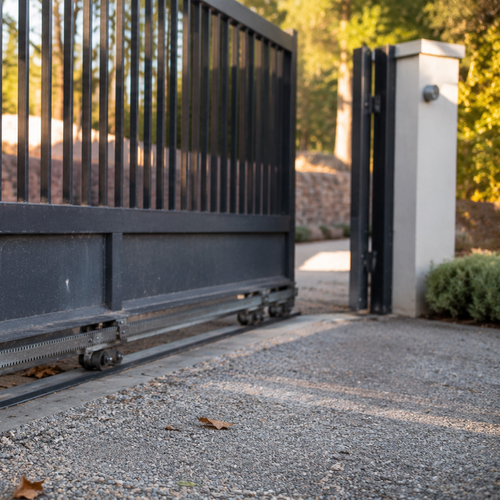
Quick Answer: A gate that opens slowly or stops partway is usually fighting resistance or running low on power. Common causes are debris or wear in the track and rollers (friction the motor can't overcome), a weak or failing motor or capacitor, a low battery or insufficient power on solar/battery gates, drifted limit settings telling the gate to stop early, or a safety sensor interrupting the cycle. Slow, straining movement points to friction or a weakening motor; stopping at the same spot points to an obstruction or a limit setting. Start by clearing the track and checking power, then call a technician for motor or control issues.
Your gate used to glide open in one smooth motion. Now it crawls, groans against itself, or makes it halfway and just stops, leaving you straddling the entrance. A gate that opens slowly or quits partway is different from one that won't move at all — it has power, and it's trying, but something is holding it back or cutting it short. That distinction actually helps, because it points you toward resistance, power, or a setting rather than a total failure.
Partial Movement Means It's Trying but Can't Finish
When a gate moves but moves poorly, three kinds of problems are usually at work: the gate is fighting more resistance than the motor can smoothly overcome, the motor doesn't have the power it used to, or something is telling the gate to stop before it's done. A gate straining slowly through its whole travel suggests friction or a weakening motor. A gate that stops at the same point every time suggests an obstruction or a limit setting. Reading which pattern you have narrows the cause quickly.
Resistance in the Track and Hardware
Debris, Dust, and a Dirty Track
For sliding gates, the track is the first thing to suspect. Dirt, leaves, rocks, and grit accumulate in the track and around the rollers, creating friction that the motor has to fight. In coastal and dusty areas, tracks foul faster than people expect. A gate dragging slowly, or stalling where the track is worst, is often simply fighting debris. Clearing and cleaning the track restores smooth travel in many cases.
Worn Rollers, Hinges, or Bearings
Beyond loose debris, the moving hardware wears out. Worn or seized rollers on a sliding gate, or stiff, corroded hinges on a swing gate, add resistance that slows the gate and strains the motor. Salt air accelerates this corrosion. As friction builds, the motor works harder, and the gate moves more slowly, until it may not have the strength to complete the cycle.
Not Enough Power
A Weak or Failing Motor or Capacitor
The motor provides the force to move the gate, and the capacitor gives it the boost it needs to run. As a motor wears or a capacitor weakens, the gate loses speed and power — it moves sluggishly and may stall before finishing because the motor simply can't drive it all the way. A gate that's gotten progressively slower over time often has a motor or capacitor nearing the end of its life.
A Low Battery or Insufficient Power
On solar or battery-backed gates, a battery that's aging or undercharged delivers less power, so the gate moves slowly or stops partway, especially after several cycles drain it. Dirty or shaded solar panels that can't recharge the battery cause the same thing. A gate that works fine when freshly charged but slows or quits as the day goes on points toward a power-supply problem.
A Signal Telling It to Stop
Drifted Limit Settings
Gate operators use "limits" that tell the gate exactly where to stop when fully open and fully closed. If those settings drift, the gate may stop short of fully open — appearing to "stop halfway" when it's actually reached what it thinks is its open position. A gate that consistently halts at the same incomplete point, without straining, often has a limit-setting issue rather than a mechanical one.
A Safety Sensor Interrupting the Cycle
The safety photo-eyes can also cut a cycle short. If a sensor is partly blocked, misaligned, or dirty and trips midway, the gate may stop or reverse partway as a safety response. A gate that stops and reverses, rather than just slowing, may be reacting to a sensor.
| What you notice | Likely cause | Technician focus |
|---|---|---|
| Slow, straining through whole travel | Track debris or worn rollers/hinges | Inspect track and gate hardware |
| Progressively slower over weeks | Weak motor or capacitor | Test the motor and capacitor |
| Slows or quits as day goes on | Low battery / weak solar charge | Test battery, charger, and panel output |
| Stops at same spot, no strain | Drifted limit setting | Check travel limits and controller |
| Stops and reverses partway | Safety sensor tripping | Test sensors and the safety circuit |
Note whether the gate strains as it slows or stops smoothly without effort. Straining points to friction or a weak motor — a mechanical or power problem. Stopping cleanly at the same spot with no strain points to a limit setting or sensor — a control problem. That one observation tells you, and your technician, where to look first.
A Technician Separates Wear From Control Faults
A slow or stopping gate needs the track, rollers, hinges, motor, capacitor, battery, travel limits, and safety sensors considered together. A technician uses whether the gate strains, stops at the same point, or reverses partway to separate mechanical wear from a power or control fault, then services the affected equipment.
If the gate is straining and progressively weakening, the motor or capacitor may be failing. If it stops cleanly at the wrong point, the travel limits or safety inputs need attention. InteleGates diagnoses the problem before recommending repair or replacement.
Frequently Asked Questions
Why does my gate stop at the same spot every time?
Stopping at the same incomplete point, especially without straining, usually points to a limit-setting issue — the operator thinks it has reached its fully open position when it hasn't, because the limit has drifted. It can also be an obstruction at that exact spot in the track. If the gate stops cleanly with no effort, suspect the limits; if it strains and stalls there, look for debris or wear at that point in the track.
Why is my gate opening so slowly all of a sudden?
A sudden slowdown often comes from new resistance — debris in the track, a seized roller, or a stiff hinge — or from a power issue, such as a weakening battery. A more gradual slowdown over weeks more often signals a worn motor or capacitor. Start by clearing and inspecting the track and checking the battery; if the gate keeps slowing despite a clean track and good power, the motor likely needs attention.
Can a low battery make my gate stop halfway?
Yes, on solar or battery-backed gates. An aging or undercharged battery delivers less power, so the gate may move slowly or stall partway, particularly after several cycles have drawn it down. Dirty or shaded solar panels that can't recharge the battery cause the same pattern. A gate that operates well when freshly charged but weakens through the day is showing a classic low-power symptom.
Why does my gate start to open, then reverse?
A gate that starts moving and then reverses partway is often reacting to a safety sensor. If a photo-eye is blocked, misaligned, or dirty and trips during the cycle, the gate stops and reverses as a safety response. It can also be an obstruction that the gate detects. A technician checks the sensors, safety circuit, gate path, and operator controls to identify the cause.
Is a slow gate a sign that the motor is dying?
It can be. A motor that's wearing out, or a weakening capacitor, gradually loses the power to drive the gate at full speed, so progressive slowing is a common sign of a motor nearing the end of its life. But slow movement can also come from friction — a dirty track, worn rollers, stiff hinges — that makes a healthy motor work too hard. Ruling out resistance first tells you whether the motor itself is the problem.
Find What's Holding It Back
A gate that opens slowly or stops halfway is trying but cannot finish, held back by friction, low power, or a control signal. Straining, sluggish movement points to track or hardware wear or a weakening motor; clean stops at the same spot point to a limit setting or a sensor. InteleGates checks the gate travel, battery, motor, capacitor, limits, and safety controls before recommending repair or replacement.
Gate crawling or stalling halfway? — Get the track, motor, and controls checked by gate specialists to restore smooth operation. InteleGates Inc. serves Los Angeles, Long Beach, Anaheim. Call (833) 468-4283.