
Sliding vs Swing Gates: Which Fits Your Property Best?
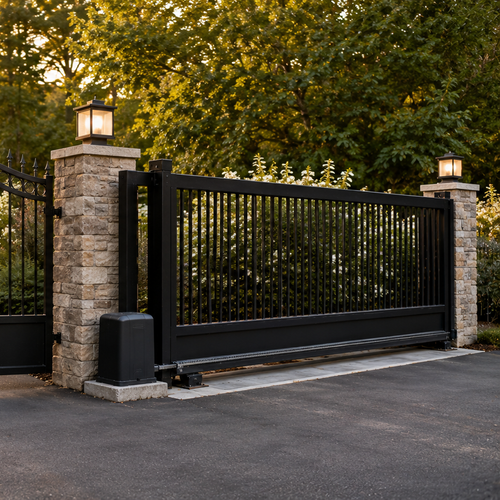
Quick Answer: Swing gates hinge open like a door and need clear space for the arc to swing; they suit level ground and wider entrances and tend to be simpler. Sliding gates roll sideways along a track and need room to the side rather than in front; they suit tight driveways, sloped ground, and high- or high-traffic settings. Choose a swing gate when you have the swing room and level ground; choose a sliding gate when space in front is limited, the driveway slopes, or you want stronger safety and faster, heavy-duty cycling for a busy property.
Putting in an automatic gate starts with a choice that shapes everything after it: sliding or swing. They're the two main styles, and picking the wrong one for your property leads to a gate that doesn't fit the space, struggles with the terrain, or doesn't suit how often it's used. The right choice comes down to your driveway, your ground, and your priorities — and once you understand how each type works, the decision usually becomes clear.
Two Different Ways to Open
The core difference is simple. A swing gate is hinged on one or both sides and swings open like a door, arcing into (or out from) your property. A sliding gate hangs from or rolls along a track and slides sideways, parallel to the fence line, to open. That single distinction — swinging through an arc versus sliding to the side — drives every practical consideration: how much space you need and where, how the gate handles slope, how secure and durable it is, and how it holds up to heavy use.
Space: Where You Have Room Matters
This is often the deciding factor. A swing gate needs clear, unobstructed space for its arc — the area the gate sweeps through as it opens must stay empty, which means you can't park a car or store anything in that path. A short driveway where a vehicle would sit in the swing path is a problem for a swing gate.
A sliding gate needs space to the side instead, along the fence line, for the gate to retract into. It doesn't intrude on the driveway in front at all, which makes it ideal for short driveways or entrances where there's no room for a gate to swing inward. The question is essentially: do you have room in front (swing) or to the side (slide)?
Slope and Terrain
Ground that isn't level strongly favors sliding gates. A swing gate has to clear the ground through its entire arc, so a driveway that slopes up will catch a swinging gate — it can't open without hitting the rising ground. A sliding gate moves sideways along a relatively level track and isn't affected by a sloped driveway in the same way. If your entrance slopes, a sliding gate is usually the practical choice.
| Factor | Swing Gate | Sliding Gate |
|---|---|---|
| Space needed | Clear arc in front of the gate | Room to the side along the fence |
| Best driveway | Longer, with room to swing | Short or tight — no front clearance needed |
| Sloped ground | Struggles — gate catches the slope | Handles slope well |
| Safety feel | Solid, but can be forced at the hinge | Harder to force; strong for high safety |
| Mechanism | Simpler, fewer ground parts | Track and rollers need upkeep |
| Heavy daily cycling | Good for moderate use | Built for frequent, heavy-duty use |
Control and Daily Use
For high-control and high-traffic settings, sliding gates often have the edge. Because they're anchored along a track and don't have a swing arc, they can be harder to force open and are commonly used for commercial properties, apartment complexes, and gated communities that cycle the gate constantly. They're built to handle frequent, heavy-duty use.
Swing gates offer solid control, too, and a classic look that many homeowners prefer, and they work very well for residential entrances with the space and level ground to suit them. For moderate residential use on the right property, a swing gate is a clean, effective choice.
Maintenance Considerations
The mechanisms differ in upkeep. A sliding gate's track and rollers need attention — debris, dust, and grit (common in coastal and dusty areas) collect in the track and must be kept clear for smooth operation, and rollers wear over time. A swing gate has fewer ground-level parts to foul, though its hinges and the operator arm need care, and the hinges bear the full weight of the gate as it swings. Neither is maintenance-free, but they require attention in different places. In a coastal or dusty metro, factoring in that upkeep — keeping a slide track clear or keeping swing hinges sound and rust-free — is part of choosing a gate you'll be happy with for years, not just on installation day.
Before deciding, stand at your entrance and look at two things: how much flat space sits in front of the gate versus to the side, and whether the driveway is level or sloped. Those two observations alone usually point clearly to swing (room in front, level) or sliding (tight in front, sloped, or high-traffic).
Frequently Asked Questions
A sliding gate is usually better for a short driveway. A swing gate needs clear space in front to arc open, and on a short driveway, a parked car or the street would sit in that path. A sliding gate retracts to the side along the fence line and doesn't intrude on the driveway in front, making it well-suited to short or tight entrances where there's no room to swing.
It's often problematic. A swing gate must clear the ground through its entire arc, so a driveway that slopes upward will catch the gate as it tries to open — it can't complete the swing without hitting the rising ground. Sliding gates handle slope much better because they move sideways along a track. On sloped terrain, a sliding gate is generally the more practical option.
Both can be secure, but sliding gates often have an edge for high-control needs. Because they're anchored along a track and lack a swing arc, they can be harder to force open, which is why they're common for commercial properties, apartments, and gated communities. Swing gates still provide solid control and suit many residential settings well. The best choice balances control with your space and terrain.
They require maintenance in a different place. Sliding gates rely on a track and rollers that need to be kept clear of debris, dust, and grit, and that wear over time, so the track is a key upkeep point. Swing gates have fewer ground-level parts to foul, but need attention to their hinges and operator. Neither is maintenance-free; sliding gates just concentrate their upkeep around the track.
Sliding gates are frequently the choice for busy commercial properties, apartments, and gated communities because they're built for frequent, heavy-duty cycling and can be harder to force, supporting both durability and control. Swing gates suit moderate-use residential settings better. For a gate that opens and closes constantly all day, a sliding gate's heavy-duty design typically holds up best.
Match the Gate to Your Space and Terrain
Choosing between a sliding and a swing gate comes down to a few practical realities: where you have room (in front for a swing, to the side for a slide), whether your ground is level or sloped, and how heavily the gate will be used. Swing gates suit longer driveways with level ground and moderate use; sliding gates suit tight or sloped entrances and busy, control-focused properties. Look honestly at your entrance, and the right type usually picks itself.
Deciding between a sliding and swing gate? — Get expert guidance and installation tailored to your property from gate specialists. InteleGates Inc. serves Los Angeles, Long Beach, Anaheim. Call (833) 468-4283.
