
InteleGates Guide
Underground Gate Opener Guide for Swing Gates
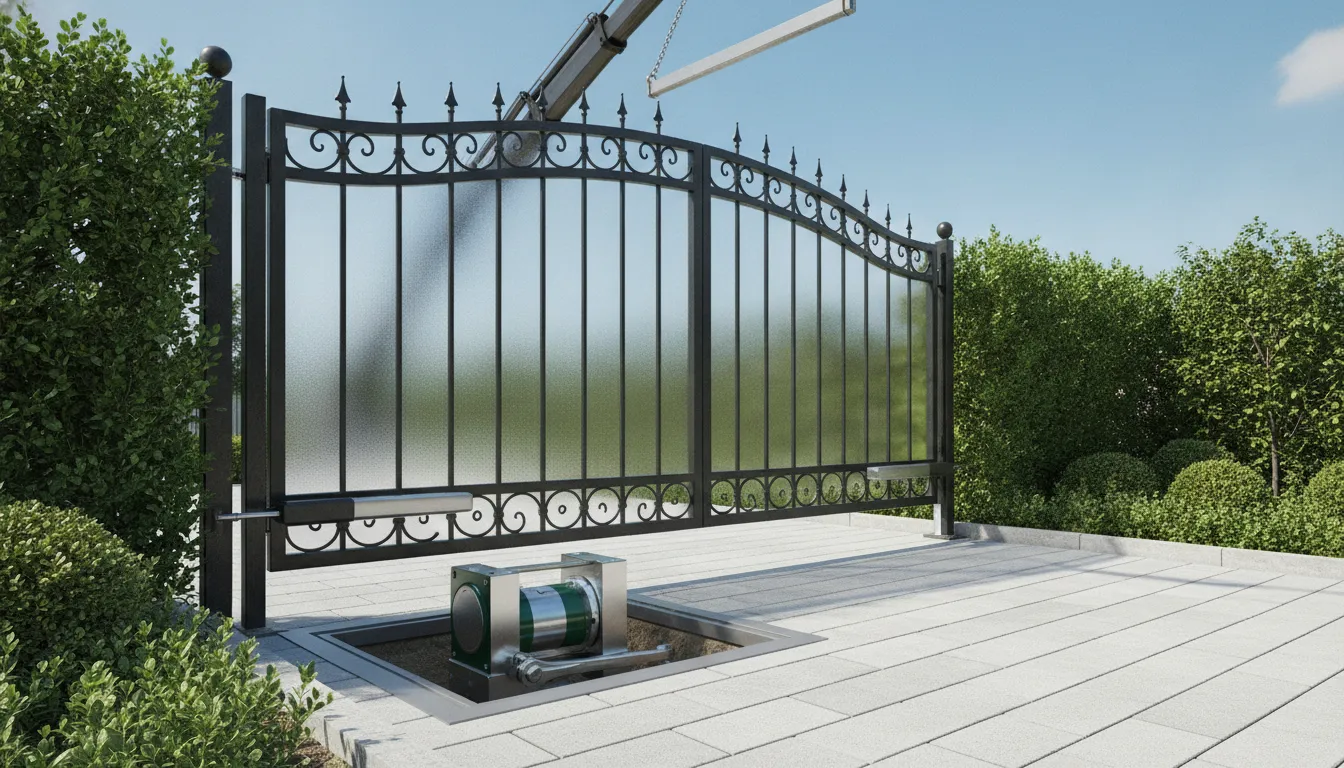
A swing gate may need automation without visible hardware at a carefully designed entrance. A below-grade operator can be worth evaluating. The appeal is straightforward, but the decision depends on more than appearance. Soil conditions, drainage, hinge geometry, electrical access, traffic patterns, controls, and future service access all affect whether the system is a practical fit.
An underground gate opener places the motor and drive mechanism below grade near the swing-gate hinge, keeping the operating hardware largely out of sight. This arrangement can preserve clean sightlines, but it requires a properly planned enclosure, water-management approach, control system, and maintenance strategy.
For that reason, the right starting point is understanding what is actually installed below the gate and how it supports the gate's movement. That foundation makes it easier to assess suitability before discussing equipment, controls, or installation planning.
Request a professional underground gate opener assessment
What Is an Underground Gate Opener?
An underground gate opener is a swing-gate operator concealed below grade near the gate hinge. Instead of placing an actuator on the gate post or beside the gate leaf, the motor and drive mechanism sit inside a below-grade enclosure. The gate still opens and closes through its hinges, while most of the operating hardware remains out of sight.
This arrangement is often chosen when the appearance of an entry matters as much as its operation. A concealed operator preserves clean sightlines around a driveway, courtyard, estate entrance, or commercial property. It can be a practical design choice for renovations and properties where visible equipment would distract from the architecture or landscape. The focus is not on hiding a weak system. It is on matching the operator arrangement to the gate, the site, and the owner's priorities.
How it works with a swing gate
An underground gate opener is designed for a swinging gate, not a sliding gate. A single swing gate has one moving leaf. A double swing gate has two leaves that open from the center or close toward it. The operator configuration, hinge arrangement, gate geometry, and control sequence must all work together so the leaves move as intended.
These systems may use electromechanical or hydraulic actuation, depending on the application and selected equipment. The appropriate choice depends on factors such as the gate's construction, movement, frequency of use, available space, and operating requirements. A concealed installation can support an elegant result, but it does not remove the need to evaluate the gate and surrounding property carefully.
Automation also includes more than the motor. Controls, electrical access, sensors, and safety features determine how people and vehicles interact with the entrance. Depending on the site, an automated swing gate may work with remote controls, an intercom, a keypad, telephone entry, or another access-control system. The operator should be treated as part of the complete gate automation design, not as an isolated piece of hardware.
For an overview of related system planning, see InteleGates' gate automation services. The next question is whether the property's gate geometry, ground conditions, drainage, access controls, and service requirements make a below-grade arrangement a good fit.
Is an Underground Gate Opener Right for Your Swing Gate?
An underground gate opener can be a strong fit when a swing gate needs discreet automation, but the right choice depends on the property rather than appearance alone. A professional assessment looks at how the gate moves, how often it operates, and how the operator can work reliably within the site conditions.
Start with the gate geometry. A single-leaf gate and a double-leaf gate place different demands on the operator, hinges, controls, and opening sequence. The direction and available arc of travel also matter. Sloped driveways, nearby walls, landscaping, and pedestrian paths can affect whether the leaves have enough clearance to open safely without disrupting traffic flow. Review these swing gate layout considerations before treating a concealed operator as a simple equipment selection.
Gate condition and movement
An underground system still depends on a gate that is structurally sound and moves correctly. Worn hinges, sagging leaves, binding, uneven clearances, or excessive friction can place unnecessary strain on the motor and affect consistent operation. The assessment should consider the existing gate as it is, including its weight, dimensions, hinge arrangement, and movement through the full opening and closing cycle. Swing gate operators may use hydraulic or electromechanical actuation, with the system selected around the gate and its operating requirements.
Terrain, traffic, and daily use
Terrain can influence both the gate's movement and the practical location of below-grade equipment. A level residential driveway may have different requirements from an entrance exposed to runoff, frequent vehicle cycles, or turning traffic. Property managers and commercial owners should account for peak activity, authorized users, opening speed expectations, and whether vehicles or pedestrians need separate access patterns. These details help determine the operator capacity, control arrangement, and safety features that make sense for the site.
Power and operating requirements
Electrical access is another part of suitability. The assessment should confirm how power and control wiring can reach the operator, controls, sensors, and other system components without creating an impractical service arrangement. Access needs may include remotes, an intercom, keypad, RFID, telephone entry, or vehicle detection. Soft start and stop, along with pinch-point protection, may also be relevant depending on the gate and its surroundings.
The best recommendation accounts for the complete system: gate condition, geometry, terrain, drainage planning, electrical access, traffic flow, controls, and long-term serviceability. InteleGates evaluates those relationships before recommending automation, installation, or maintenance for properties across Los Angeles and Orange County.
Why Drainage and Access Matter Below Grade
A concealed operator can preserve clean sightlines, but placing the motor below grade makes the surrounding site conditions especially important. Water management, enclosure placement, electrical access, and future service access should be considered together. A below-grade design is not simply an above-ground operator moved out of view. The equipment needs a suitable environment that supports dependable operation and practical maintenance over time.
Water management starts with the enclosure
The underground enclosure sits near the swing gate hinge, where surface runoff, irrigation, and changing soil conditions can affect the equipment. A properly planned enclosure and drainage approach help limit unwanted water exposure, but the right arrangement depends on the property's terrain and existing conditions. As one commercial gate resource explains, below-grade systems require specific attention to sealed housing, vault placement, drainage, and maintenance access: underground gate opener planning.
This is why a site assessment should look beyond the gate itself. Slopes, low points, nearby planting, paving, and drainage patterns can all influence where equipment can be located and how it can be accessed later. The objective is not to promise a universal drainage solution. It is to match the operator and enclosure arrangement to the actual property.
Electrical routing should support the whole system
The motor is only one part of an automated swing gate. Electrical routing must also serve the controls, safety devices, sensors, and any access equipment selected for the property. Planning these connections as one system helps avoid a setup where the operator is considered first and the control equipment is treated as an afterthought.
Electrical access can be more complex when the operator is below grade or when the gate is separated from the building's practical service points. A professional review can identify how power and control pathways relate to the gate location without relying on assumptions about the property.
Service access matters years after installation
Hidden hardware should not mean inaccessible hardware. The design should leave a practical path for inspection, adjustment, manual release access, and future service. Underground systems are not maintenance-free, and usage frequency, weather, surrounding conditions, and equipment selection all influence the maintenance plan.
For that reason, ask how routine attention will be handled before choosing a concealed arrangement. InteleGates provides electric gate system maintenance for systems that need ongoing review. A thoughtful plan protects the property's appearance while keeping the motor, controls, and safety equipment serviceable when attention is needed.
How Underground Swing Gate Operators Work With Access Controls
The operator is the movement component, while access controls determine who or what can request that movement. An underground gate opener places its motor and drive mechanism below grade near the swing-gate hinge, so the visible gate line remains relatively clean. The concealed location does not change the need for a coordinated control and safety system. It makes proper equipment selection, wiring, drainage planning, and testing especially important.
A remote can send an open command from a vehicle or nearby location. An intercom lets a resident, attendant, or property manager speak with a visitor before releasing the gate. Keypads, key cards, and RFID readers can provide access for authorized people without requiring a handheld remote. Telephone entry and buzzer systems can serve properties where visitors need to contact an occupant or office. For more context, see these remote and intercom gate controls.
Vehicle detection and safety devices work together
Access control is not limited to the device that starts the cycle. A LOOP vehicle-detection system can identify a vehicle in the appropriate detection area and support vehicle-triggered access control. Sensors can help the control system recognize an obstruction or confirm conditions around the gate. Their placement and behavior depend on the gate layout, traffic pattern, selected equipment, and site requirements.
A magnetic lock may be included where the overall design calls for an independent locking component. The operator opens and closes the gate, but it should not automatically be treated as the sole device holding the gate closed. The lock, release arrangement, controls, and operator must be evaluated as one system so that authorized entry and safe exit remain practical.
Smooth movement depends on coordinated setup
Swing gate systems may use hydraulic or electromechanical actuation. Depending on the equipment and design, soft start and soft stop can reduce abrupt movement at the beginning and end of a cycle. Pinch-point protection and other safety features also need to correspond with the gate's movement and surrounding clearances. These features are not interchangeable across every installation, so final compatibility is site and equipment dependent.
Professional testing should check the motor, sensors, access-control devices, electrical system, and gate operation under varied conditions. That includes testing each authorized entry method, confirming that safety devices respond as intended, and checking how the system behaves with normal vehicle and pedestrian traffic. A concealed operator can be an excellent fit for a design-focused property. But the right controls and safety devices must be selected around the actual gate, site, and operating requirements.
Underground vs. Above-Ground Swing Gate Automation
| Consideration | Underground automation | Above-ground automation |
|---|---|---|
| Visibility | The motor and drive mechanism sit below grade near the hinge, keeping visible hardware to a minimum. | The operator is visible beside or above the gate, making the equipment easier to identify during a property walk-through. |
| Site sensitivity | Requires careful planning for the underground enclosure, drainage, ground conditions, and future access. | Usually places fewer components below grade, but available post, wall, or gate-side space must accommodate the operator. |
| Service access | Service planning must account for access to the below-grade housing and protection from water exposure. | Visible components are generally easier for a technician to inspect and reach, subject to the gate layout. |
| Aesthetic fit | Well suited to designs where clean sightlines and discreet automation are important. | Can be a practical fit when visible operator hardware is acceptable within the property's design. |
| Planning needs | Assessment should cover gate geometry, terrain, drainage, electrical access, controls, and maintenance requirements. | Assessment still needs to confirm gate movement, mounting conditions, power, controls, safety devices, and service access. |
An underground gate opener is not automatically the better choice simply because it is concealed. Its below-grade position makes drainage, enclosure placement, and long-term service access important parts of the decision. Rainwater management and environmental conditions should be considered before equipment is selected, and maintenance planning remains necessary even when the mechanism is protected from direct view.
Above-ground automation may be the more practical fit when the gate structure provides suitable mounting space and visible hardware does not conflict with the property's appearance. It can also make inspection and servicing more straightforward. That does not make it a compromise in every setting. The right arrangement depends on how the gate moves, how much it is used. The available space, the terrain, electrical access, and the controls that need to work with the operator.
For either approach, a professional assessment should connect the gate, operator, controls, sensors, and electrical system into one workable plan. InteleGates evaluates these conditions for residential, commercial, and industrial properties across Los Angeles and Orange County, then recommends automation based on the site rather than a one-size-fits-all layout.
What a Professional Assessment Should Confirm
An underground gate opener depends on the relationship between the gate, the ground, the operator, the electrical system, and the access controls. A professional assessment brings those pieces together before equipment is selected. It should produce a clear understanding of what the property needs, what the existing gate can support, and how the completed system will be serviced over time. The assessment should confirm the following:
- Gate geometry and movement. The technician should evaluate whether the gate is a single- or double-leaf swing configuration. How the leaves move through their opening path, and whether hinges, clearances, weight, and alignment support automation. The assessment should also consider traffic flow and the property's operating requirements. These details help determine whether a concealed operator is a suitable fit and whether the movement can remain controlled and consistent.
- Ground conditions and drainage. Below-grade equipment requires careful attention to the ground around the operator enclosure. The assessment should consider terrain, soil conditions, likely water exposure, surface drainage, and how rainwater will be managed. Drainage is not a detail to assume away. Water management and enclosure placement can affect equipment serviceability, so these conditions should be reviewed as part of the electric gate installation plan.
- Enclosure and service access. A concealed design can preserve the appearance of a swing gate, but the equipment still needs an appropriate enclosure and practical access for qualified service. The professional should confirm where the operator will sit, how the enclosure relates to the gate hinge area. And whether future inspection or maintenance can be performed without creating avoidable disruption.
- Power and wiring. The assessment should identify the available electrical access, the route for wiring, and the relationship between the operator, controls, sensors, and other connected equipment. Electrical requirements are site-dependent. A qualified professional should determine the appropriate arrangement rather than relying on a general assumption about an existing circuit or future expansion.
- Controls and user access. The recommended system should match how people use the property. Possible controls may include remotes, keypads, intercoms, key cards, RFID, telephone entry, buzzers, magnetic locks, or vehicle detection through a LOOP sensor. The assessment should clarify which users need access, where control points belong, and how the operator will integrate with the property's broader access-control expectations.
- Sensors and safety functions. The professional should identify the appropriate safety devices and confirm how they interact with gate movement and access controls. Depending on the system, features may include soft start and stop and pinch-point protection. The goal is a coordinated operating sequence that accounts for people, vehicles, and the gate's movement, subject to the selected equipment and site conditions.
- Maintenance expectations. An underground gate opener should not be treated as maintenance-free simply because its motor is concealed. Usage frequency, environmental exposure, drainage, and access conditions should inform a practical maintenance plan. The provider should explain what ongoing service involves and how future concerns can be addressed.
- Testing under varied conditions. Before the system is considered ready, final testing should cover the motor, sensors, access controls, electrical system, and gate operation. Testing should include normal user scenarios and relevant variations in access and movement. This final review helps confirm that the installed system performs as planned and that the owner understands its controls and service expectations.
When Should You Call a Gate Automation Professional?
Bring in a gate automation professional when the operator must fit the property, the gate, and the way people use the entrance as one coordinated system. An underground gate opener can keep visible hardware to a minimum, but the concealed design makes early planning especially important. A qualified assessment can determine whether the swing gate, below-grade enclosure, controls, power, drainage, and service access are suitable before equipment is selected.
You are planning a new swing-gate automation system
New construction and major driveway projects are the right time to discuss automation. The professional can review whether the gate is a single- or double-leaf configuration. How it moves through its opening area, and how vehicle and pedestrian traffic will approach it. Terrain, operating frequency, electrical access, and the desired access method all affect the system design. InteleGates installs and services swing gate operators in both single and double configurations, with hydraulic or electromechanical actuation selected according to site requirements.
The gate is being remodeled or appearance matters
Design-led remodels often call for a discreet motor solution. If visible operator hardware would interrupt a finished wall, landscape, or architectural sightline, an underground arrangement may be worth evaluating. The decision should still account for ground conditions and future service access, rather than treating appearance as the only criterion. Reviewing concealed gate motor options can help clarify the visual tradeoffs before the remodel is finalized.
Movement has become unreliable
Slow, uneven, hesitant, or inconsistent movement is a reason to schedule an assessment, not a reason to experiment with the motor or controls. The cause may relate to the operator, gate geometry, sensors, electrical system, drainage, or changing usage demands. A professional can evaluate the complete relationship between those components and recommend appropriate repair, adjustment, replacement, or automation service.
You want better controls or a maintenance plan
Call before adding a keypad, intercom, remote, telephone entry system, RFID reader, or vehicle-detection loop. The control layer should match the operator and daily traffic pattern. A professional can also plan maintenance around usage frequency and environmental conditions. For underground equipment, drainage and access deserve particular attention because below-grade placement requires practical water management and a sensible route for future service.
InteleGates provides gate automation services across Los Angeles and Orange County, with assessment, installation, repair, integration, testing, and maintenance focused on the motor and access-control system.
Talk with InteleGates about your swing-gate automation needs
Frequently Asked Questions
What is a ghost gate opener?
A ghost gate opener is a concealed automation system, usually installed below grade near the hinge area of a swing gate. The term describes the low-visibility appearance, not one specific motor or technology. Equipment selection still depends on the gate's geometry, weight, usage, electrical access, and control requirements.
Can an underground gate opener operate a heavy swing gate?
It may be suitable, but "heavy" alone does not identify the right operator. A professional evaluates the gate leaf or leaves, hinge condition, movement, traffic flow, terrain, and expected cycle frequency before recommending hydraulic or electromechanical equipment. Single- and double-gate configurations can require different system planning.
Is there a 120V underground swing gate opener?
Some systems may be designed for 120V power, but voltage compatibility is site- and equipment-dependent. The assessment should confirm available electrical service, control-board requirements, wiring conditions, and the selected operator's specifications. Do not choose an opener based on voltage alone.
Why is drainage important for an underground opener?
The motor enclosure sits below grade, so soil conditions, water movement, enclosure placement, and drainage need careful review. Poor water management can affect serviceability and equipment performance. The installation plan should also preserve practical access for inspection and future maintenance rather than treating the system as maintenance-free.
What should a professional assess before installation?
The assessment should confirm swing-gate geometry, terrain, traffic flow, operating requirements, ground and drainage conditions, electrical access, controls, safety devices, and maintenance access. Final testing should include the motor, sensors, access-control equipment, electrical system, and operation under varied conditions. This process helps match the automation to the property instead of forcing the site to fit a product.
Ready to Assess Your Underground Gate Opener?
An underground gate opener can be a strong fit when the gate, surrounding ground, drainage, electrical access, and control requirements work together. A professional assessment helps identify the appropriate automation approach and service considerations before a project moves forward. To request a professional underground swing-gate automation assessment, contact InteleGates through the contact page and share your gate setup and goals.