
InteleGates Guide
Underground Gate Exit Sensor Installation
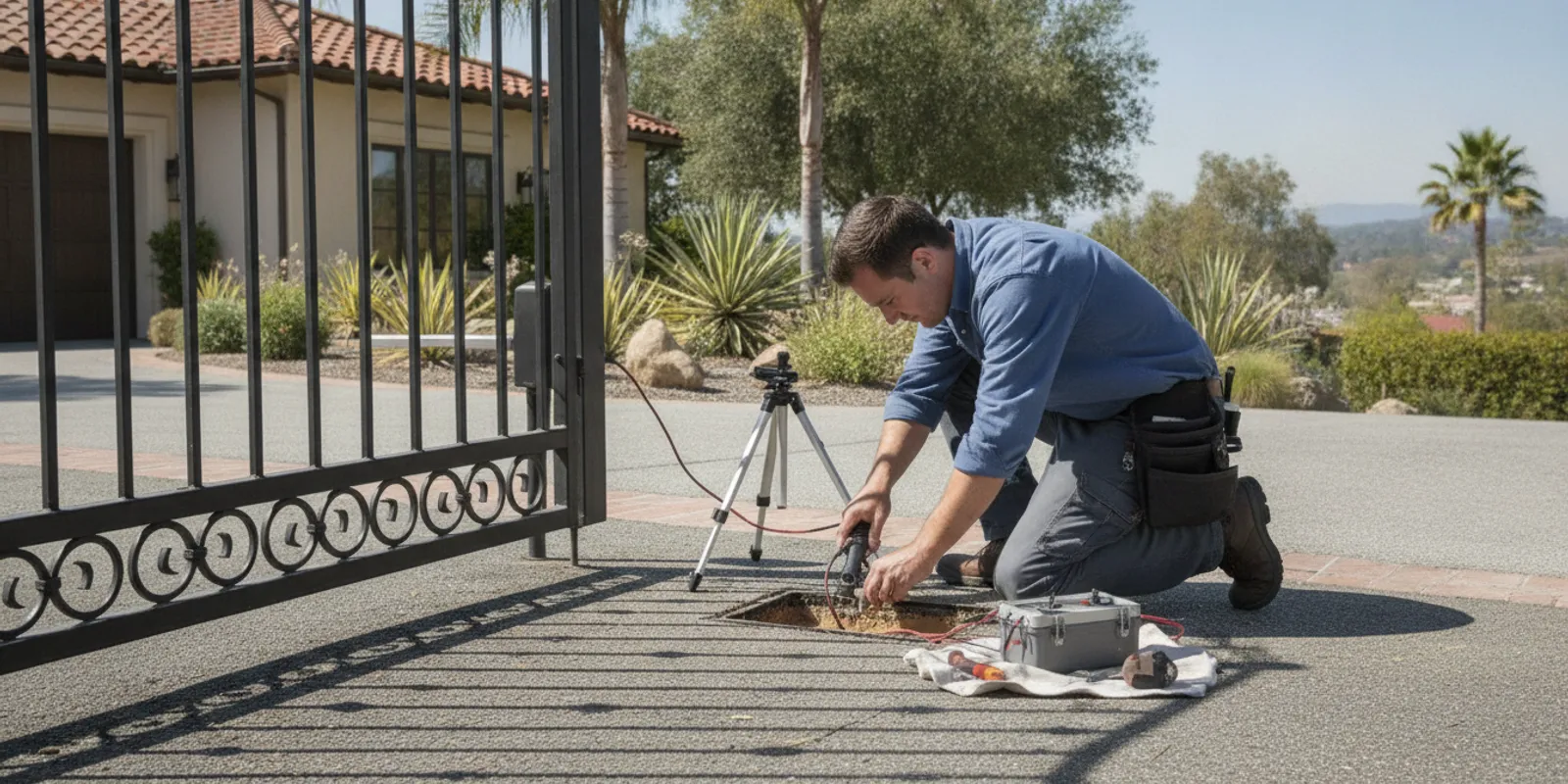
An underground gate exit sensor installation lets a vehicle leaving the property trigger an existing automatic gate. The sensor is usually a wire loop in the pavement and a detector that signals the operator. Whether that function fits the site depends on the vehicle path, the pavement, the lead-in to the controls, and the operator already in place. Ron Albert brings 25+ years of hands-on gate and access-control experience. A site review separates the detection request from any separate gate or operator problem.
Request an assessment for your existing gate
What does an underground gate exit sensor installation include?
The exit function is a command, not a second operator. A loop in the exit path detects a vehicle. The detector sends that signal to an opening input on the existing controls. If the operator supports that input and the gate is already moving correctly, the signal can start the opening sequence as the vehicle leaves.
That sequence has several parts. The loop has to sit where the intended vehicles actually pass. The detector has to be housed where it can connect to the controls. The operator has to accept the command and move the gate. Existing protective devices stay part of the system. Adding detection does not replace them, and it does not repair a gate that drags, binds, or stops.
InteleGates services and automates existing gates. It does not manufacture gates or fences. For the care of the operator and the rest of the system, the electric gate system maintenance page describes what a service visit looks at. If the gate already fails to move, electric gate repair is the closer starting point than a new sensor.
How a loop senses a vehicle is a separate subject. The guide to how gate loop detectors work covers the coil, the detector, and the operator together. This page stays on the question of what changes the installation from one driveway to the next.
Why does the installation scope change from one driveway to the next?
Two properties can want the same result and still need different work. The loop location, the surface, the route to the detector, the control board, and the daily traffic are not the same. Those differences decide what a technician inspects before recommending a setup.
- Vehicle route: The loop belongs where exiting vehicles actually travel. A straight lane is different from a driveway where cars turn sharply, stop near the gate, or leave from more than one direction.
- Surface and access: Concrete, asphalt, cracks, patches, and drainage change how a loop can be placed and sealed. The path from that loop back to the detector needs a workable route.
- Existing operator and board: The operator has to be in working condition and have a suitable input for the detector. The visible manufacturer and model help identify what is already installed.
- Gate movement: A sliding gate, a swing gate, and a barrier arm travel differently. The exit command has to fit that movement, not the other way around.
- Traffic pattern: A single-family driveway, a shared residential entrance, and a commercial lane see different vehicle sizes, volumes, and stopping habits.
- Other controls: Remotes, keypads, telephone entry, and intercoms already tell the operator what to do. The exit signal has to sit alongside those controls.
A single lane over intact pavement can be straightforward to review. A shared entrance is not. Cars may wait near the gate while another vehicle turns out. The technician needs to know which movement should open the gate and where a vehicle can wait. The sensor does not set that sequence. The operator and its controls do.
An underground swing operator is a different piece of equipment. The underground gate opener guide is about the operator under a swing gate, including drainage and access below grade. An exit sensor can be discussed with that operator, but the sensor is not the operator.
What should a technician inspect before recommending a setup?
A useful visit follows the signal from the vehicle to the gate. It starts at the intended crossing point, then looks at the loop and lead-in, the detector, the control input, the operator, the gate movement, and the protective devices already installed. A fault in one of those parts should be named separately from the requested sensor work.
- Map the exit path. Note where each vehicle travels, where it may pause, and whether every exit uses the same lane. Mention delivery trucks or other larger vehicles if they take a different line.
- Look at the pavement. Surface type, cracks, old patches, and drainage tell the installer what the site review has to account for. Those notes do not replace the visit.
- Find the detector and controls. The detector needs a place to live, and the loop lead-in needs a path to the operator controls.
- Identify the operator. Read the manufacturer and model from the outside of the enclosure if the labels are visible. Do not remove covers or change settings to find them.
- Describe gate behavior. Say whether the gate opens and closes normally, pauses, reverses, or acts differently at certain times. A movement problem may need diagnosis before the exit function can be judged.
- List the other access devices. Keypads, remotes, intercoms, and telephone entry already command the same operator. The exit function has to work with them.
- Agree on the boundary of the visit. Ask whether the proposed work covers the loop, the detector, the connection, and a functional check, and which repairs would be separate.
Most gate problems can be diagnosed during the initial service visit. Repair time depends on the cause of the problem, parts availability, and the condition of the gate and operator. When a worn motor, sensor, control board, or track or chain component cannot be repaired, the technician replaces that component. That is a repair decision, not part of every sensor installation.
The gate automation pages keep the conversation on the equipment that moves an existing gate. Electric gate system installation covers operator work when the operator itself is the project.
How should you compare exit-sensor options?
Compare the scope and the fit with the property, not a detector by itself. Ask how the location, the wiring route, the control input, and the final check relate to the way vehicles leave. The table is a discussion checklist. It is not a substitute for a site visit, and it is not a menu of products.
| Part of the review | Questions to ask | Why it matters |
|---|---|---|
| Vehicle path | Where will vehicles cross, and do all exits use that route? | The trigger location should match real traffic. |
| Pavement | What surface is present, and where can the loop sit? | Site conditions shape the installation approach. |
| Lead-in and detector | Where will the detector sit, and how will wiring reach the controls? | The signal needs a workable path to the operator. |
| Operator and controls | What are the make and model, and is there a compatible input? | The detector has to communicate with the existing system. |
| Gate behavior | Does the gate move reliably, and what should happen after detection? | A sensor cannot fix a separate movement fault. |
| Safety and access | How will the exit trigger interact with protective devices and other access controls? | The whole operating sequence needs review. |
| Scope and testing | Which components and checks are included, and what needs separate service? | Clear boundaries prevent assumptions about the work. |
Ask how the technician will confirm the trigger after the work. A practical check follows the intended vehicle path and confirms that the signal produces the expected gate response. If the site has more than one lane or vehicle type, ask whether each relevant route will be checked. The exact test depends on the equipment and the site.
An exit loop and a safety device do different jobs. A general overview of loop underground sensor installation covers how loops are placed in a driveway. It does not decide whether an exit command is the right function for a particular operator. Photo eyes and edges are a third topic. The automatic gate safety sensors guide explains those devices and how they differ from vehicle loops.
How is an exit sensor different from a safety device?
An exit sensor is there to open the gate for a vehicle that is leaving. A safety device is there to reduce entrapment risk while the gate moves. They can both be present, and they are not interchangeable. Treating a vehicle loop as if it protected people near the gate is a mistake.
Since 2000, two means of entrapment protection have been required in each entrapment zone for gate operators covered by UL 325. The Door and Access Systems Manufacturers Association states that requirement in its UL 325 and gate installations FAQ. Adding an exit loop does not satisfy that requirement, and it does not replace devices already installed for entrapment protection. A qualified technician should look at the operator, the gate, and the devices that are actually on the site.
Tell the technician where people walk or wait, how vehicles queue, and which protective devices are already installed. Do not assume a new detector makes the entrance safe. If the question is about the safety standard rather than the exit function, the UL 325 gate safety requirements article is the place for that discussion.
What should you gather before you call?
A short list makes the first conversation more useful. Gather what you can see from outside the equipment. Do not open an electrical enclosure or change a setting to get the information.
- The city, and whether the property is a home, a multi-unit community, or a commercial site.
- The gate type: sliding, swing, barrier arm, vertical lift, or another configuration.
- The operator manufacturer and model, if the label is visible without opening the enclosure.
- What happens now when a vehicle leaves, and when that behavior started.
- Where vehicles drive, pause, or turn, including a second lane or another exit path.
- Any recent pavement or gate work, if you know about it.
- Which remotes, keypads, intercoms, or telephone-entry devices are already in use.
If a loop is already in the pavement, describe the symptom. The gate may fail to open, open only sometimes, or open when no vehicle is expected. Those patterns are clues. They do not prove whether the detector, the wiring, the control input, the operator, or the traffic pattern is involved.
Related entrance equipment has its own pages. Gate access control and access control systems describe the wider entrance. A phone-entry question belongs with gate telephone entry. A keypad question belongs with gate keypad service. An operator-board fault is closer to gate control board repair than to a new loop.
InteleGates serves Los Angeles County and Orange County. Regular office hours are Monday through Thursday, 8:30 AM to 5:00 PM, and Friday, 8:30 AM to 3:00 PM. Emergency gate service is available Sunday through Friday for qualifying emergencies. Call for availability. Confirm the property is inside the current service area before arranging a visit. If the operator is a LiftMaster, the LiftMaster gate operator page is one example of brand-specific context on the site.
How can you tell a sensor issue from a gate issue?
Start with the symptom. If the gate moves normally from another control but does not respond when a vehicle leaves, the detection path or its connection is a reasonable place to look. If the gate also struggles from a remote or a keypad, the operator, the gate movement, the power, or the controls may need attention too. Those clues guide a diagnosis. They are not a test to run yourself.
Timing helps. Note whether the problem is constant or occasional, whether it began after paving or electrical work, and whether it affects every vehicle or only some routes. If the gate opens when you did not expect it, say where the vehicle was and which other controls were in use. Do not keep triggering a misbehaving gate if people or vehicles could be in its path.
Separate sensor work from operator repair so the proposed tasks stay clear. LiftMaster repair and electric gate maintenance cover operator condition. Intercom system service covers a different device on the same entrance. Naming the symptom first keeps a detection request from being treated as a full operator replacement, or the reverse.
What changes at a shared or commercial entrance?
A shared entrance has more than one driver's route. Residents, visitors, deliveries, staff, and service vehicles may stop in different places or approach at different angles. A useful review looks at the common path and the exceptions. It does not assume every vehicle crosses one point the same way.
Write the operating need down before the visit. Note the busy hours, whether two vehicles sometimes follow closely, and whether a delivery truck uses a wider turn. Also note who is allowed to request a change to the controls. That separates a requested change in behavior from a fault that needs repair.
On a small residential driveway, the owner can usually describe the usual route and the gate behavior directly. On a larger property, a manager may need observations from the people who use the entrance. The closer that description is to everyday use, the easier it is to judge whether the proposed detection point fits the site.
Frequently asked questions
Can an underground exit loop open any automatic gate?
No. The detector has to be compatible with the operator and the controls, and the existing system has to support the exit function. The equipment and the site both need to be checked.
Does the loop replace the gate operator?
No. The loop detects a vehicle and sends a signal. The operator moves the gate. An operator fault or a gate that does not travel correctly may need separate service.
Can I choose a loop location without a site review?
You can describe the route and the likely crossing point. The final location still has to account for the pavement, the wiring path, the controls, and the full gate sequence. A qualified installer reviews those conditions on site.
Should I adjust the control board before service?
No. Do not open the enclosure, handle wiring, or change settings as a test. Share the symptoms and the equipment details you can see from outside.
What if the gate also fails to open from the remote?
Say that the problem happens with more than one control. That pattern can point to the operator, power, controls, or gate movement in addition to vehicle detection. The system should be looked at as a whole.
Discuss your existing gate and exit sensor needs
Share the operator details, the vehicle route, the gate behavior, and the result you want. A technician can then judge the next step for the existing system.