
InteleGates Guide
Vertical Pivot Gate Operator Guide
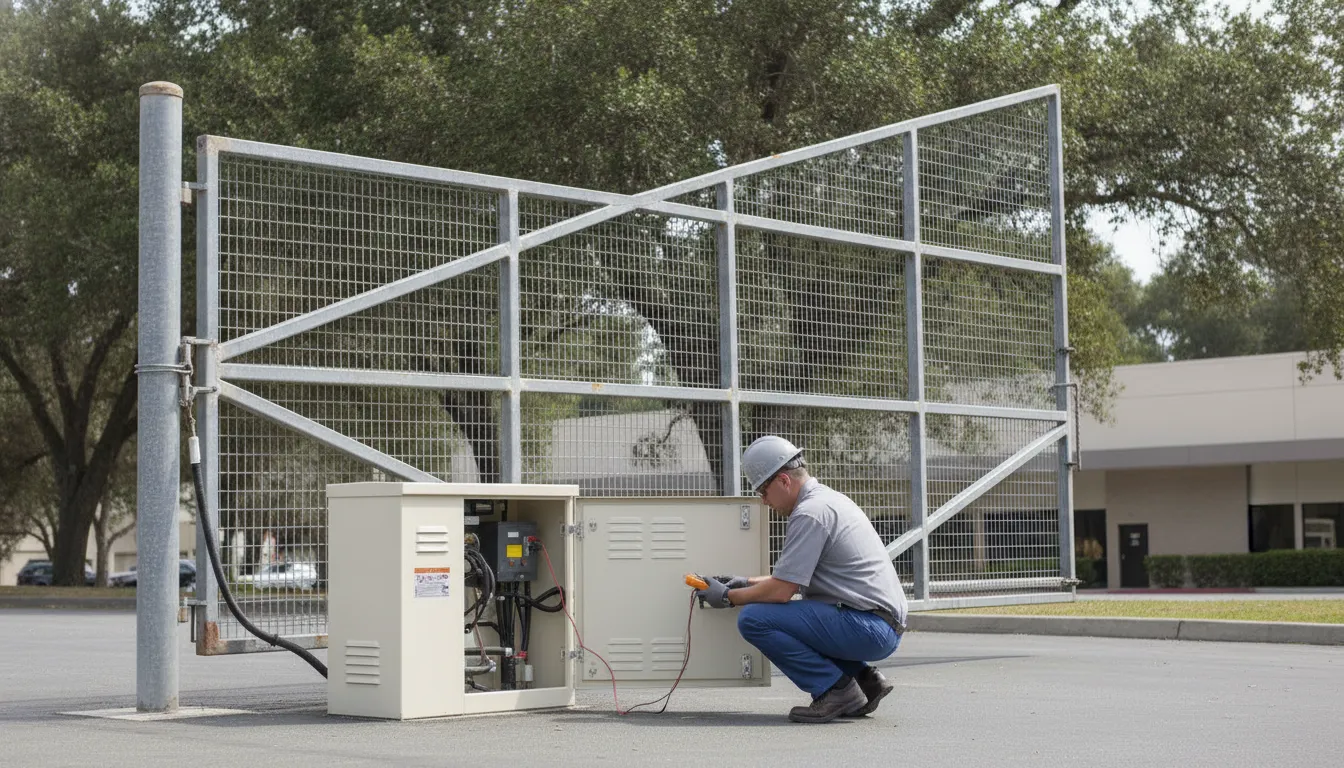
A vertical pivot gate operator rotates one corner of a vehicle gate so the leaf rises from a closed horizontal position toward a near-vertical open position. It is not a swing operator, a slide operator, or a barrier arm. The operator, counterbalance, foundation, and safety devices have to match that motion, or the gate will bind, drift, or stop partway through travel.
Request a vertical pivot operator assessment
InteleGates specializes in gate automation, electric gate operators, access control, and related electrical and electronic systems. We do not manufacture gates or fences. On a pivot system, the useful first step is diagnosis: confirm the leaf, the operator, and the safety devices before anyone recommends a replacement motor.
What a vertical pivot gate operator does
Picture the closed gate as a long leaf lying across the lane. One end is the pivot. The operator turns that end so the free end climbs an arc and the opening clears vehicles underneath. A barrier arm only lifts a slim arm. A vertical lift operator raises the whole leaf straight up on guides. A pivot leaf travels on an angle, so overhead clearance and the path of the free end both matter.
Most operators built for this motion use an electromechanical drive rather than hydraulics. The drive turns an arm or linkage that is tied to the gate. Springs, a counterweight, or both offset the leaf so the motor is not lifting the full weight on every cycle. Battery backup is common because a dead operator can leave a heavy leaf in a bad position during an outage.
The gate panel itself is a separate product. A service company can install, repair, or maintain the operator and its controls. It should not be described as the fabricator of the leaf or the fence. If the leaf is bent, rusted through, or built so it cannot be balanced, the operator cannot fix that by itself.
Where the motion fits
This layout is often chosen where a swing arc would hit a slope, a parked car, or a short driveway. It also fits where a slide gate has no room to run along the fence. Snow and some debris sit under a raised leaf instead of in a ground track. The tradeoff is structural. The pivot foundation, the hinge hardware, and the balance all carry a large moment every time the gate moves.
Commercial lanes, industrial yards, and some estate drives use the design when the opening is wide and side clearance is poor. It is a poor fit when overhead lines, trees, or a low canopy cross the rising path. It is also a poor fit when the leaf is too heavy or too flexible for the operator's rated moment.
How to check operator compatibility
Compatibility is a site measurement, not a catalog guess. A technician starts with the leaf that is already there, or with the leaf a gate builder will supply, and then matches an operator that can move that load through the real arc.
| Check. | What to measure. | Why it changes the operator choice. |
|---|---|---|
| Leaf and moment. | Length, weight, and where the weight sits from the pivot. | A long light leaf and a short heavy leaf can demand different spring packs and drive ratings. |
| Travel path. | Overhead clearance and the arc of the free end. | Wires, branches, and signs in the arc make the layout unsafe even if the motor is strong enough. |
| Foundation and hand. | Left-hand or right-hand pivot, pad size, and soil at the corner. | The operator and leaf share one corner. A soft or undersized pad lets the system walk out of alignment. |
| Power and backup. | Available voltage, conduit, and battery-backup expectation. | Low voltage and backup change wire size, control location, and what happens in an outage. |
| Cycle use. | Vehicles per day, and whether the lane is residential or commercial. | A high-cycle lane needs a duty rating and a maintenance interval the light-duty unit may not have. |
| Controls already on site. | Remotes, keypads, readers, loops, and intercom brand. | The new operator has to accept those inputs, or the access plan has to change with it. |
Spring count and spring tension are part of that match. Manufacturer manuals set spring quantity from gate moment, then tension the pack so the leaf is balanced near the closed position. Slide height and arm geometry are adjusted only after that balance is close. Those steps belong to a trained installer with the manual for that model. They are not a weekend adjustment.
If you are comparing operator classes before a site visit, the gate operator brands overview is the broader buying frame. This page stays on the pivot motion only. General sizing math for swing and slide gates lives on its own article and should not be copied onto a pivot leaf.
What a site visit should confirm
A useful assessment covers the pad, the hand of the operator, the leaf condition, the balance, the full arc, and the safety devices. It also notes drainage at the pivot corner. Standing water and a settling pad show up later as a gate that closes crooked. Photos of the nameplate, the spring pack, and the control board save a second trip when a part has to be ordered.
Most gate problems can be diagnosed during the initial service visit. Repair time depends on the cause of the problem, parts availability, and the condition of the gate and operator.
Safety devices on a rising leaf
A pivot leaf is large, and the free end moves through a wide arc. Entrapment risk sits at the pivot, along the bottom edge as it meets the ground, and anywhere a person or vehicle can be struck by the moving panel. UL 325 is the operator standard that requires monitored entrapment protection on automated vehicular gates. The public UL gate-operator briefing describes inherent protection in the operator plus external devices such as photoelectric eyes and sensing edges, with rules that differ by gate type.
On this layout, non-contact photo eyes and a monitored sensing edge are the usual external pair. The edge belongs on the bottom or leading surface that can meet an obstruction. Photo eyes belong where a vehicle or person crosses the opening, and they have to stay aligned after the foundation settles. Loops detect vehicles. They do not replace an entrapment device for a person standing near the leaf.
UL also separates gate operators by class of use, from a single home through guarded industrial sites. The class on the nameplate should match how the lane is actually used. A residential-duty unit on a busy commercial lane is a compatibility problem, not a settings tweak. For the broader rule set, read the UL 325 gate safety requirements guide and the automatic gate safety sensor guide. This section only covers how those devices sit on a pivot leaf.
The cited overview is UL's gate operator safety briefing for code authorities. It is a standards summary, not a substitute for the current manual on the operator you own. Test every external device after service. A bypassed edge or a bagged photo eye is how a rising leaf becomes a crush hazard.
Obstruction force is not a substitute
Inherent reversal, the operator sensing resistance and stopping or reversing, is required. It is not enough by itself on layouts that also need an external device. If the only protection is a force setting turned up so the gate will finish its arc, the system is masking a balance or alignment fault. Fix the mechanical cause, then set force back to the manual's range.
How the operator should work with access control
The operator opens and closes the leaf. Access control decides who is allowed to start that cycle. On a pivot gate those are different devices, even when they share a cabinet.
Typical inputs are a keypad, a remote, a card reader, a telephone entry unit, or a vehicle loop that triggers close after a car passes. Each input is a dry contact or a supervised signal into the operator control board. Mixing brands is normal. What fails is wiring an old loop or a sticky keypad into a new board without testing the open, stop, and close logic.
Free-exit and close-on-loop logic need a clear lane. A vertical leaf that is still coming down will block the loop's expected path. Timers have to allow the full arc, including a slow start and slow stop, before a close command is accepted. If the property uses a gate keypad, gate remotes, or a vehicle detection loop, those pages cover the devices. Here, the point is timing: the pivot arc is slower and taller than a barrier arm, so copy-paste settings from a parking arm are wrong.
Manual release matters as much as the electronics. Staff need a documented way to secure or move the leaf when power and backup are both down. That procedure should match the operator manual. It should not depend on someone lifting a counterbalanced leaf by hand.
Symptoms that call for diagnosis
Do not keep cycling a pivot gate that stops, leans, or groans. Extra commands heat the motor and can unload a spring pack that is already out of range. Call for diagnosis when you see any of these:
- The leaf stops at the same point in the arc, or it reverses without hitting an obvious obstruction.
- One side hangs lower than the other when the gate is closed, or the bottom edge strikes the pavement.
- Springs look uneven, a spring is broken, or the gate feels heavy the moment the manual release is opened.
- The operator hums, clicks, or runs while the leaf barely moves.
- Photo eyes or the sensing edge fault after rain, or the gate only runs while a device is bypassed.
- The pad has cracked, the operator cabinet has shifted, or the pivot hardware shows fresh metal wear.
- Remotes or the keypad start the operator, but the leaf does not finish a full open and close.
Noise is a clue, not a diagnosis. A grind at one point in travel often means the arm geometry or the balance changed. A buzz with no motion often means a control, capacitor, or limit issue. The electric gate motor noise guide walks through sounds in general. On a pivot operator, pair that with a look at springs and the foundation before you assume the motor is done.
Repair versus replacement follows the same rule as any other operator. If the leaf, pad, and safety devices are sound and the fault is a worn part with a manual behind it, repair is rational. If the operator is undersized for the moment, the cabinet is full of bypassed safety wiring, or the leaf can no longer be balanced, replacement of the operator is the honest recommendation. The repair or replacement guide covers that decision without treating a pivot leaf as a swing gate.
Operation and maintenance that prevent repeat visits
Day-to-day operation should be boring. The leaf starts smoothly, clears the lane, and settles closed without bouncing. Limits and slowdown points are what keep the free end from slamming. After any power outage, watch one full cycle before you rely on unattended use. Backup batteries can run a few cycles and then leave the leaf short of closed.
Maintenance is a short list, done on a schedule rather than after a failure. Manufacturer charts for this operator type commonly call for the following pattern. Your manual wins if it is stricter.
- Each week, test the sensing edge and confirm the gate reverses or stops.
- Each month, test photo eyes, loops, and other accessories, and check battery voltage.
- Each year, grease the arm and frame fittings the manual names, and inspect spring tension and hardware.
- As needed, clear debris, ice, or mud from the pivot area and clean the photo eyes.
Do not add grease to a sealed gearbox, and do not tension springs to hide a bent leaf. Those shortcuts unload the wrong part. A maintenance visit should also confirm entrapment devices are still monitored by the board. A device that is powered but not monitored can fail the UL 325 check even though it looks installed.
Electric gate maintenance is the service page for scheduled care. Electric gate repair is the right path when the leaf is already down or stopping mid-travel. Installation of a new operator, including pad coordination with the gate builder, starts from electric gate system installation.
What not to do between visits
Do not hang signs, holiday lights, or screening on the leaf. Added weight changes the moment the springs were set to carry. Do not let irrigation spray the operator cabinet or the spring pack. Do not prop photo eyes out of the way so deliveries can pass. If the gate is in a high-cycle lane, put it on a written maintenance interval instead of waiting for a stuck-open call. Property managers can use the same visit to review who has codes and remotes.
How this differs from a vertical lift or a barrier arm
People shop these three layouts together because each one avoids a long slide track. They do not share an operator.
A vertical lift gate operator raises the leaf straight up. It needs overhead guides and a clear vertical route. Our vertical lift gate operator guide covers that path, the overhead check, and lift-specific service. Do not use a pivot operator on a guided vertical leaf, or a lift operator on a pivoting leaf.
A barrier arm lifts a lightweight arm, usually in a few seconds, for a parking lane. The foundation, the entrapment devices, and the cycle rating are different. The barrier arm operator guide is the commercial-lane article. A full vehicle leaf that pivots is closer to a gate than to a parking arm, even though both rotate upward.
Swing and slide operators are a third family. They need a different arc or a runway, and their entrapment zones sit at the ends and along the track. If the property is still choosing a layout, start with a site look at clearance rather than with a motor brand. Gate automation is the service overview for that choice across Los Angeles and Orange County. Commercial gate automation in Los Angeles covers higher-cycle sites without repeating this operator's balance checks.
When a specialist should inspect the system
Call a gate-automation technician before you replace the operator if the leaf was never balanced after a repair. Do the same if the foundation has shifted, a safety device is bypassed, or nobody can find the spring-pack manual. Also call before you add a new keypad, reader, or loop. The control change is small. The effect on open and close timing is not.
InteleGates diagnoses the operator, controls, and safety devices on electric gate systems. We do not build the gate leaf or the fence. If the panel has to be replaced, that work belongs with a gate builder, and the operator balance has to be reset afterward. Service covers Los Angeles and Orange County, including estate drives and commercial lanes that already use this style of operator.
Regular office hours are Monday through Thursday, 8:30 AM to 5:00 PM, and Friday, 8:30 AM to 3:00 PM. Emergency gate service is available Sunday through Friday for qualifying emergencies. Call for availability at 833-468-4283.
Call 833-468-4283 to schedule a pivot operator diagnosis
Frequently asked questions
What is a vertical pivot gate operator?
It is the motor and linkage that rotate a vehicle gate upward from one corner. The leaf swings through an arc to a near-vertical open position. Springs or a counterweight offset the weight so the motor can start and stop the leaf under control.
How is it different from a vertical lift gate?
A pivot leaf rotates on an arc from one corner. A vertical lift leaf travels straight up on guides. The operators, foundations, and safety-device placement are not interchangeable. A site with no overhead room can fail both layouts.
Can you add an operator to an existing pivot gate?
Sometimes. The leaf has to be straight, strong enough for the moment, and able to be balanced. The corner pad has to hold the operator still. If those checks fail, a new motor will not make the gate reliable.
How often should the safety devices be tested?
Test the sensing edge weekly and the photo eyes and other accessories monthly, unless the operator manual requires a shorter interval. Test again after any impact, any electrical work, or any time the gate is held on a bypass.
Who should adjust the springs?
A technician with the model manual should set spring count and tension. The adjustment changes how the leaf behaves through the whole arc. Guessing at tension can unload the drive or let the free end drop.