
InteleGates Guide
Electric Gate Opener Kit: What to Check First
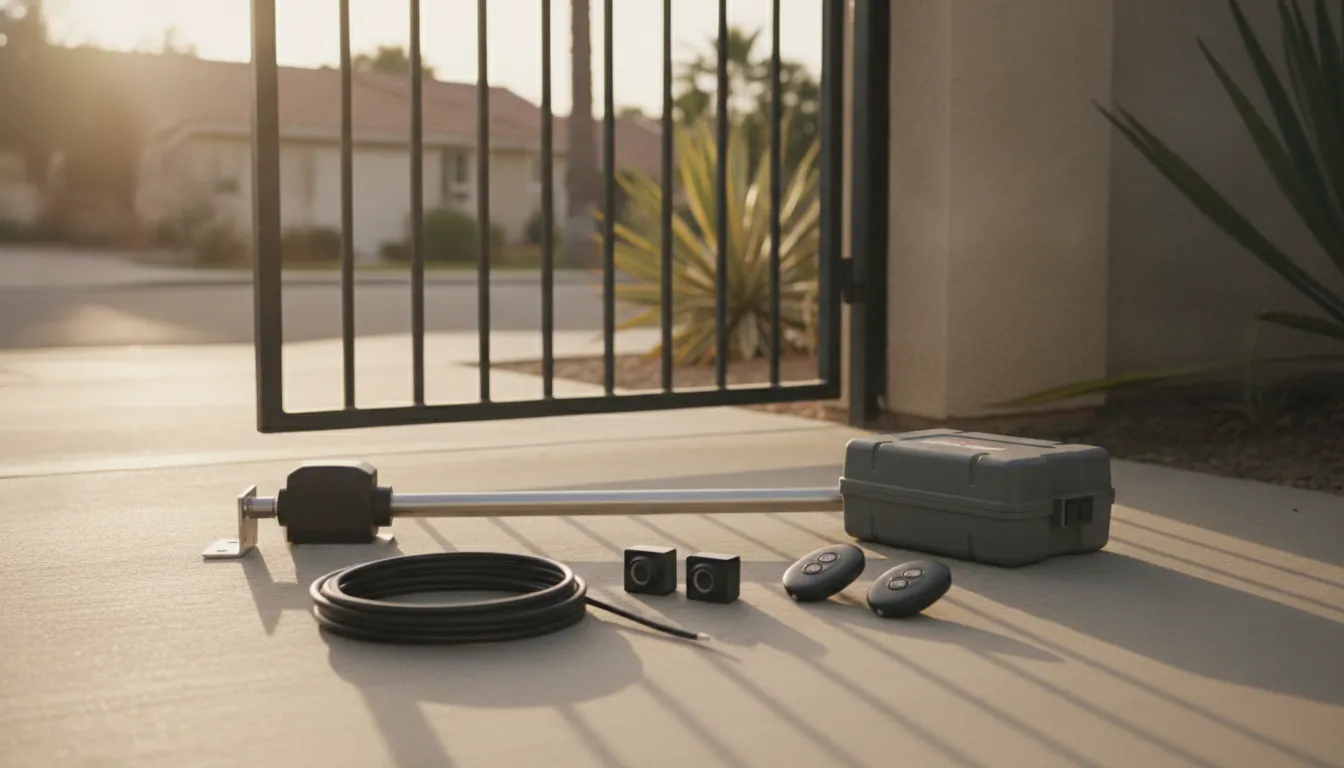
An electric gate opener kit is a boxed set of operator parts sold for one gate movement. The carton usually holds the drive, a control board, one or two remotes, and sometimes a photo eye. That list does not tell you whether the kit fits the gate already on the driveway. Leaf weight, swing or slide direction, power at the post. And the safety devices the operator can monitor all have to line up before the box is a useful choice.
Property owners in Los Angeles County and Orange County often start with a product page because the kit looks complete. The safer first step is a check of the existing gate, then a look at what the kit actually includes. InteleGates installs and services operators and access equipment on existing gates. We do not build the gate leaf, and we do not treat a kit label as a site assessment.
This guide covers what a typical kit contains, which conditions on the current gate matter, and when a technician should look before anyone orders parts. It does not walk through mounting, wiring, or repair.
What an electric gate opener kit usually includes
Retail pages use "kit" to mean the operator plus the accessories the seller chose to bundle. The core is the drive that moves the leaf. On a swing gate that is often an actuator arm or a pair of arms. On a sliding gate it is a motor and gearbox that pull the leaf along its track. The control box holds the board that starts, stops, and reverses that drive.
Most kits also include a small set of remotes and the receiver that hears them. Some add a photo eye, a warning device, mounting brackets, and a short run of low-voltage cable. Battery backup shows up on some packages and is absent on others. Access controls such as a keypad, telephone entry, or loop detector are usually separate, even when the product photo looks complete.
A package photo is not a parts list. Read the included-items line and the operator manual's accessory list. If the manual says entrapment devices must be from a qualified set, a generic sensor in another carton may not be accepted by that board. The DASMA UL 325 FAQ tells installers to use the devices the operator manufacturer has qualified. And to check the manual rather than assume every photo eye or edge fits every operator.
| Kit item | What it does | What the label does not prove |
|---|---|---|
| Drive or actuator. | Moves the existing leaf. | It does not prove the leaf weight, length, and travel match the rating. |
| Control board. | Starts, stops, and reverses the drive. | It does not prove your access gear and safety devices can connect. |
| Remotes and receiver. | Send an open or close command. | It does not prove a keypad, phone entry, or loop is included. |
| Photo eye, if packed. | Watches one path for an obstruction. | It does not prove every entrapment zone on this gate is covered. |
| Brackets and hardware. | Give the drive a place to bolt on. | It does not prove the post, hinge, or track can carry the load. |
| Battery, if packed. | Keeps a limited number of cycles during an outage. | It does not prove how many cycles this site will actually get. |
Two kits with the same leaf rating can still differ in duty, voltage, and which safety inputs the board monitors. That is why the included list matters more than the word kit on the title.
Which existing-gate conditions the kit has to match
The kit is chosen for a gate that is already there. InteleGates works on that existing leaf and the operator behind it. If the leaf sags, drags, or needs a person to push it through the last foot. An operator kit will not correct the hinge, the track, or the slab. Those conditions get fixed on the gate itself, or the new drive will fight them.
Start with how the leaf moves. A swing kit and a slide kit are not interchangeable. A single-leaf kit does not become a dual-leaf kit because a second arm is added later, unless the manufacturer offers that exact expansion. Travel direction matters too. Some swing arms are set up to pull the leaf in, and some to push it out. The driveway, the slope, and the parked cars decide which one is even possible.
Then look at the structure the kit will bolt to. A swing arm needs a post or pier that can take the pull. A slide operator needs a pad, a straight track, and a leaf that rolls without binding. Visible rust at the hinge, a bent track, or a leaf that hits the latch hard are reasons to pause before ordering. The operator rating on the carton is a maximum under the maker's test conditions. Not a promise for a tired gate in coastal air or a windy canyon lot.
- Confirm swing or slide, and whether one leaf or two must move.
- Watch a full open and close. Note drag, sag, and where the leaf stops.
- Check the post, hinge, track, and latch for damage the motor would inherit.
- Match leaf length and a realistic weight to the kit rating, then ask a technician to confirm.
- Note the slope and the wind exposure. Both change how hard the drive works.
Operator size, duty cycle, and wind load are their own subject. If the question is how large the motor should be, use a sizing conversation rather than a kit title. The check here is simpler: does this box even belong to this gate's movement and condition?
Power, duty, and add-ons a kit label leaves out
A kit title often names the leaf length and a weight. It rarely names how the entrance is used. A house driveway that cycles a few times a morning is a different load from a community gate or a commercial lot that cycles all day. UL 325 requires a vehicular gate operator to be marked with the usage classes it is built for. Class I is a typical single-family home. Higher classes cover multi-family, commercial, and restricted industrial sites. A residential carton on a busy entry is a mismatch even when the weight number looks fine.
Power is the next gap. Many boards want a dedicated supply at the operator, and some packages are sold as low-voltage or solar-ready without stating the wire run. The panel output, or the shade on that side of the lot. If the gate sits far from the panel, the kit's plug-in transformer is not a plan. Battery backup, when it is included, supports a limited number of moves during an outage. It is not a second power source for a gate that never had reliable power.
Access gear is easy to assume and often missing. Remotes in the box do not replace a keypad, a telephone entry panel, or a vehicle loop. Those devices have to be compatible with the board's inputs. If the property already has a working keypad or intercom. The useful question is whether the new operator can take that existing control, not whether the kit photo shows a remote.
Los Angeles County and Orange County sites add local conditions the carton ignores. Marine air near the coast, hillside wind, and long driveways between the house and the street all change the installation. None of those show up in a national product title. A technician looking at the entrance can say whether the kit's power and duty marks fit the way the gate is actually used.
Safety devices the carton may not finish
A moving gate can pinch, drag, or strike. That is why a modern operator is built to work with entrapment protection, not as a bare motor. Since 2000, the expectation in the trade has been two independent means of entrapment protection in each direction of travel. DASMA's UL 325 FAQ states that point and recommends replacing operators made before 2000 when they cannot accept those devices. The same sheet says there is no automatic duty to upgrade every older operator, and that any upgrade depends on the product and the manufacturer.
A photo eye in the kit covers the zone it is aimed at. It does not, by itself, cover every pinch point along a long slide or both leaves of a dual swing. Contact edges and additional photo eyes are added where the gate's geometry creates another zone. The operator manual lists which of those devices the board will monitor. A sensor the board cannot supervise may look installed and still leave the system short of the standard the maker designed for.
UL 325 is a product safety standard. DASMA notes that it is voluntary as a national rule, and that many jurisdictions meet it because their building, fire, or residential codes reference it. Inspectors and fire officials are the people who check an installation when those codes apply. A kit that says it is built to the standard still has to be installed with the required devices, clearances, and warning placement. ASTM F2200, the specification for automated vehicular gate construction, sits beside that operator standard. The gate leaf itself has to be built in a way an operator can move safely. InteleGates does not fabricate that leaf. If the gate has large openings a person could reach through, or a slide path with no safe clearance, the kit is the wrong first purchase.
Sensor placement and the checks a technician runs are covered in the automatic gate safety sensor guide and the UL 325 gate safety overview. Use those pages when the question moves past the carton. They cover what has to be on this entrance.
When a professional look beats choosing from the label
Choosing from the label is reasonable only when the gate moves freely, the power source is already understood, and the kit matches that entrance. The class, the travel, and the included safety gear all have to fit. Many Los Angeles and Orange County driveways fail at least one of those tests. The hinge may be tired. The slide track may no longer be straight. Power may be a lamp post on the wrong side of the drive. Or the community gate may cycle far more than a residential kit is marked for.
A professional assessment looks at the leaf, the structure, the power, and the access gear together. Most gate problems can be diagnosed during the initial service visit. Repair time depends on the cause of the problem, parts availability, and the condition of the gate and operator. That visit is also the right moment to decide whether the current operator can stay. With a worn component replaced, or whether a different kit belongs on the entrance. When a worn motor, sensor, control board, or track or chain component cannot be repaired, the technician replaces that component. A new kit is not the automatic answer to a board fault or a dragging leaf.
- Walk the full travel and note drag, sag, or a leaf that will not latch.
- Identify swing or slide, one leaf or two, and which way the leaf must move.
- Find the power source and the distance from the panel to the operator location.
- List the access devices already in use, including remotes, keypads, and entry panels.
- Compare that list with the kit's class mark, included parts, and monitored safety inputs.
- Stop and book an assessment if any item is unknown or the gate does not move freely by hand.
InteleGates does that assessment for existing gates across Los Angeles County and Orange County. The electric gate installation page describes how an operator is matched to an entrance. Gate automation covers the broader system around the motor. Neither page is a substitute for looking at the specific leaf.
How a kit choice fits the rest of the entrance
Once the kit matches the leaf, the rest of the entrance still has to connect. A remote in the box is only one way to command the gate. Properties that already use a keypad, a card reader, or telephone entry need a board that can take those inputs. The access control system page is the place to sort those devices. The kit article only needs the warning: do not assume they are in the carton.
Power loss is a separate decision. If the entrance must keep moving during an outage. Look at whether the operator accepts battery backup and how the site is used, not at a marketing line that says backup is included. The gate opener battery backup guide covers that choice. Slide and swing geometry, brand families, and underground operators each have their own pages too. A kit buyer who needs those answers should read sliding versus swing openers, operator brand comparisons, or the underground opener guide instead of stretching one product box to cover them.
Owners who want the motion explained before they shop can read how an automatic gate opener works. Owners who already know the gate is a rolling leaf should use the rolling gate opener guide. Sizing questions belong on how to size a gate operator. Keeping those topics separate is what makes a kit check useful. The box answers "what parts ship." The site answers "what this entrance needs."
Ask a technician to check the entrance
Frequently asked questions
What comes in an electric gate opener kit?
A typical kit includes the drive, a control board, and at least one remote. Some add a photo eye, brackets, and a battery. Keypads, telephone entry, and vehicle loops are usually separate. Read the included-items list rather than the product photo.
Can any electric gate opener kit run the gate I already have?
No. The kit has to match swing or slide travel, one leaf or two, and a leaf that already moves freely. A rating on the carton does not correct a sagging hinge, a bent track, or a leaf that drags.
Does the photo eye in the box satisfy the safety requirement?
Not by itself. Trade guidance since 2000 calls for two independent means of entrapment protection in each direction. The operator manual lists which devices that board will monitor, and the gate's layout decides how many zones need a device.
Should I replace an older operator with a new kit?
Not automatically. DASMA notes there is no blanket requirement to upgrade every installed operator, and that a pre-2000 unit may not accept current entrapment devices. A technician can say whether the current operator can be repaired or should be replaced.
Who can check a kit against a Los Angeles or Orange County gate?
InteleGates assesses existing gates and the operator, controls, and access gear on them. Call or use the contact page to describe the leaf, how it moves, and what fails today. Most problems can be diagnosed on the first visit. Repair time still depends on the cause, parts, and the condition of the gate and operator.
Talk with a technician before you order
Ordering from the label is a guess when the gate does not move freely. It is also a guess when the power source is unclear, or when the kit's class and safety gear do not match the entrance. InteleGates serves existing electric gates and access systems across Los Angeles County and Orange County. Regular office hours are Monday through Thursday, 8:30 AM to 5:00 PM, and Friday, 8:30 AM to 3:00 PM. Emergency gate service is available Sunday through Friday for qualifying emergencies. Call to confirm availability.
Describe the gate, how it travels, and what you want the entrance to do. A technician can tell you whether a kit is the right next step or whether the current operator and leaf need attention first. Reach the team through the contact page or call 833-468-4283.